

In 2026, the most profitable move in coastal California isn't merely finding a low entry price; it's securing the asset with the most resilient regulatory strategy. You likely recognize that Santa Cruz remains a premier destination for long term wealth, yet the 14% increase in local tenant protection complexities since 2024 creates a daunting barrier for many. Paul Burrowes has 15 years of experience guiding sophisticated clients through these hurdles. He ensures that every apartment building investment is built on a foundation of rigorous data and structural integrity.
This guide promises to help you understand the multifamily landscape with expert insights on ROI and strategic acquisition. We'll provide a clear framework for evaluating assets and managing the specific zoning hurdles of Santa Cruz County. By leveraging the specialized resources available, you'll gain the confidence to manage local compliance and protect your capital. We'll explore the current market dynamics and the precise steps needed to optimize your portfolio for the coming decade.
Key Takeaways
-
Understand why Santa Cruz remains a premier "barrier-to-entry" market and how its 2026 economic landscape supports long-term asset resilience.
-
Navigate the complexities of California’s regulatory environment, including rent control and just-cause eviction laws, to ensure your portfolio remains compliant.
-
Evaluate the "Real ROI" of your next apartment building investment by analyzing specific cap rate trends and operating expenses unique to the Central Coast.
-
Uncover the strategic advantages of off-market networking and deep-dive due diligence to identify high-stakes opportunities before they reach the general market.
-
Partner with Paul Burrowes, who leverages 15 years of experience to provide the sophisticated guidance necessary for securing your financial legacy.
Table of Contents
-
Why Santa Cruz Apartment Building Investment Remains a Resilient Choice in 2026
-
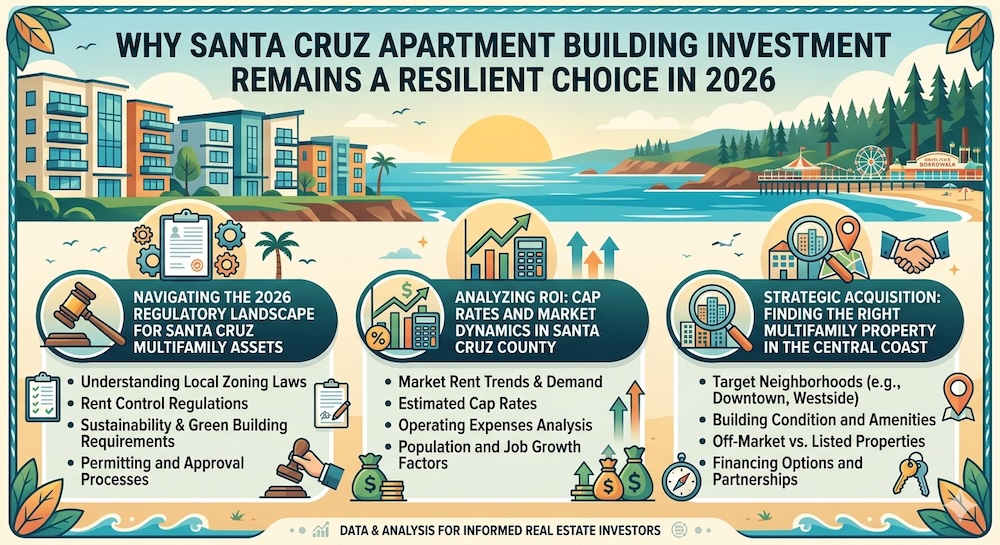
Navigating the 2026 Regulatory Landscape for Santa Cruz Multifamily Assets
-
Analyzing ROI: Cap Rates and Market Dynamics in Santa Cruz County
-
Strategic Acquisition: Finding the Right Multifamily Property in the Central Coast
-
Maximizing Your Portfolio with Paul Burrowes and David Lyng Real Estate
Why Santa Cruz Apartment Building Investment Remains a Resilient Choice in 2026
An apartment building investment in 2026 represents a sophisticated commitment to capital preservation within the Central Coast's most constrained housing market. This asset class involves the acquisition and strategic management of multi-unit residential properties, focusing on long-term yield rather than speculative gains. Paul Burrowes has 15 years of experience identifying these opportunities, where the underlying fundamentals of real estate investing align with local economic scarcity. Unlike broader markets, Santa Cruz functions as a high-barrier-to-entry zone due to strict zoning laws and geographic limitations between the Pacific Ocean and the Santa Cruz Mountains.
The stability of multifamily assets in this region provides a necessary counterweight to the volatility seen in equity markets throughout the mid-2020s. Institutional and private investors alike view these properties as a "recession-resistant" hedge. People always require a roof over their heads, and in a town defined by its proximity to world-class education and a growing satellite tech hub, the demand for rental housing remains inelastic. This structural demand ensures that cash flow remains consistent even when other sectors of the economy face contraction.
The 2026 Santa Cruz Market Thesis
The 2026 market thesis centers on a persistent supply-demand imbalance. With vacancy rates in the city consistently hovering below 2.8%, the competition for quality units is intense. This shortage is exacerbated by the University of California, Santa Cruz, which continues to support a population of over 19,000 students and faculty who require local housing. Additionally, the migration of tech professionals into Scotts Valley and the Westside has shifted the demographic toward high-income renters.
Multifamily vs. Single-Family Investments
Scalability remains the primary differentiator when comparing apartment buildings to single-family rentals. Managing ten units under one roof is significantly more efficient than maintaining ten separate houses across the county. This centralization reduces per-unit operating costs and streamlines property management logistics. More importantly, multifamily assets allow for "forced appreciation." By improving the Net Operating Income (NOI) through renovated interiors or energy-efficient upgrades, an investor can directly increase the property's valuation independent of general market appreciation.
The risk profile in coastal California favors the multifamily model because of its diversified income streams. If one tenant vacates a single-family home, the property is 100% vacant. In a 12-unit apartment building, a single vacancy only impacts 8.3% of the monthly revenue. This safety net is vital for those seeking a secure legacy for their family or corporation.
Navigating the 2026 Regulatory Landscape for Santa Cruz Multifamily Assets
Successful apartment building investment in Santa Cruz requires more than just capital; it demands a sophisticated understanding of a shifting legislative environment. As we approach 2026, the intersection of state mandates and local ordinances creates a high-stakes environment for property owners. Analyzing Santa Cruz County housing market data reveals a persistent supply-demand imbalance that continues to drive aggressive policy shifts. Investors must move beyond surface-level awareness to implement rigorous, long-term asset protection strategies.
The primary concern for most sophisticated investors remains the expansion of rent control and just-cause eviction laws. Under the Tenant Protection Act (AB 1482), annual rent increases are limited to 5% plus the local Consumer Price Index (CPI), with a hard cap of 10%. However, local Measure O requirements add another layer of complexity. For developments with 7 or more units, 20% of the project must be designated as affordable housing. This 20% threshold represents a significant shift from previous decades, forcing developers to find creative ways to maintain yield. Compliance isn't a one-time event; it's a continuous operational requirement that dictates the long-term viability of your portfolio.
California Compliance and Tenant Protections
The 2026 regulatory horizon introduces stricter reporting mandates for multifamily owners. Updates to AB 1482 now require precise documentation for "no-fault" evictions, such as owner move-ins or substantial renovations. Failure to follow these protocols can result in statutory penalties exceeding $15,000 per violation. To secure your position, it is vital to review the 2026 Santa Cruz Landlord Alert for a breakdown of these specific legal triggers. Professional land use consulting is no longer a luxury for the elite; it's a foundational necessity to avoid the legal pitfalls that accompany modern tenancy management.
Zoning, Entitlements, and ADU Potential
While regulations often feel restrictive, current zoning laws offer strategic "density bonuses" in specific Santa Cruz transit corridors. These bonuses allow for a 35% to 50% increase in unit counts if certain affordability criteria are met. Additionally, the strategic integration of Accessory Dwelling Units (ADUs) into existing apartment complexes has become a premier value-add tactic. Adding two detached ADUs to a standard multifamily lot can increase gross rental income by 18% without the need for a full rezoning process. For beachfront properties, navigating the Coastal Commission adds a 12-to-18-month timeline to most entitlement applications. This requires a partner who understands the granular details of coastal development permits and environmental impact reports.
Managing these risks requires a proactive stance rather than a reactive one. The landscape for apartment building investment is increasingly defined by those who can anticipate legislative pivots before they impact the bottom line.
Analyzing ROI: Cap Rates and Market Dynamics in Santa Cruz County
Achieving a sustainable return on an apartment building investment requires a shift from superficial metrics to a rigorous analysis of net cash flow. Current data from 2024 shows that cap rates remain compressed; Santa Cruz city averages 3.8%, while Watsonville offers a slightly higher yield at 5.1% for well-maintained assets. These numbers reflect a market where stability is the primary currency, and long-term appreciation often outweighs immediate cash-on-cash returns.
Property Class Breakdown: Santa Cruz Edition
Class A assets, primarily luxury builds in Downtown Santa Cruz or Scotts Valley, offer the highest level of security. These properties command top-tier rents and attract institutional-grade tenants, though they often trade at cap rates below 4%. For investors seeking a balance of growth and stability, Class B complexes in Mid-County represent the sweet spot. These established buildings provide reliable income with lower volatility. Conversely, Class C units in Watsonville or the Westside present a high-intensity management challenge. While they offer a higher potential upside through aggressive renovation, they require a sophisticated operational infrastructure to handle the increased maintenance and tenant turnover.
Operating Expense Realities
Sophisticated investors recognize that the "Real ROI" is often hidden in the line items of an operating statement. In California, utility costs have surged by 12% over the last 18 months, making water-saving retrofits a mandatory investment rather than an optional upgrade. Insurance premiums also demand careful scrutiny; specialized coverage for high-density housing has seen significant adjustments in the current climate. Owners must also navigate the fiscal implications of capital gains taxes, which can significantly erode the proceeds of a sale if a 1031 exchange isn't meticulously executed. While the county boasts a 98% occupancy rate, a prudent pro forma should still factor in a 3% vacancy allowance to account for the necessary downtime during unit turns.
The "Value-Add" strategy remains the most effective lever for increasing equity in this region. By renovating older Class C units to a Class B standard, investors can bridge the significant rent gap that exists in the Mid-County corridor. This process involves more than just aesthetic updates; it requires a structural commitment to the asset's longevity. Those who invest in the durability of their systems, such as HVAC and roofing, face far fewer legal and financial liabilities during the hold period.
Tax planning serves as the final pillar of a successful apartment building investment strategy. Prop 13 provides a degree of predictability in property tax assessments, yet the initial acquisition often triggers a substantial reset. Utilizing a 1031 exchange allows for the deferral of tax liabilities, enabling the portfolio to grow through the compounding of pre-tax dollars. This high-level financial engineering, combined with a deep understanding of local market dynamics, ensures that a Santa Cruz real estate portfolio remains a resilient vehicle for generational wealth.

Strategic Acquisition: Finding the Right Multifamily Property in the Central Coast
Identifying a profitable apartment building investment in Santa Cruz requires a level of scrutiny that goes far beyond a cursory glance at the Multiple Listing Service. While on-market listings provide a baseline for market sentiment, they're frequently priced at a premium that compresses cap rates for the average investor. Off-market networking provides access to generational assets that haven't changed hands in 30 years, often allowing for more flexible negotiations and favorable terms.
Physical integrity is a paramount concern for any coastal asset. The marine layer isn't just a weather pattern; it's a persistent environmental stressor that dictates your long-term maintenance budget. Salt air and moisture levels that average 75% daily humidity can accelerate the degradation of exterior cladding, window seals, and mechanical systems. We look for signs of concrete spalling and corrosion in HVAC units, especially in buildings constructed between 1970 and 1985. These aren't just aesthetic repairs; they're significant capital expenditure risks that must be factored into your initial valuation to protect the longevity of the asset.
Neighborhood Selection Strategies
Location determines the ceiling of your ROI in the Santa Cruz ecosystem. Scotts Valley currently commands a 12% premium on rents because of its strategic proximity to the Hwy 17 commute corridor. It remains the primary choice for Silicon Valley professionals who seek a reprieve from the valley while maintaining a 30-minute commute to major tech hubs. Meanwhile, Watsonville is emerging as a high-growth zone, with rental demand increasing by 4.2% annually as the regional workforce seeks more attainable housing options. For investors targeting high-net-worth tenants, evaluating luxury multifamily opportunities near the coast offers a path to premium yields through superior amenities and ocean views.
Due Diligence Checklist for Apartment Buyers
Deep-dive due diligence requires a forensic approach to the property's history and operations. It's not enough to review a pro forma statement; you must analyze actual lease agreements and historical rent rolls to identify discrepancies. In Santa Cruz, 45% of older multifamily buildings contain unpermitted additions or converted garages. These issues can lead to significant city fines or forced reversals of habitable space if they aren't identified before the close of escrow. Consider the following points during your review:
-
Utility Efficiency: Analyze the last 24 months of water and trash bills to identify leaks or inefficient usage patterns.
-
Permit History: Cross-reference the building's current configuration with city records from the 1960s and 70s to ensure all units are legal.
-
Management Performance: A 10% vacancy rate in a market where the average is 3.5% suggests operational failure rather than market weakness.
A specialized broker acts as your strategic partner in these transactions, handling the complex commercial terms that define the success of an apartment building investment. They negotiate beyond the purchase price, focusing on seller carry-back options, repair credits, and 1031 exchange timelines. This professional oversight ensures that your capital is deployed with precision and that every potential risk is mitigated before you commit to the purchase. This rigorous approach is what separates a standard acquisition from a high-performing legacy asset.
Consult with Paul Burrowes for a strategic portfolio review.
Maximizing Your Portfolio
Paul Burrowes represents the intersection of institutional rigor and local market intelligence. With 15 years of experience in the Santa Cruz County market, he acts as a strategic architect for those seeking to expand their wealth through high-stakes real estate. His extensive network and specialized consulting experts provide investors with an unparalleled advantage. Successful apartment building investment requires more than just capital; it demands a partner who understands the granular details of the local regulatory environment.
A Consultative Approach to Investment
Paul's methodology transcends traditional brokerage by addressing the technical complexities of land use and development. He identifies value where others see obstacles, particularly regarding the entitlement and zoning hurdles that often stall significant projects. His track record includes a background in land use planning, which allows him to provide a forensic analysis of a property's true potential. He evaluates density limits, setback requirements, and utility capacities with the precision of a developer. This foresight protects your capital from unforeseen municipal restrictions.
-
Strategic Analysis: Every potential acquisition undergoes a rigorous stress test against current market volatility and long-term appreciation trends.
-
Zoning Mastery: Paul interprets local ordinances to maximize the "highest and best use" of every square foot in your portfolio.
-
Risk Mitigation: His consultative model prioritizes the security of your principal by identifying hidden liabilities during the due diligence phase.
Paul defines his approach to 1031 exchanges as a strategic synchronization of capital preservation and asset optimization, meticulously timing the identification period to secure high-yield replacement properties before tax deadlines expire.
Securing Your Santa Cruz Legacy
Investing in the Santa Cruz multifamily sector isn't merely a financial move; it's the construction of a lasting legacy. Paul prioritizes long-term partnerships over transactional brokerage, acting as a stable guardian of your interests through shifting economic cycles. He understands that a high-performing apartment building investment is a living asset that requires ongoing strategic oversight. Whether you're a private investor or a corporate entity, his poise and expertise provide a protective barrier against market uncertainty. He doesn't just sell property; he engineers portfolios for permanence and growth.
The local market demands a sophisticated eye for detail and a deep connection to the community's economic fabric. You can begin exploring the current inventory of high-potential assets by viewing the latest Santa Cruz real estate listings. These opportunities represent the baseline of what's possible when you align with a consultant who values integrity and technical excellence above all else. Paul's commitment to your success is reflected in his proactive management of every negotiation and contract detail.
Your portfolio deserves the attention of a seasoned professional who treats your goals with the seriousness they require. Don't leave your wealth to chance in a complex regulatory environment. Schedule a private consultation today to discuss your specific portfolio goals and discover how years of specialized experience can fortify your investment strategy.
Securing Your Multifamily Legacy in the Santa Cruz Market
Navigating the 2026 real estate landscape requires a blend of historical perspective and forward-thinking precision. Success in the Central Coast depends on mastering the intricate land use planning and zoning laws that define our region. As market dynamics shift, stabilizing cap rates and high rental demand prove that a well-executed Apartment building investment remains a cornerstone of wealth preservation. You'll find that the most resilient portfolios are those built on a foundation of rigorous analysis and local intelligence.
Paul Burrowes has 15 years of experience guiding sophisticated investors through these complex cycles. Backed by the legacy of David Lyng Real Estate, an institution founded in 1980, Paul provides the specialized expertise necessary to protect your assets from regulatory uncertainty. He doesn't just facilitate transactions; he acts as a strategic architect for your financial future. It's time to move beyond generic advice and embrace a tailor-made approach that prioritizes your long term security.
Consult with Paul Burrowes to optimize your Santa Cruz investment strategy. Your path to a sustainable and high-performing multifamily portfolio starts with a partner who values integrity as much as ROI. We look forward to building your legacy together.
Frequently Asked Questions
Is an apartment building investment in Santa Cruz better than a single-family rental?
Multifamily assets generally outperform single-family rentals in Santa Cruz due to lower vacancy risks and superior economies of scale. While a single vacancy in a house results in 100% income loss, a 10-unit building maintains 90% occupancy during turnovers.
What is the average Cap Rate for apartment buildings in Santa Cruz County in 2026?
Projections for 2026 indicate that average capitalization rates will stabilize between 4.8% and 5.2% for Class B assets. This shift reflects a correction from the 4.1% lows recorded in 2021. Investors should target properties in the 95060 zip code that offer a 5.0% entry cap to offset rising insurance premiums. Precise underwriting is essential since operational costs in California have increased by 12% since 2023.
How do California’s rent control laws (AB 1482) affect my investment ROI?
AB 1482 limits annual rent increases to 5% plus the local Consumer Price Index, or a maximum of 10% total. This legislation requires a long-term perspective on yield because it prevents aggressive market-rate adjustments upon lease renewals. Strategic management ensures your internal rate of return stays above the 7.5% target.
Can I add ADUs to an existing apartment building in Santa Cruz to increase value?
California state law allows multifamily owners to add up to two detached ADUs and convert existing non-livable spaces into units representing 25% of the current count. Adding a 500-square-foot studio can generate an additional $2,400 in monthly revenue. This strategy significantly enhances the valuation of your apartment building investment without the high cost of acquiring new land. It's a proven method to increase equity by approximately $350,000 per added unit.
What are the main risks of buying older multifamily properties in Watsonville?
The primary risks in Watsonville involve seismic retrofit mandates and the presence of lead-based paint in structures built before 1978. Investors must budget at least $20,000 per unit for immediate capital expenditures to meet modern safety codes. Electrical systems often require upgrades to 200-amp service to support modern appliances. Failure to account for these specific costs can reduce your first-year cash-on-cash return by 4.0% or more.
How much of a down payment is typically required for a commercial multifamily loan?
Commercial lenders in the Santa Cruz market typically require a down payment ranging from 25% to 35% of the purchase price. Most institutions look for a Debt Service Coverage Ratio of 1.25 or higher to approve the financing. Providing a 30% down payment remains the standard for stabilized properties over $2.5 million.
Does Paul Burrowes assist with the entitlement process for new apartment developments?
Paul Burrowes provides expert advisory services for the entitlement process, helping developers navigate the 2023-2031 Housing Element requirements. He coordinates with city planners and environmental consultants to ensure projects meet the rigorous standards of the California Environmental Quality Act.
What are the most desirable neighborhoods for apartment investments in Santa Cruz?
The Westside and Seabright neighborhoods are the most lucrative areas for an apartment building investment because vacancy rates stay below 2.5%. These submarkets command rents that are 18% higher than the county average due to their proximity to the beach and major employment hubs. Capitola also offers high stability with a 97% historical occupancy rate. Investing in these specific pockets ensures consistent demand and a faster appreciation schedule over a 10-year hold period.
Article by
Paul Burrowes

Paul Burrowes, CRS, CCEC, SFR, NHCP, LHC, REALTOR® With over fifteen years of experience and an elite list of credentials, Paul Burrowes is a REALTOR® dedicated to merging deep local expertise with modern innovation. Paul leverages the latest technology and AI-driven insights to provide his clients with the most accurate, data-rich information available in the Santa Cruz, Monterey, Santa Clara, and Silicon Valley markets. He serves as a personal adviser, skilled negotiator, and detail-oriented advocate, ensuring every transaction—from initial question to final signature—goes off without a hitch. Contact Paul at paul@burrowes.com, (831) 295-5130, (408) 497-3989, or DRE# 01955563.
Disclaimer: This article was developed with the assistance of AI technology to synthesize market data, then reviewed, edited, and verified for accuracy by Paul Burrowes to ensure it meets the highest professional standards.
Enjoy this blog post? Click here to subscribe for updates
Leave A Comment