


Understanding your budget is the first step to finding a home in Santa Cruz County without overextending your finances.
Understanding the Santa Cruz Real Estate Market
Santa Cruz is known for its coastline, tight-knit community, and easy access to Silicon Valley, and that desirability shows up in home prices. Limited inventory and steady demand mean well-priced homes in good condition often draw multiple offers, so buyers need to move quickly and decisively once they find the right property.
The market also responds to broader economic conditions, including interest rates, employment, and overall economic health. Lower rates put more buyers in a position to purchase, which tends to push prices up; a slowing economy can have the opposite effect, cooling demand as buyers grow more cautious. Watching these trends helps you time your search and set realistic expectations.
Factors Influencing Home Affordability
Income is the starting point for any lender's evaluation. Most use a debt-to-income ratio to confirm that your monthly housing costs stay within a manageable share of your gross income, which protects both you and the lender from an overextended loan.
Existing debt matters just as much. Credit cards, auto loans, and student loans all factor into what a lender will approve, so paying down balances before you apply can meaningfully increase your buying power.
Local market conditions round out the picture. In a competitive market like Santa Cruz, homes can sell above asking, so understanding recent comparable sales and price-per-square-foot trends helps you set a realistic budget rather than being caught off guard mid-search.
Calculating Your Budget: Income and Expenses
Start with your gross monthly income from all sources — salary, bonuses, dividends, rental income — then lay out your recurring expenses: existing debt payments, utilities, groceries, insurance, and transportation.
From there, calculate your debt-to-income ratio (DTI). Lenders generally prefer a DTI of 36% or lower, with housing costs capped around 28% of gross income. On a $10,000 monthly income, that puts total debt payments under $3,600 and housing costs under $2,800.
Your budget should also reflect your broader financial goals — retirement contributions, education savings, an emergency fund. Qualifying for a larger loan doesn't mean it fits your life; building those priorities into your number keeps your home purchase sustainable long after closing.
The Role of Down Payments in Home Buying
Your down payment directly shapes your monthly payment and total loan cost. Putting down 20% avoids private mortgage insurance (PMI), an added cost that protects the lender if you default.
Saving toward that goal in a high-cost area takes a plan: a dedicated savings account, trimming discretionary spending, and looking into down payment assistance programs. Some buyers also draw from retirement accounts or receive gifted funds from family.
A larger down payment does more than lower your monthly bill — it can help you secure a better rate, since lenders view a lower loan-to-value ratio as less risky, and it builds equity from day one.
Mortgage Options Available in Santa Cruz
Conventional loans aren't government-backed and typically call for stronger credit and a larger down payment, but they offer competitive rates and flexibility for buyers who qualify.
FHA loans are built for first-time buyers and those with lower credit scores, with down payments as low as 3.5%. VA loans, available to eligible veterans and active-duty service members, often require no down payment at all. Given Santa Cruz's price points, many buyers also encounter jumbo loans — needed once a purchase exceeds conforming loan limits — which usually require a larger down payment and stricter underwriting.
How Interest Rates Impact Your Buying Power
Interest rates shape both your monthly payment and the total cost of your loan. Even a small shift changes what you can comfortably afford.
Take a $500,000 mortgage as an example. At today's rate of roughly 6.5%, the monthly principal and interest payment (excluding taxes and insurance) runs about $3,160. If rates climb to 7.5%, that payment rises to around $3,496 — an extra $336 a month, or roughly $121,000 in additional interest over a 30-year term. That's the kind of swing that makes rate-shopping worth the effort.
Rates themselves are driven by Federal Reserve policy, inflation, and broader economic conditions — factors outside your control. What you can control is your credit profile: a stronger score and lower debt load help you qualify for the best rate available, and comparing offers from multiple lenders can make a real difference in what you're offered.
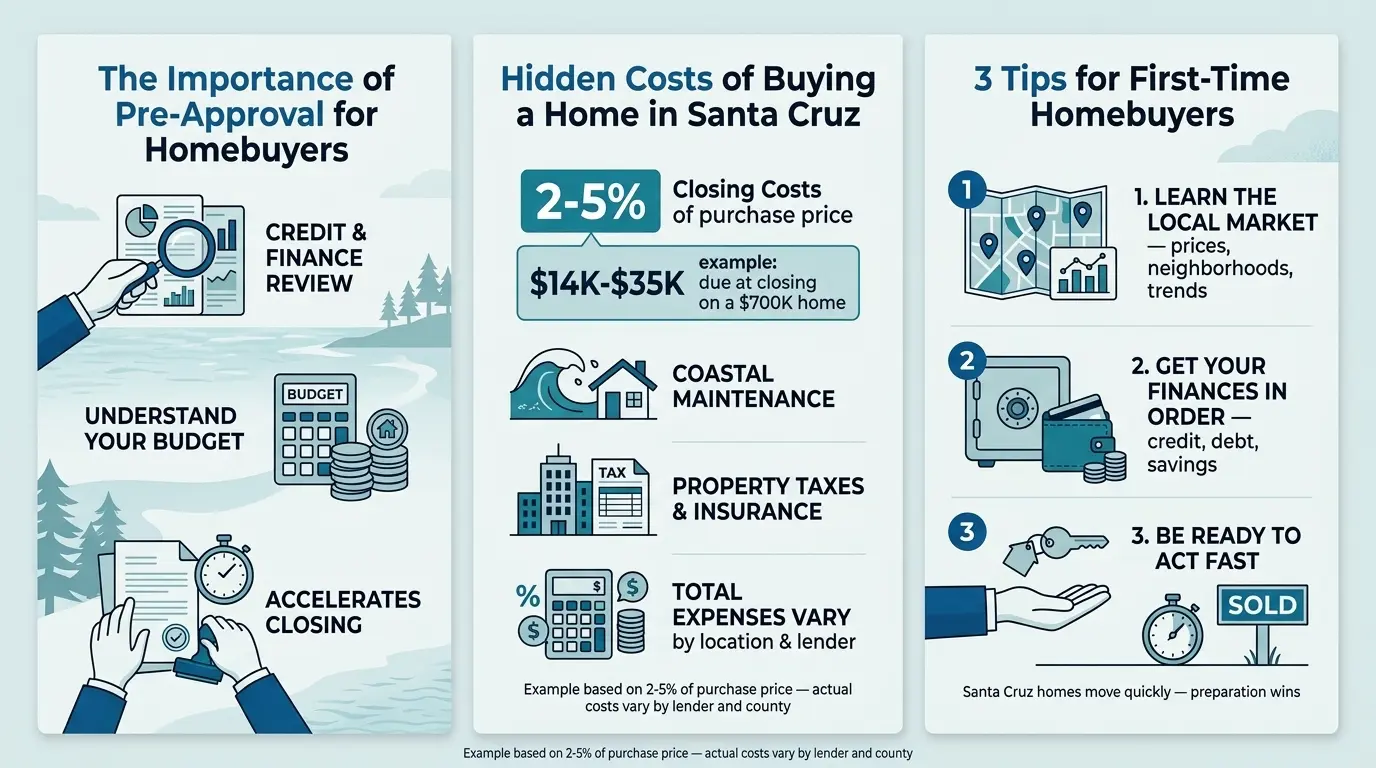
The Importance of Pre-Approval for Homebuyers
In a competitive market like Santa Cruz, a pre-approval letter signals to sellers that you're a serious, qualified buyer. It's based on a full review of your credit, income, and debt, and it gives you a clear budget before you start touring homes.
The process also surfaces issues early — credit discrepancies, unexpectedly high debt — so you can address them before they slow down an offer. And because much of the financial vetting is already done, pre-approval can speed up closing once you're under contract, which matters in a market where delays can cost you the property.
Hidden Costs of Buying a Home in Santa Cruz
The purchase price is only part of the picture. Closing costs — appraisals, inspections, title insurance, attorney fees — typically run 2% to 5% of the price, so a $700,000 home could mean $14,000 to $35,000 due at closing.
Ongoing maintenance is another factor coastal buyers should plan for. Salt air and humidity accelerate wear on paint, roofing, and landscaping, so it's worth setting aside a contingency fund for repairs beyond routine upkeep.
Property taxes and homeowners insurance round out the recurring costs. Santa Cruz property taxes are based on assessed value, and it's worth comparing quotes from several insurers to find solid coverage at a competitive rate.
Tips for First-Time Homebuyers in Santa Cruz
Learn the local market first. Understanding price trends and neighborhoods helps you set realistic expectations, and a local agent can point you toward areas that fit both your lifestyle and your budget.
Get your finances in order before you start touring homes — check your credit report, pay down debt, and save for both a down payment and closing costs. Getting pre-approved early clarifies your number and signals to sellers that you're ready to move.
Be ready to act. Homes in Santa Cruz can go quickly, so have your pre-approval letter and proof of funds on hand, and work with an agent who can flag new listings and guide you through the offer process as soon as the right home comes up.
Frequently Asked Questions
- How much house can I afford in Santa Cruz?
- Most lenders cap housing costs around 28% of gross monthly income and total debt at 36%. Your real number depends on income, existing debt, down payment size, and current rates — a pre-approval gives you the most accurate figure.
- How does a 6.5% interest rate affect my mortgage payment?
- On a $500,000 loan, 6.5% runs about $3,160 a month in principal and interest. A one-point jump to 7.5% adds roughly $336 a month, or about $121,000 over a 30-year term.
- How much do I need for a down payment in Santa Cruz?
- 20% avoids PMI, but FHA loans allow down payments as low as 3.5%, and VA loans can require none for eligible veterans and service members. Jumbo loans, common at Santa Cruz price points, typically call for more down.
- What credit score do I need to buy a home in Santa Cruz?
- Conventional loans generally call for a credit score in the high 600s or better for the most competitive rates, while FHA loans allow scores as low as 580 with 3.5% down. A higher score typically means a lower rate and more loan options.
- What debt-to-income ratio do lenders look for?
- Most lenders prefer total debt at or below 36% of gross monthly income, with housing costs alone at or below 28%. Some programs allow more flexibility depending on credit score and down payment size.
- What closing costs should I budget for in Santa Cruz?
- Plan for 2% to 5% of the purchase price to cover appraisal, inspection, title insurance, and attorney fees. On a $700,000 home, that's roughly $14,000 to $35,000 due at closing.
- How long does mortgage pre-approval take?
- Usually a few days to a week once you've submitted income, asset, and credit documentation to a lender. Having your paperwork organized ahead of time speeds things up.
- What's the difference between a conventional loan and an FHA loan?
- Conventional loans generally require stronger credit and a larger down payment but offer competitive rates and flexibility. FHA loans are government-insured, allow down payments as low as 3.5%, and have more lenient credit requirements — a common fit for first-time buyers.
Conclusion: Making Informed Decisions for Your Home Purchase
Buying in Santa Cruz is a significant financial commitment, and getting there starts with understanding the market, calculating a realistic budget, and knowing your mortgage options. Pre-approval and a clear-eyed view of hidden costs go a long way toward a smoother process.
Weigh both the immediate costs — down payment, closing costs, monthly payment — and the ongoing ones, like maintenance, taxes, and insurance, against your broader financial goals. With a solid budget and the right guidance, homeownership in Santa Cruz is well within reach.


Paul Burrowes, CRS, CCEC, SFR, NHCP, LHC, REALTOR® With over fifteen years of experience and an elite list of credentials, Paul Burrowes is a REALTOR® dedicated to merging deep local expertise with modern innovation. Paul leverages the latest technology and AI-driven insights to provide his clients with the most accurate, data-rich information available in the Santa Cruz, Monterey, Santa Clara, and Silicon Valley markets. He serves as a personal adviser, skilled negotiator, and detail-oriented advocate, ensuring every transaction—from initial question to final signature—goes off without a hitch. Contact Paul at paul@burrowes.com, (831) 295-5130, (408) 497-3989, or DRE# 01955563.
Disclaimer: This article was developed with the assistance of AI technology to synthesize market data, then reviewed, edited, and verified for accuracy by Paul Burrowes to ensure it meets the highest professional standards.
Local Lenders
CrossCountry Mortgage, LLC
Brian Dean
Senior Mortgage Advisor
408-489-0952
thebriandeanteam.com
brian.dean@ccm.com
Jean Adams
Senior Mortgage Advisor
jean.adams@ccm.com
408-250-4550
Mark Junod
Senior Mortgage Advisor
831-600-4709
markjunod.com
mark.junod@ccm.com
Ryan Buckholdt
Branch Manager
M 831-818-2339
D 831-425-8326
W ryanbuckholdt.com
E ryan.buckholdt@ccm.com
Matthew Falconer
831-435-9197
teamfalconer.com
matthew.falconer@ccm.com
Santa Cruz Home Finance
Tai Boutell
Santa Cruz Home Finance
831-419-6931
tai@santacruzlending.com
Andrea Schenk
Mortgage Consultant
831.431.0496
andrea@santacruzlending.com
Bay Area Mortgages
David Warter
Mortgage Advisor
831-419-7604
bayareamortgages.com
dave@bayareamortgages.com
US Bank
David DeTeso
Mortgage Loan Officer
831-688-7161
831-234-1045
david.deteso@usbank.com
Selesa Webster
Sr. Mortgage Loan Originator
831.227.0727
selesa.webster@usbank.com
Shawna Watson
U.S. Bank Home Mortgage
Mortgage Loan Officer
Construction Loan Specialist
831.818.4909
shawna.watson@usbank.com

Enjoy this blog post? Click here to subscribe for updates
Leave A Comment