

If you are thinking about selling your Santa Cruz County home, one of the most important questions is probably not:
“What is my home worth?”
It is:
“How much will I actually have left after I sell?”
A home may be worth $750,000, $1 million, $1.5 million, or $2.5 million, but the sale price is not the same as your net proceeds.
Your mortgage payoff, real estate expenses, escrow and title costs, property preparation, potential buyer concessions, and other expenses can all reduce the amount you ultimately receive.
Understanding your estimated net proceeds before you put your home on the market can help you make better decisions about pricing, repairs, moving, buying your next home, retirement, or downsizing.
As a local Santa Cruz County REALTOR®, I help homeowners look at the entire financial picture—not simply an estimated market value.
What Are Net Proceeds?
Your net proceeds are the approximate amount of money you receive from the sale of your home after paying the costs associated with selling the property and satisfying existing financial obligations.
The basic calculation is:
− Mortgage and Other Loan Payoffs
− Real Estate Compensation and Selling Expenses
− Escrow, Title and Transfer Costs
− Repairs, Preparation and Seller Concessions
− Other Applicable Expenses
= Estimated Net Proceeds
The exact calculation will depend on your individual property, mortgage, transaction and financial circumstances.
That is why an estimated seller net sheet can be much more useful than simply looking at an online home-value estimate.
The Basic Net Proceeds Calculation
Consider a hypothetical Santa Cruz home that sells for $1,500,000.
If the seller has an estimated mortgage and other loan payoff of $450,000, that leaves $1,050,000 in equity before selling expenses.
The seller then needs to account for the expenses associated with completing the transaction.
For example:
− $450,000 mortgage payoff
− selling and transaction expenses
− preparation costs
= estimated net proceeds
The important point is that your home's market value and your available cash after the sale are two different numbers.
Step 1: Determine Your Likely Sale Price
Everything begins with a realistic estimate of what your home could sell for in the current market.
That isn't necessarily the same as:
- Your original purchase price
- Your property tax assessment
- Your neighbor's recent sale
- A Zillow or other online estimate
- The amount you need from the sale
- The price you would like to receive
A professional comparative market analysis considers factors such as:
- Recent comparable sales
- Current competing listings
- Location
- Square footage
- Lot size
- Condition
- Remodeling and improvements
- Views
- Outdoor living areas
- Garage and parking
- Property type
- Current buyer demand
- Days on market
- Local market conditions
This is especially important in Santa Cruz County, where location can have an enormous effect on value.
A coastal property, mountain home, suburban property, rural property, and downtown residence can have very different buyer pools and pricing considerations—even when the homes are similar in size.
Your estimated net proceeds are only as accurate as your estimated sale price.
Step 2: Determine Your Mortgage Payoff
For many homeowners, the mortgage payoff is one of the largest deductions from the sale proceeds.
Suppose your home sells for $1,500,000 and your mortgage payoff is $600,000. You have approximately $900,000 remaining before accounting for selling expenses.
However, don't assume the balance shown on your latest mortgage statement is necessarily the exact payoff amount.
Your final payoff may also include:
- Accrued interest
- A home equity loan
- HELOC balance
- Other liens
- Loan-related fees
- Other amounts required to satisfy the loan
The escrow company will obtain the official payoff information during the transaction.
For long-term Santa Cruz homeowners, the mortgage balance can be particularly important because years of ownership may have created substantial equity.
Step 3: Understand Your Selling Expenses
Selling a home involves a number of expenses.
One of the most significant is the compensation paid to the real estate professionals involved in the transaction.
Real estate compensation is negotiable and is not set by law. The amount and structure should be discussed with your REALTOR® before entering into a listing agreement.
Other potential expenses may include:
- Escrow
- Title services
- County recording charges
- Transfer taxes or fees
- HOA documents
- Home warranty
- Property inspections
- Pest inspections
- Repairs
- Staging
- Photography
- Moving expenses
- Buyer credits or concessions
Not every seller will incur every expense.
The important thing is to understand the estimated total cost of your particular transaction before you list your home.
Step 4: Consider the Cost of Preparing Your Home
Another expense that can be overlooked is the money spent preparing a home for market.
Depending on the property, preparation could range from a few hundred dollars to tens of thousands of dollars.
Potential expenses include:
- Interior painting
- Exterior painting
- Landscaping
- Deep cleaning
- Window cleaning
- Flooring
- Minor repairs
- Roof repairs
- Deck repairs
- Electrical work
- Plumbing
- Pest work
- Staging
- Decluttering
- Hauling and disposal
But there is an important distinction: You don't necessarily want to fix everything.
The better question is:
Which improvements are likely to produce enough benefit to justify their cost?
Spending $40,000 preparing a home does not automatically mean you will receive $40,000 more when you sell.
Sometimes a relatively small investment in paint, landscaping, cleaning and presentation can make a substantial difference.
Other properties may have significant deferred maintenance that needs to be addressed before going to market.
The right strategy depends on the property, neighborhood, competing inventory and likely buyer.
Step 5: Account for Seller Concessions
The final accepted price isn't necessarily the same as the amount that ultimately reaches the seller.
Depending on the transaction, a seller may agree to provide a buyer credit or concession.
For example, the parties could negotiate a credit toward:
- Certain closing costs
- Repairs
- Interest-rate assistance
- Inspection-related issues
- Other transaction terms
Consider two hypothetical offers:
- Offer A: $1,500,000 with $20,000 in negotiated concessions
- Offer B: $1,485,000 with no comparable concession
The higher offer isn't necessarily the better financial outcome.
This is why an experienced seller's strategy should evaluate the entire offer, not just the headline price.
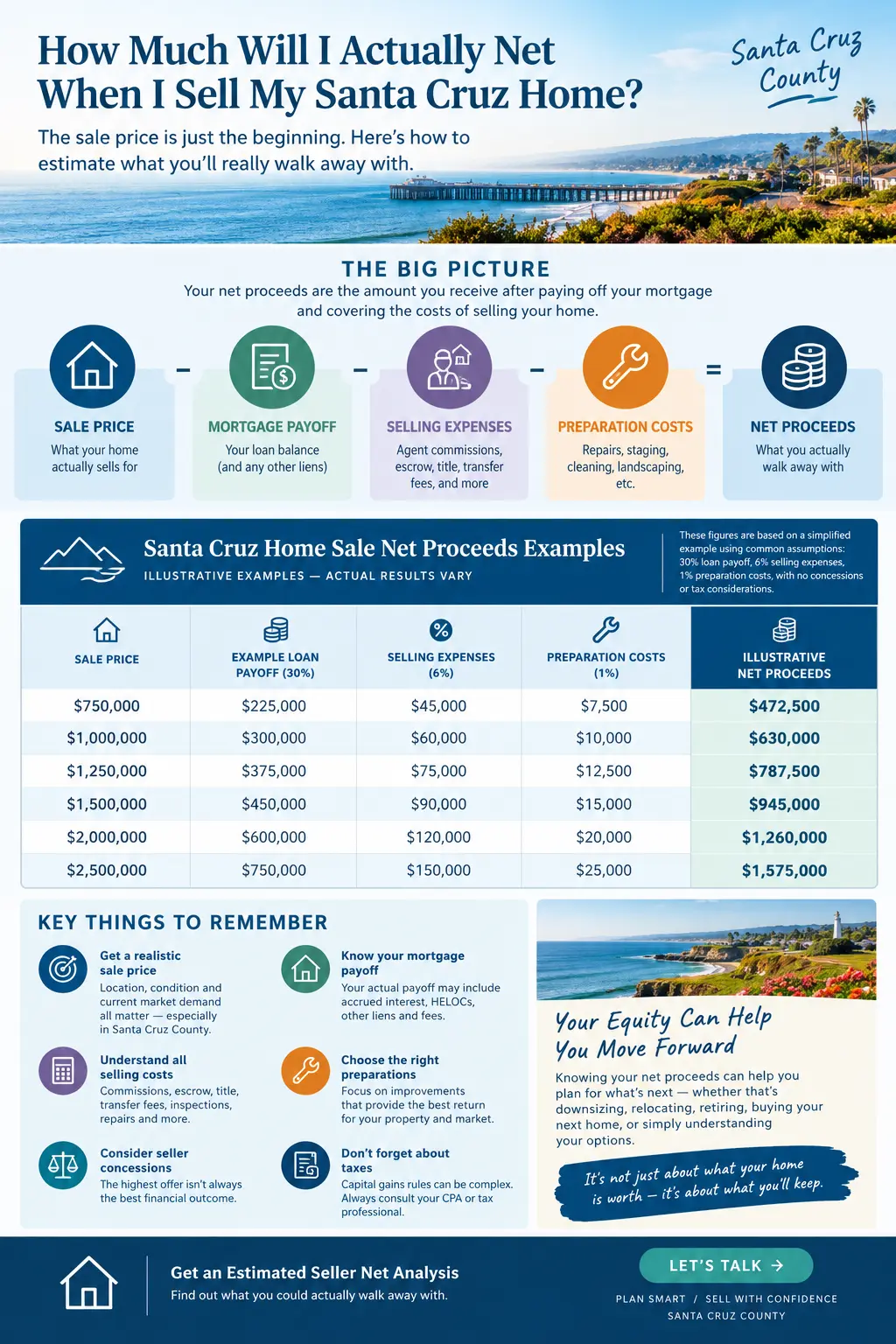
Santa Cruz Home Sale Net Proceeds Examples
The following table illustrates how dramatically the final amount can differ from the headline sale price.
These are hypothetical examples only, not estimates of what a particular Santa Cruz homeowner will receive.
For illustration, the examples assume:
- Mortgage and other loan payoff = 30% of the sale price
- Selling and transaction expenses = 6%
- Preparation costs = 1%
- No additional concessions or unusual expenses
- No income-tax or capital-gains calculation
Under those assumptions, approximately 63% of the sale price would remain.
| Hypothetical Sale Price | Example Loan Payoff | Example Selling Expenses | Example Preparation | Illustrative Net |
|---|---|---|---|---|
| $750,000 | $225,000 | $45,000 | $7,500 | $472,500 |
| $1,000,000 | $300,000 | $60,000 | $10,000 | $630,000 |
| $1,250,000 | $375,000 | $75,000 | $12,500 | $787,500 |
| $1,500,000 | $450,000 | $90,000 | $15,000 | $945,000 |
| $2,000,000 | $600,000 | $120,000 | $20,000 | $1,260,000 |
| $2,500,000 | $750,000 | $150,000 | $25,000 | $1,575,000 |
Why these examples are useful—but not a substitute for your own calculation
Your actual result could be significantly higher or lower.
For example, a homeowner who purchased many years ago may have a much smaller mortgage balance than the example above.
Another homeowner may have:
- A HELOC
- A larger mortgage
- Significant repair costs
- A buyer concession
- HOA expenses
- Other liens
- Different transaction expenses
The difference can be hundreds of thousands of dollars.
That's why your own estimated seller net sheet is much more valuable than a generic percentage.
What About Capital Gains Taxes?
Capital gains taxes are an important consideration for some homeowners, but they should be evaluated separately from the ordinary costs of selling a home.
Some homeowners may qualify for an exclusion of capital gains on the sale of a principal residence if they meet applicable federal requirements.
Your circumstances may depend on factors including:
- Your original purchase price
- How long you have owned the property
- How long you have occupied it as your principal residence
- Capital improvements
- Previous rental use
- Other ownership circumstances
- Your individual tax situation
Your REALTOR® can help you understand the real estate transaction, but a REALTOR® is not a substitute for a CPA or qualified tax professional.
If you expect a significant taxable gain, consult your tax professional before making a major financial decision.
How Your Net Proceeds Can Affect Your Next Move
Knowing your estimated net proceeds can be especially important if you are planning another major financial decision.
Downsizing
If you're considering moving from a larger Santa Cruz County home to a smaller property, knowing your net proceeds can help you compare your current housing costs with your potential future expenses.
Retirement
You may be planning to use some of your home equity to purchase a less expensive home or supplement retirement assets.
Relocation
If you're leaving Santa Cruz County, knowing your estimated proceeds can establish a realistic budget for your next home.
Buying Before Selling
If you're planning to purchase another property before selling your current home, your expected equity may affect your financing strategy.
Moving Closer to Family
A move to another California community—or out of state—may make a large amount of accumulated home equity available for your next chapter.
Simply Understanding Your Options
You don't have to be ready to list your home to benefit from knowing your numbers.
Sometimes the most valuable information is simply:
“If I sold today, approximately how much equity would I walk away with?”Why You Should Calculate Your Net Before Listing
I recommend calculating your estimated net proceeds before making major decisions about selling.
Knowing your numbers can help you determine:
- Whether your desired sale price is realistic
- How much you can spend preparing the property
- Whether remodeling makes financial sense
- Whether selling now makes sense
- Whether waiting might be better
- How much you could put toward your next home
- Whether downsizing is financially attractive
- How much cash you may have available after closing
- What minimum net amount you are comfortable accepting
It can also help you avoid a common mistake: Focusing on the sale price instead of the final financial result.
A $1.5 million sale sounds impressive. But the more important question is:
How much of that $1.5 million will you actually keep?
Frequently Asked Questions
How much money do I keep when I sell my house in Santa Cruz?
It depends on your sale price, mortgage payoff, selling expenses, preparation costs, concessions and other transaction-specific expenses. Two homeowners selling homes for the same price can have dramatically different net proceeds.
What is the difference between home equity and net proceeds?
Home equity is generally the value of your property minus the debt secured by the property. Net proceeds are what remains after the mortgage and other debts and the costs of selling the property have been accounted for.
Does my mortgage balance affect how much I make from selling?
Yes. The amount required to pay off your mortgage and any other liens is deducted from the sale proceeds before the remaining funds are distributed to you.
How much does it cost to sell a home in Santa Cruz County?
There is no single fixed percentage that applies to every transaction. Selling expenses can include real estate compensation, escrow and title costs, transfer-related charges, preparation, inspections, repairs, staging and negotiated buyer concessions.
Should I remodel before selling my Santa Cruz home?
Not necessarily. Some improvements can improve marketability and potentially the sale price, while major renovations may not provide enough return to justify their cost. A property-specific pre-listing evaluation can help determine where your money is best spent.
Can I estimate my net proceeds before listing?
Yes. A preliminary seller net analysis can estimate your potential proceeds using an estimated market value, mortgage payoff and anticipated selling expenses. The final amount will depend on the actual sale and closing statement.
What I Recommend for Santa Cruz County Sellers
Before putting your home on the market, I recommend looking at three numbers:
- Estimated Market Value
What could your property realistically sell for in the current market? - Estimated Selling Costs
What will it cost to prepare, market and close the transaction? - Estimated Net Proceeds
After those costs and your mortgage payoff, approximately how much money will you have left?
Those three numbers provide a much clearer picture of your financial position than an online home-value estimate alone.
And for many homeowners, the third number is ultimately the one that matters most.
Get an Estimated Seller Net Analysis
If you're considering selling your Santa Cruz County home, I can help you develop an estimated seller net analysis based on your property's potential market value, outstanding mortgage, anticipated preparation costs and other known transaction expenses.
You don't have to be ready to list your home. In fact, you don't need to make a decision about selling before you understand your numbers.
A preliminary analysis can help you answer some important questions:
- What is my home worth?
- How much equity do I have?
- What will it cost to sell?
- How much could I actually walk away with?
- Would selling now make sense for my situation?
Ready to find out what you could actually net?
A smart selling strategy starts with knowing not only what your Santa Cruz home may be worth—but what you are likely to keep.
Request a Free Home Valuation and Estimated Seller Net Analysis
Paul Burrowes, CRS, CCEC, SFR, NHCP, LHC, REALTOR® With over fifteen years of experience and an elite list of credentials, Paul Burrowes is a REALTOR® dedicated to merging deep local expertise with modern innovation. Paul leverages the latest technology and AI-driven insights to provide his clients with the most accurate, data-rich information available in the Santa Cruz, Monterey, Santa Clara, and Silicon Valley markets. He serves as a personal adviser, skilled negotiator, and detail-oriented advocate, ensuring every transaction—from initial question to final signature—goes off without a hitch. Contact Paul at paul@burrowes.com, (831) 295-5130, (408) 497-3989, or DRE# 01955563.
Disclaimer: This article was developed with the assistance of AI technology to synthesize market data, then reviewed, edited, and verified for accuracy by Paul Burrowes to ensure it meets the highest professional standards.


Enjoy this blog post? Click here to subscribe for updates
Leave A Comment