
In Santa Cruz County, the most lucrative land development opportunities often hide behind the very regulatory hurdles that deter 85% of prospective investors. You likely recognize that the path to a successful project in this region is rarely linear. Between the evolving 2026 Coastal Commission mandates and the rising cost of environmental impact fees, the barriers to entry can feel insurmountable to those without an institutional roadmap.
This guide provides the clarity you need to master these complexities with absolute precision. Under the strategic guidance of Paul Burrowes, you'll learn to identify high-yield sites and streamline the entitlement process. We'll examine the specific feasibility metrics, zoning nuances, and infrastructure cost-saving measures essential for securing your capital and maximizing property value in the 2026 market. This consultative approach ensures your investments aren't just compliant, but are positioned for enduring stability and growth.
Key Takeaways
-
Gain a comprehensive understanding of how to transform underutilized sites into premium real estate assets through strategic land development practices.
-
Master the intricate entitlement process by effectively navigating zoning analyses and pre-application protocols with Santa Cruz planning departments.
-
Identify and mitigate high-stakes regulatory risks, including California Coastal Commission mandates and specific environmental habitat constraints.
-
Evaluate the "Highest and Best Use" for your parcels to ensure long-term asset appreciation within the projected 2026 financial landscape.
-
Leverage the 30-year expertise of Paul Burrowes to bridge the gap between complex technical regulations and successful project execution.
Understanding Land Development in Santa Cruz County: More Than Just Construction
Land development represents the transition of raw acreage or underutilized urban parcels into high-performing real estate assets. This process requires more than simple architectural plans; it demands an analysis of zoning, environmental constraints, and market demand. By Understanding Land Development as a precise engineering of value, investors can secure the long term stability of their portfolios. In Santa Cruz County, 2026 stands as a threshold year. This date marks a critical point in the 6th Cycle Regional Housing Needs Allocation (RHNA), where state mandates require the county to plan for exactly 4,634 new housing units. Missing these benchmarks risks the loss of local land use control, making strategic planning essential for every stakeholder.
The economic impact of these projects extends far beyond the immediate site. Successful land development bolsters the local tax base, which grew by 5.8% in the 2023, 2024 fiscal year, providing the capital necessary for community infrastructure. Development isn't a monolithic concept. It encompasses several distinct strategies tailored to the unique topography of the Central Coast:
-
Residential Subdivisions: These projects expand the available housing inventory in a region where supply remains historically low.
-
Commercial Infill: This strategy revitalizes downtown corridors by repurposing existing footprints for modern retail or office needs.
-
ADU Expansion: Accessory Dwelling Units allow homeowners to optimize their existing residential land, providing "gentle density" that respects the neighborhood character.
The Local Landscape: Santa Cruz vs. Scotts Valley
The regulatory climate varies significantly between the Santa Cruz city limits and the Scotts Valley corridor. Santa Cruz often prioritizes high density infill near transit hubs to meet state housing goals. Conversely, Scotts Valley manages development within a tighter geographic bowl where infrastructure capacity is a primary concern. The Santa Cruz Mountains impose strict physical limits; here, slope stability and wildfire risk mitigation often dictate a density reduction of 40% compared to flatland parcels. Identifying these complexities requires expert oversight. Utilizing realty santa cruz ca resources allows developers to pinpoint sites where the underlying value hasn't yet been realized by the broader market.
Types of Development Projects Trending in 2026
Urban Santa Cruz is shifting toward "Missing Middle" housing. These multi-family units bridge the gap between single family homes and high rise apartments, providing a solution for the local workforce. In the hills connecting Los Gatos and Scotts Valley, luxury estate development remains a primary focus for private wealth preservation. These projects often involve custom infrastructure to handle rugged terrain and private well systems. Meanwhile, South Santa Cruz County maintains a different posture. Strict protections for the $600 million annual agricultural industry mean that conversion of farmland into residential use is rare. It requires an exhaustive environmental review process that ensures the land development doesn't compromise the region's food security or ecological integrity.
Build-ability
A. Certificate of Compliance (COC): This proves the parcel was legally created in accordance with the Subdivision Map Act. An "Unconditional COC" is the gold standard; a "Conditional COC" means specific requirements must still be met to legalize the lot.
B. Approved and Signed Plans/Permits: A building permit application that has been fully vetted, approved, and signed by the Planning Department.
2. Why "Raw Land" is sometimes not "Buildable" A parcel in Santa Cruz may have an APN (Assessor’s Parcel Number) and a tax bill, but that does not mean it is a legal building site. To be truly "buildable," a parcel must satisfy these requirements:
Parcel Legality: Verified via a Parcel Legality Study or COC.
Water Access: A "Will Serve" letter from a water district or a County-issued permit for a private well.
Sewage Disposal: An approved septic (Onsite Wastewater Treatment System) permit from Environmental Health or a sewer connection permit.
Emergency Access: Must meet fire agency standards for road width, turnarounds, and gradient for ambulances and fire trucks.
Site Safety: A Geologic Hazards Assessment (GHA) proving the site is free from landslides, fault zones, or debris flow risks.
Legal Access: A parcel may not be used as a building site unless its principal frontage and access is located on a public or private right-of-way. Read your deed to confirm access or contact a Zoning planner by email or by making an appointment.
The Entitlement Path: Navigating the Santa Cruz Planning and Permitting Process
Securing entitlements in this region requires a multi-phased approach that prioritizes risk mitigation and regulatory alignment. It's not a linear path; it's a strategic orchestration of technical data and environmental stewardship. Navigating the Santa Cruz Planning and Permitting Process requires an understanding of local ordinances and the 2026 General Plan updates. Success in land development depends on early identification of constraints during the five core stages of entitlement:
-
Step 1: Preliminary Site Feasibility and Zoning Analysis. Analyze the site’s underlying rights against the 2026 County Code to determine the highest and best use.
-
Step 2: The Pre-Application Meeting. This consultative session with County or City Planning Departments identifies potential red flags before significant capital is committed.
-
Step 3: CEQA (California Environmental Quality Act) Review. This environmental scrutiny is the standard for projects in California, requiring detailed impact reports.
-
Step 4: Public Hearings and Discretionary Permits. Most projects require a discretionary permit, meaning they're subject to approval by the Planning Commission after public testimony.
-
Step 5: Finalizing the Tract or Parcel Map. This final legal step involves technical recordation, ensuring the project is ready for the construction phase.
The Critical Role of the Planning Department
Santa Cruz officials prioritize long term sustainability and architectural integrity. Interpreting the 2026 County Code requires high level expertise because "By-Right" approvals are statistically rare, occurring in fewer than 18% of major residential filings according to recent planning data. Most land development ventures face a discretionary process, where project outcomes depend on subjective findings by the Planning Commission. Engaging with local stakeholders and neighborhood associations early is a protective measure. Proactive communication often resolves 90% of local opposition before the first public hearing occurs.
Pre-Development Checklists for Investors
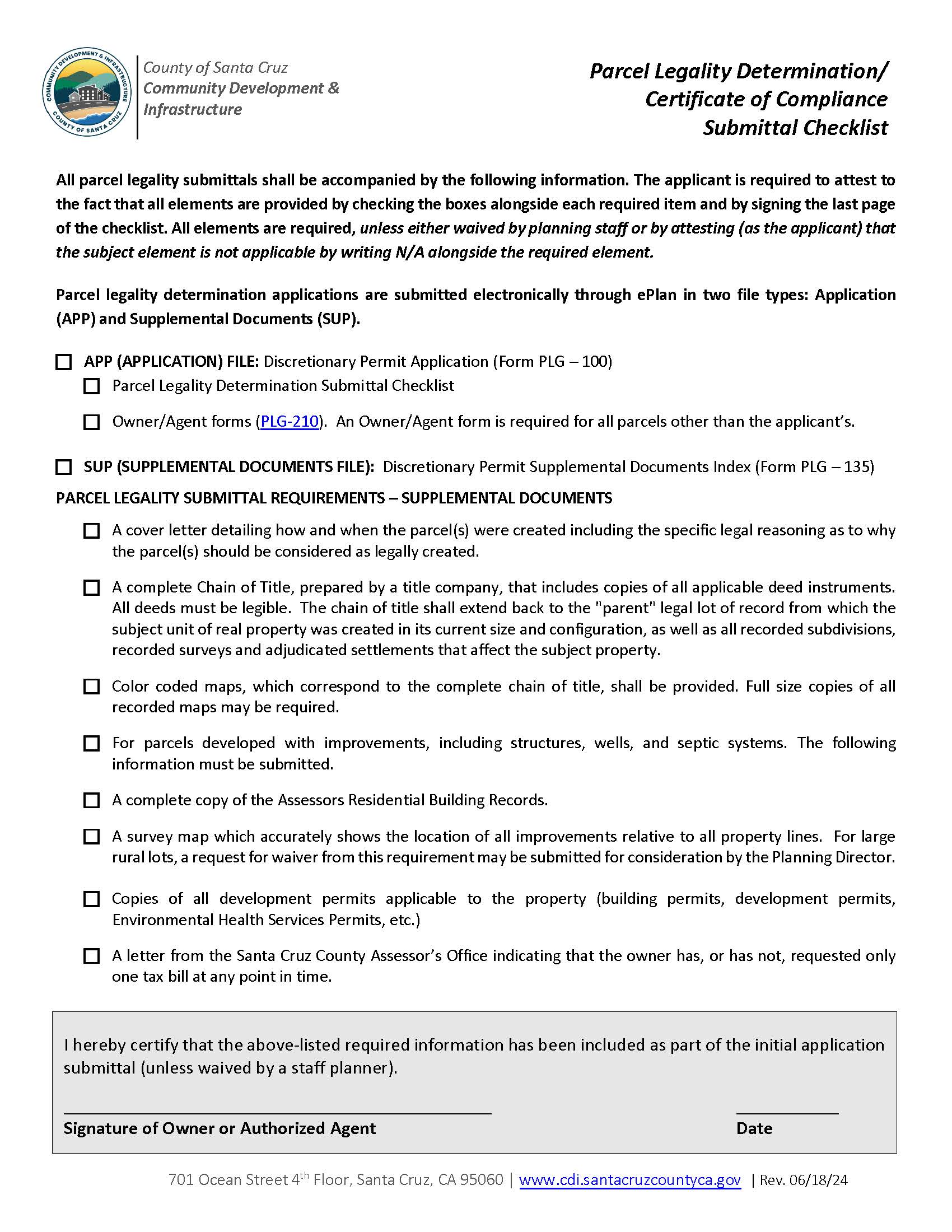
Precision starts with the data. Investors must commission topography surveys, geotechnical reports to address slope stability, and biological assessments for sensitive habitats. These documents form the foundation of your risk management strategy. Utility capacity is the most frequent deal breaker in the Santa Cruz mountains and coastal flats. Water hookups are particularly scrutinized due to Tier 3 restrictions and historical moratoriums. The will-serve letter functions as the definitive confirmation from a utility provider that they possess the capacity and intent to service the proposed project.
Securing risk assessment can prevent technical hurdles from becoming financial liabilities. Our approach ensures your assets are protected through every regulatory hurdle.
Evaluating Site Feasibility: Zoning, Environmental, and Coastal Constraints
Successful land development in Santa Cruz requires a surgical understanding of overlapping jurisdictions. The California Coastal Commission stands as the primary arbiter for any project within the coastal zone, often exercising authority that supersedes local municipal preferences. Developers must align their visions with the Local Coastal Program (LCP), a framework that prioritizes public access and the preservation of "view corridors." When planning beachfront and ocean view homes , your building envelope is frequently dictated by these aesthetic and accessibility mandates rather than simple setback rules. Our role is to provide the strategic foresight necessary to ensure your project respects these boundaries while maximizing asset value.
The Coastal Commission and Beachfront Development
Securing a Coastal Development Permit (CDP) in 2026 demands a proactive approach to environmental stewardship and public utility. The Commission focuses heavily on sea-level rise projections through the year 2075, requiring structures to be resilient against accelerated bluff erosion. Strategies for success include integrating public access easements or restoring native dune vegetation to offset the footprint of the build. View corridor protections often limit the height and massing of second-story additions, making it vital to conduct a 3D visual impact analysis before submitting formal plans. This level of preparation transforms a high-risk application into a structured, defensible proposal.
Environmental Protections and CEQA Compliance
The regulatory landscape for 2026 introduces tighter CEQA (California Environmental Quality Act) compliance measures that directly impact land development timelines. Santa Cruz is home to several "Sensitive Habitats" where the presence of the Ohlone Tiger Beetle or the California Red-Legged Frog can halt a project for entire seasons. Mitigation involves more than just a biological survey; it often requires permanent conservation easements or off-site habitat restoration. We recommend reviewing our 2026 Santa Cruz landlord alert to understand how these broader compliance shifts impact long-term asset management and property rights.
The Z’berg-Nejedly Forest Practice Act adds another layer of complexity for timberland conversions in the Santa Cruz Mountains. Removing even a small stand of redwoods requires a specialized Timberland Conversion Permit, a process that can add six to nine months to your schedule. Before committing capital, consult the Environmental Site Feasibility guidelines provided by the County. These resources are essential to ensure the parcel can support necessary infrastructure, such as nitrate-reducing septic systems or reliable well water, which are mandatory for any new development outside the urban services line.
Construction in Wildland-Urban Interface (WUI) zones carries a distinct financial premium. New 2026 building codes for fire-prone areas can increase structural costs by 18% compared to urban infill projects. These requirements focus on non-combustible materials, specialized eave venting, and defensible space management. In the mountain regions, slope stability remains the final hurdle. Seismic requirements necessitate deep pier foundations or retaining systems, especially on gradients exceeding 30%. Every foot of elevation gain translates directly into engineering complexity and increased capital expenditure, making site analysis the only path to a predictable return on investment.
Maximizing Asset Value: Strategic Land Use for 2026 Investors
Determining the Highest and Best Use (HBU) of a Santa Cruz parcel requires more than a cursory glance at zoning maps. It demands analysis of legal permissibility, physical possibility, and financial feasibility. By March 2026, the threshold for a viable project has shifted toward high-efficiency footprints that balance environmental stewardship with aggressive equity growth. Investors must evaluate whether a site's optimal path involves a single estate or a clustered development to ensure the long-term durability of the asset. This level of precision is the hallmark of land development strategies in a constrained coastal market.
The financial climate of 2026 dictates a disciplined approach to capital. With construction loan rates projected to hover around 5.75%, the "carry cost" of a project can erode margins if timelines slip by even 90 days. Investors are now prioritizing sites where the entitlement path is clear or already underway. Speed to market isn't just a preference; it's a risk management necessity. We observe that projects with a 12-month entitlement window yield a 15% higher internal rate of return compared to those mired in multi-year discretionary reviews.
Infrastructure costs often represent the most significant hurdle for mountain and coastal parcels. In Santa Cruz, fire suppression requirements and updated drainage standards can add $250,000 to $400,000 to a project's baseline budget before vertical construction begins. You'll need to account for:
-
Fire-rated access roads: Width and grade requirements set by Cal Fire.
-
On-site water storage: Specific gallon requirements for fire protection in WUI zones.
-
Stormwater mitigation: Low-impact development (LID) structures to manage runoff.
Strategic investors are neutralizing these costs by leveraging state-mandated housing laws. California's SB 9 and updated density bonus programs allow for a 20% to 35% increase in lot yield on qualifying parcels. This legislation effectively de-risks land development by allowing the distribution of fixed infrastructure costs across a higher number of finished units, significantly lowering the cost-per-door and enhancing the project's overall resilience.
ROI Analysis for Luxury and Investment Properties
Success depends on choosing the right product for the specific micro-market. While custom luxury homes offer high prestige and significant top-line revenue, multi-unit developments often provide more stable cash flow and a broader exit pool. A selling strategy must be integrated into the initial feasibility study. We recommend using a free home valuation to benchmark the after-repair value (ARV) against current neighborhood peaks, ensuring your pro forma remains grounded in documented market data.
The 2026 Market Landscape and Buyer Demand
The 2026 market shows a distinct flight to quality. "Ready-to-build" lots in areas like Scotts Valley are fetching a 22% premium because they offer a shield against the uncertainty of the permitting process. Silicon Valley wealth continues to migrate toward the Santa Cruz mountains, seeking privacy without sacrificing connectivity. For a deeper dive into these shifts, read our strategic guide to the 2026 market landscape to align your portfolio with current buyer demographics. The National Association of Home Builders has a Land Development Checklist.
Protect your capital and optimize your project's trajectory by partnering with an expert who understands the intersection of regulation and ROI. Consult with our team today to secure your investment's future.
Partnering for Success: Expert Land Development Consulting with Paul Burrowes
Success in the Santa Cruz market requires more than just a vision; it demands a technical bridge between creative architectural design and institutional financing. Paul Burrowes serves as this essential link. While an architect focuses on the aesthetic and structural integrity of a project, and a bank focuses on the debt-to-equity ratio, a consultant ensures the project remains viable within the local regulatory framework. Without this strategic oversight, even the most inspired designs can stall at the Planning Commission or fail to meet the stringent appraisal requirements of a commercial lender.
With a 15-year track record across Santa Cruz County and Silicon Valley, Paul Burrowes provides a level of institutional knowledge that mitigates the inherent volatility of the California building environment. He understands the specific nuances of the 1976 Coastal Act and the varying density requirements across different municipalities. This expertise turns speculative ventures into predictable assets. Since 1994, he has guided clients through multiple market cycles, ensuring that their land development strategies remain resilient regardless of shifting interest rates or legislative changes.
The Burrowes Advantage lies in the seamless integration of land use planning with high-end real estate brokerage. By partnering with David Lyng Real Estate, Paul manages the entire lifecycle of a project. He doesn't just help you obtain permits; he positions the final product for a successful close of escrow. This holistic approach ensures that every decision made during the pre-construction phase directly supports the eventual market valuation. It's a method of risk management that protects your capital from the first site visit to the final signature.
Consulting Services for Developers and Landowners
Effective development hinges on precise advocacy and market foresight. Paul Burrowes represents your interests before the Planning Commission, ensuring that zoning and entitlement hurdles don't derail your construction timeline. By analyzing current economic indicators, he ensures your project aligns with the specific expectations of the 2026 buyer , who prioritizes sustainability and integrated technology. He identifies red flags, such as hidden environmental easements or infrastructure deficits, before you commit 100% of your capital to a site. This vetting process is essential for maintaining the long-term integrity of your investment portfolio.
Your Next Steps in Santa Cruz Development
The path from raw land to a completed project is complex and requires a partner who values long-term asset security. You can schedule a comprehensive site feasibility consultation to evaluate the highest and best use of your property. Paul’s current portfolio includes off-market land listings and unique opportunities that aren't available to the general public. Secure your project’s future and ensure your capital is protected by leveraging 30 years of local expertise. Contact Paul Burrowes for a consultation today to begin your next venture with total confidence.
Mastering the 2026 Santa Cruz Development Landscape
Success in the 2026 Santa Cruz market requires more than capital; it demands a surgical understanding of the 1976 Coastal Act and California Environmental Quality Act (CEQA) frameworks. The complexity of local zoning and environmental constraints means that land development projects often succeed or fail during the initial entitlement phase. You'll need a strategy that prioritizes asset longevity and regulatory precision to navigate these high-stakes requirements. Paul Burrowes offers 30 plus years of local land use expertise to ensure your project meets every standard. Licensed with David Lyng Real Estate, he provides a specialized approach to Coastal Commission and CEQA compliance that protects your investment from the 12 to 18 month delays common in unguided projects. Don't leave your portfolio's growth to chance when you can leverage a history of proven results. It's time to transform complex regulations into a clear competitive advantage for your next venture. Partner with Paul Burrowes for your next Santa Cruz development project to secure a legacy of excellence on the Central Coast.
Frequently Asked Questions
How long does the land development process take in Santa Cruz County?
The land development process in Santa Cruz County typically spans 18 to 36 months from initial application to final approval. Complex projects involving Environmental Impact Reports under the California Environmental Quality Act often extend toward the three-year mark. Our consultants navigate these regulatory timelines by coordinating early with the Planning Department to mitigate delays caused by the county's 30-day completeness review cycles.
What is the difference between a building permit and an entitlement?
An entitlement grants the legal right to use the land in a specific way, whereas a building permit authorizes the actual construction of structures. Entitlements involve discretionary approvals like General Plan amendments or variances that can take 12 months to secure. Conversely, building permits focus on technical compliance with the 2022 California Building Standards Code; they ensure the physical integrity and safety of the proposed project.
Can I subdivide my lot in Santa Cruz under current 2026 laws?
You can subdivide qualifying urban lots under Senate Bill 9 and the 2026 updated Local Coastal Program guidelines. These regulations allow for urban lot splits that create two parcels of at least 1,200 square feet each. Current zoning mandates that 20 percent of new units in developments over five homes meet affordable housing criteria. This legislative framework provides a structured path for density increases while maintaining the architectural character of the region.
How much are the typical development impact fees in Santa Cruz?
Typical development impact fees for a single-family residence range from $40,000 to $80,000 depending on the specific school district and water service area. In 2025, the City of Santa Cruz increased capital improvement fees by 4.5 percent to fund infrastructure upgrades. These costs include transportation mitigation, park dedication, and fire protection fees; they're calculated based on the total square footage of the habitable space.
Does the California Coastal Commission have jurisdiction over my inland property?
The California Coastal Commission maintains jurisdiction over any property located within the designated Coastal Zone, which extends up to five miles inland in rural areas of Santa Cruz. Even if your site isn't beachfront, projects within this boundary require a Coastal Development Permit. Statistics show that 35 percent of Santa Cruz County land falls under this oversight, necessitating a review of coastal resource impacts and public access requirements.
What is a "will-serve" letter and why is it mandatory for development?
A will-serve letter is a formal document from a utility provider confirming they've the capacity to supply water, sewer, or electricity to your project. Santa Cruz County Code Section 13.10 requires these letters before the Planning Commission will hear a land development proposal. Without a 100 percent guarantee of utility service, the county won't approve the project, making this a critical milestone in the initial feasibility phase.
How do wildfire zoning laws affect my ability to build in the Santa Cruz Mountains?
Wildfire zoning laws require all new structures in the Santa Cruz Mountains to meet Very High Fire Hazard Severity Zone standards established by CAL FIRE. This includes a mandatory 100-foot defensible space buffer and non-combustible Class A roofing materials. Since the 2020 CZU Lightning Complex fire, insurance providers often require a 150-foot clearance from steep slopes before issuing the necessary coverage for new construction projects.
What is the ROI on developing a custom luxury home in Scotts Valley versus Santa Cruz?
Developing a custom luxury home in Scotts Valley currently yields a 15 to 20 percent higher return on investment compared to coastal Santa Cruz. While Santa Cruz commands higher sale prices, the land acquisition costs in Scotts Valley are approximately 30 percent lower. Our analysis of 2025 market data indicates that luxury builds in the 95066 zip code offer a more predictable path to equity growth through lower initial capital outlays and faster permitting cycles.
Land Use Planning Services
Swift Consulting Services, Inc.
500 Chestnut Street, Suite 100
Santa Cruz, CA 95060
(831) 459-9992
(831) 459-9998 fax
John Swift
John@swiftconsultingservice.com
Hamilton Land Planning
911 Center St
Santa Cruz, CA 95060
(831) 423-9992
Deidre Hamilton
deidre@hamiltonlandplanning.com
Hogan Land Services
Santa Cruz, Santa Rosa, Livermore
Toll free 877-544-2104
Mike Hogan - 831-425-1617
Adam Rivera
asr@hoganls.com
Lawlor LandUse
Owen Lawlor
612 Spring Street
Santa Cruz, CA 95060
Phone: (831) 212-8594
IFLAND ENGINEERS, INC.
Civil Engineering | Structural Design | Development Planning
Jon Ifland
Live Oak Business Park
5300 Soquel Avenue, Suite 101
Santa Cruz, CA 95062
T 831-426-5313 x.206
F 831-426-1763
www.iflandengineers.com
Article by
Paul Burrowes

Paul Burrowes, CRS, CCEC, SFR, NHCP, LHC, REALTOR® With over fifteen years of experience and an elite list of credentials, Paul Burrowes is a REALTOR® dedicated to merging deep local expertise with modern innovation. Paul leverages the latest technology and AI-driven insights to provide his clients with the most accurate, data-rich information available in the Santa Cruz, Monterey, Santa Clara, and Silicon Valley markets. He serves as a personal adviser, skilled negotiator, and detail-oriented advocate, ensuring every transaction—from initial question to final signature—goes off without a hitch. Contact Paul at paul@burrowes.com, (831) 295-5130, (408) 497-3989, or DRE# 01955563.
Disclaimer: This article was developed with the assistance of AI technology to synthesize market data, then reviewed, edited, and verified for accuracy by Paul Burrowes to ensure it meets the highest professional standards.

Enjoy this blog post? Click here to subscribe for updates
Leave A Comment