

Understanding the Santa Cruz County real estate market is essential whether you're buying a home, preparing to sell, or evaluating your property's current value. From coastal homes in Aptos and Capitola to mountain properties in Boulder Creek and family neighborhoods in Scotts Valley and Watsonville, local housing conditions vary by location, property type, price range, and time of year.
Santa Cruz County attracts buyers seeking coastal living, outdoor recreation, established neighborhoods, and proximity to Silicon Valley and the Monterey Bay region. These advantages contribute to the area's appeal, but buyers and sellers must also navigate housing costs, financing conditions, inventory, and differences between individual communities.
This guide examines market statistics published by the Santa Cruz County Association of REALTORS® (SCCAR), explains key indicators, and explores how buyers and sellers can use this information to make informed decisions.
Santa Cruz County Housing Market Overview
Santa Cruz County is not a single, uniform real estate market. Coastal communities, inland neighborhoods, mountain properties, and areas closer to the county's southern boundary serve different buyers and offer different property characteristics.
Market conditions can vary even between neighboring communities. A home near the beach may appeal to buyers prioritizing ocean access and coastal lifestyle, while a property in Scotts Valley may attract commuters looking for a different balance of housing, neighborhood amenities, and access to Highway 17.
Buyers comparing Santa Cruz, Aptos, Capitola, Scotts Valley, and Watsonville may encounter substantial differences in home prices, lot sizes, property condition, and available housing options.
To understand current conditions, look beyond a single median sale price and consider several indicators together:
- Median sale price: The midpoint of closed-sale prices during a reporting period.
- Average sale price: The average price paid for properties sold during the period.
- Housing inventory: The number of properties available for sale at a particular point in time.
- New listings: The number of properties newly listed during the reporting period.
- Closed sales: The number of transactions completed during the period.
- Days on market: How long properties spend on the market, subject to the reporting methodology.
- Sale-to-list price ratio: The relationship between sale price and the listing price used in the calculation.
Together, these indicators help explain whether buyers have more choices, whether sellers face greater competition, and how individual properties are positioned in the market.
Santa Cruz County Single-Family Home Prices
Single-family residences are a major segment of the Santa Cruz County housing market. They range from smaller homes on compact lots to larger residences with ocean views, substantial acreage, or distinctive coastal locations.
SCCAR's monthly statistics provide an overview of countywide pricing trends. The following table lists the reported median sale prices for 2026. April's figures have been corrected using the official SCCAR April 2026 Market Statistics report.
| Month | Median Sale Price |
|---|---|
| January 2026 | $1,225,000 |
| February 2026 | $1,275,000 |
| March 2026 | $1,300,000 |
| April 2026 | $1,400,000 |
| May 2026 | $1,342,500 |
| June 2026 | $1,350,000 |
| July 2026 | $1,375,000 |
| August 2026 | $1,350,000 |
| September 2026 | $1,250,000 |
Source: Santa Cruz County Association of REALTORS® (SCCAR).
The figures illustrate why it is important to monitor the market over time rather than assume prices move steadily in one direction. The reported median rose from $1.225 million in January to $1.4 million in April, then fluctuated through September.
Monthly median prices are affected by the types of homes that sell during a given period. If more high-priced coastal properties close in one month and more modestly priced homes close in another, the median can change even when comparable property values have moved less dramatically.
These figures describe the sales mix for each month. They do not mean that an individual home's value changed by the same percentage.
For homeowners, the countywide median is a useful market indicator, but it is not a substitute for evaluating a specific property using recent comparable sales.
These figures represent different aspects of the market. Inventory measures the available supply at the reporting point, while new listings and closed sales describe market activity during the reporting period. Average and median prices measure the prices of completed transactions in different ways.
Average Sale Price Versus Median Sale Price
Average sale price and median sale price measure different things. The average sale price is calculated by adding the prices of all homes sold and dividing by the number of transactions. A small number of exceptionally expensive properties can significantly influence the average.
The median sale price is the midpoint of the transactions: half of the properties sold for more and half sold for less. A month with several luxury homes may have a higher average sale price than a month dominated by smaller homes, even if the underlying market has not changed by a comparable amount.
For many readers, the median offers a useful snapshot of the middle of the market, while the average shows how higher-priced transactions affect the overall result.
Neither statistic should be interpreted alone. Property type, location, condition, square footage, lot size, and recent comparable sales also matter.
Santa Cruz County Housing Inventory and New Listings
Housing inventory is one of the most useful indicators for understanding competition between buyers and sellers. When inventory increases, buyers generally have more properties to compare. Sellers may face more competition, making pricing, presentation, and marketing especially important.
When inventory is limited, well-positioned properties may attract strong interest because buyers have fewer alternatives.
| Month | Current Inventory |
|---|---|
| January 2026 | 274 |
| March 2026 | 349 |
| June 2026 | 442 |
| July 2026 | 444 |
| August 2026 | 462 |
| September 2026 | 478 |
Source: SCCAR Market Statistics. Selected monthly figures; consult the original reports for complete monthly data.
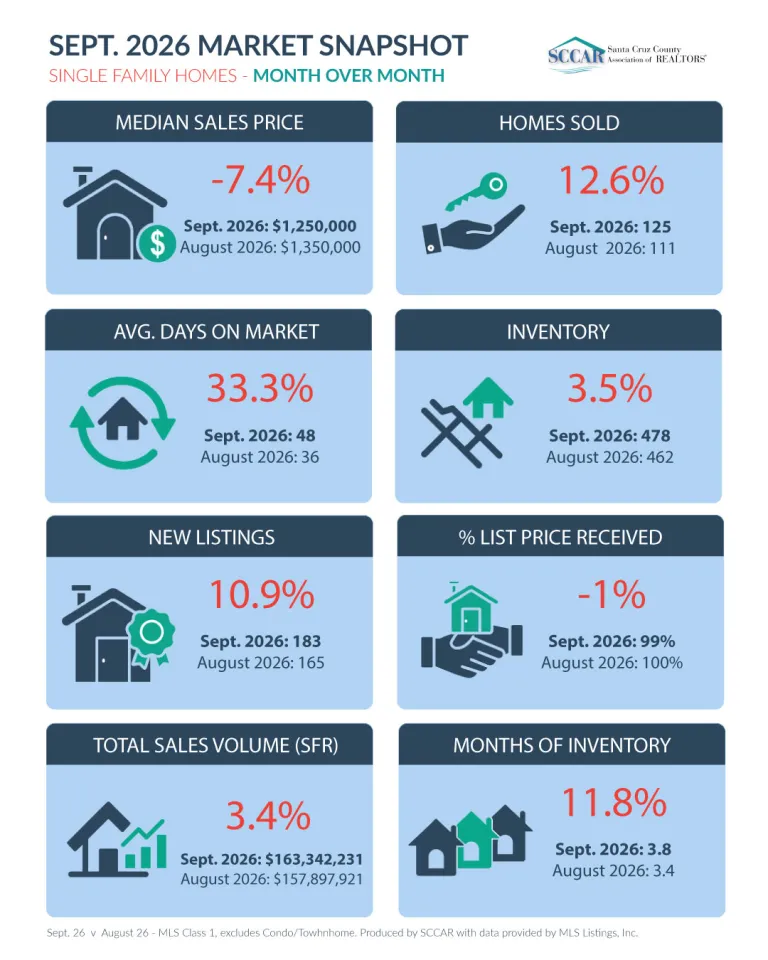
The reported figures indicate that the number of single-family homes in current inventory increased over the selected months, reaching 478 in September. More inventory can give buyers additional opportunities to compare locations, conditions, and asking prices. For sellers, it can mean competing more directly with other available homes.
Inventory alone does not determine whether a market favors buyers or sellers. New listings, closed sales, pending transactions, and the characteristics of available properties all affect competition.
New listings measure the flow of properties entering the market. If listings rise faster than buyer demand, supply may accumulate. If sales absorb new listings quickly, inventory may remain constrained.
Buyers should monitor new listings in their target neighborhoods rather than assume countywide inventory accurately describes every local market.
How Quickly Are Homes Selling in Santa Cruz County?
Days on market (DOM) measures how long a property takes to sell under the reporting system's definition. It provides context about the pace of the market.
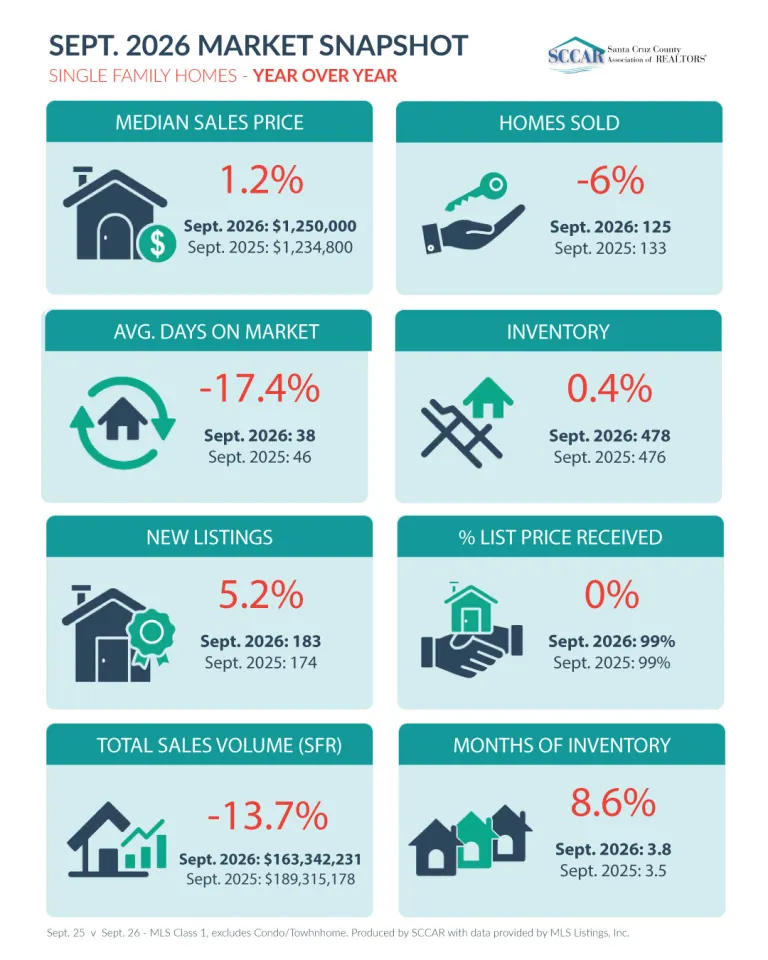
SCCAR's monthly single-family table reports 38 days on market for September 2026, compared with 36 days in August and 45 days in July.
These figures suggest that marketing time can fluctuate even over a short period. They do not mean every home will sell within that number of days.
Several factors influence how quickly a property attracts an acceptable offer:
- Asking price relative to comparable properties.
- Property condition and the need for repairs.
- Location, views, lot characteristics, and neighborhood amenities.
- Listing photography, presentation, and marketing quality.
- Buyer financing conditions and affordability.
- Competition from similar homes currently available.
- Inspection findings, disclosures, and other transaction considerations.
A well-priced home in a desirable location may receive substantial interest quickly, while an overpriced property may remain on the market longer.
For sellers, realistic initial pricing can help reach qualified buyers while the listing is new. For buyers, a longer marketing period may justify a closer look at pricing, condition, and seller expectations, but time on market alone does not guarantee a discount.
Santa Cruz County Condominium and Townhouse Market
Condominiums and townhouses provide alternatives to detached single-family homes. Depending on the property and community, they may appeal to first-time buyers, downsizers, investors, and people who prefer a smaller living space or a different maintenance arrangement.
SCCAR tracks condominiums and townhouses separately from single-family residences. This matters because these property types can have different ownership structures, price points, inventory patterns, and maintenance considerations.
| Market Indicator | Reported Figure |
|---|---|
| Current Inventory | 119 |
| New Listings | 37 |
| Closed Sales | 26 |
| Days on Market | 41 |
| Median Sale Price | $697,000 |
Source: SCCAR Market Statistics. Verify these figures against the original monthly report before publication.
The reported median is below the single-family median shown in the same monthly table. This illustrates why buyers should compare similar property types rather than rely on one countywide price benchmark.
A condominium or townhouse is not automatically less expensive to own than a detached home. Buyers should evaluate homeowners association (HOA) dues, insurance arrangements, reserve funding, special assessments, maintenance responsibilities, and community restrictions.
HOA documents deserve careful review because the association's financial condition, planned repairs, litigation, insurance coverage, and governing documents can affect ownership costs and resale prospects.
Understanding Differences Between Santa Cruz County Communities
Each community offers a different combination of housing options, lifestyle characteristics, and price levels. A local analysis should compare a property with relevant nearby sales, not simply apply the countywide median.
Santa Cruz
The city of Santa Cruz combines coastal living, established neighborhoods, downtown amenities, recreation, and access to the University of California, Santa Cruz. Buyers may encounter smaller homes and condominiums as well as larger residences in desirable neighborhoods. Proximity to the beach, views, condition, and neighborhood characteristics can materially affect value.
Aptos
Aptos attracts buyers interested in coastal amenities, established residential areas, beach access, and varied neighborhood settings. Values can differ depending on ocean proximity, views, lot size, home condition, and the specific neighborhood. Buyers should investigate applicable coastal regulations and property-specific maintenance considerations where relevant.
Capitola
Capitola is known for its coastal character, village atmosphere, and beach access. Limited availability of certain property types and the appeal of coastal locations can influence pricing. Buyers should distinguish among properties with different locations, views, sizes, and ownership arrangements.
Scotts Valley
Scotts Valley offers residential neighborhoods, local amenities, and access to Highway 17 for travel toward Silicon Valley and San Jose. Buyers may prioritize commuting access, home size, neighborhood characteristics, and proximity to schools and services. Sellers should pay close attention to competing listings and recent sales with similar characteristics.
San Lorenzo Valley
Communities such as Boulder Creek, Ben Lomond, and Felton offer wooded settings, outdoor recreation, and larger lots in some areas. Mountain properties may require additional due diligence concerning insurance availability and costs, defensible space, access, drainage, septic systems, and other property-specific issues. These factors can affect total ownership costs as well as buyer interest.
Watsonville
Watsonville offers a range of residential options in southern Santa Cruz County. Buyers may compare housing opportunities, access to services, and commuting routes with other parts of the county. Values depend on neighborhood, home size, condition, lot characteristics, and the specific market segment. The most relevant comparisons are generally properties with similar features rather than homes in a different segment.
What the 2025 Annual Santa Cruz County Statistics Tell Us
Annual statistics provide a broader view of the market by reducing the influence of individual monthly fluctuations. SCCAR's 2025 annual statistical report lists the following figures for single-family residences:
| Market Indicator | Reported Figure |
|---|---|
| Closed Sales | 1,346 |
| Median Sale Price | $1,106,875 |
| Average Sale Price | $1,250,561 |
| Average Days on Market | 48 |
| Median Price per Square Foot | $698 |
| Sale-to-List Price Ratio | 98.6% |
Source: SCCAR 2025 Annual Statistical Report.
The 2025 median provides a historical benchmark for evaluating subsequent market performance. It should not be directly compared with one month's median to calculate a precise appreciation rate: annual and monthly figures reflect different transaction mixes and time periods.
The 2025 report also lists 355 closed condominium and townhouse sales, a median sale price of $787,500, and an average of 43 days on market.
These figures illustrate why single-family homes and common-interest properties should be analyzed separately. For sellers, annual data provides context, but recent comparable sales in the property's neighborhood are usually more useful for pricing. Buyers should also consider current listings, financing costs, and property condition.
What the Statistics Mean for Santa Cruz County Home Sellers
If you are considering selling a Santa Cruz County home, market statistics can help you understand the competitive environment, but they must be applied to your specific property.
Price According to Current Competition
The countywide median is not a recommended asking price. A useful pricing analysis considers recent comparable sales, competing active listings, properties under contract where reliable information is available, and the unique features of the home.
An asking price that is too high may discourage qualified buyers and lead to extended marketing time or later price reductions.
Prepare for Informed Buyers
Buyers may compare multiple properties and scrutinize condition, maintenance requirements, insurance costs, and anticipated improvements. Addressing visible maintenance issues and presenting the property clearly can help buyers assess its value.
Evaluate the First Weeks on the Market
Early listing activity provides important feedback. Showing volume, buyer comments, competing listings, and offers can help determine whether the property's positioning is working. A thoughtful marketing strategy includes a plan for evaluating responses and making adjustments when warranted.
Understand Estimated Net Proceeds
Your potential proceeds depend on more than the sale price. Mortgage payoff, closing costs, repairs, concessions, applicable taxes, and other expenses can affect the amount you receive.
Before listing, request a seller net proceeds estimate tailored to your circumstances so you can compare possible sale prices and plan your next move.
What the Statistics Mean for Santa Cruz County Homebuyers
Compare Neighborhoods, Not Just Prices
A lower-priced property may have different maintenance requirements, commuting implications, insurance costs, or long-term resale considerations. Compare homes based on your budget, needs, and preferred lifestyle rather than assuming the lowest asking price represents the best value.
Monitor Inventory and Days on Market
Inventory indicates the range of available choices, while days on market provides context about transaction pace. Neither indicator determines the right offer on its own. Review comparable sales, the property's condition, and the level of competition before deciding how to proceed.
Calculate the Complete Monthly Cost
In addition to principal and interest, budget for property taxes, homeowners insurance, HOA dues when applicable, maintenance, and potential special assessments. Mortgage rates and insurance availability can materially affect affordability. Current financing estimates can help establish a realistic purchase budget.
Complete Appropriate Due Diligence
Review disclosures, inspections, title matters, and property-specific considerations. Depending on the property, additional investigation may be appropriate for septic systems, drainage, wildfire exposure, coastal conditions, or other issues.
A well-informed purchase balances price with condition, ongoing costs, and suitability for long-term plans.
Why Local Real Estate Expertise Matters
Countywide statistics are valuable, but they cannot fully explain the factors affecting an individual property. Two homes with similar square footage may have different values because of location, views, lot size, condition, improvements, neighborhood characteristics, or other features.
Likewise, market conditions in coastal Santa Cruz may differ from Scotts Valley, the San Lorenzo Valley, or Watsonville. A local comparative market analysis can help sellers evaluate pricing and competition. Buyers can benefit from reviewing comparable sales, assessing property-specific risks, and understanding the trade-offs between neighborhoods.
The objective is not simply to follow a median price. It is to interpret available evidence in the context of your real estate goals.
Frequently Asked Questions About Santa Cruz County Market Statistics
What is the median home price in Santa Cruz County?
The median depends on the reporting period and property type. SCCAR's monthly table lists a September 2026 median sale price of $1,250,000 for single-family residences. Confirm the figure against the original monthly report before publication, as published summaries may differ.
Are Santa Cruz County home prices increasing or decreasing?
Price trends depend on the period and property segment being evaluated. Monthly median prices can change because of the mix of homes sold, not just changes in individual property values. Comparing similar properties across equivalent periods provides a more reliable indication of market direction.
How long does it take to sell a home in Santa Cruz County?
SCCAR's monthly table reports 38 days on market for single-family homes in September 2026. Individual properties may sell more quickly or take considerably longer depending on pricing, condition, location, and buyer demand.
Is Santa Cruz County a buyer's or seller's market?
Conditions vary by location, price range, and property type. Inventory, closed sales, days on market, and the relationship between asking and sale prices help assess local competition. A neighborhood-specific analysis is more informative than a single countywide label.
Are condos and townhouses more affordable than single-family homes?
They often have lower purchase prices than detached homes in comparable market segments, but this is not universal. HOA dues, insurance, maintenance responsibilities, and special assessments should be included when comparing total ownership costs.
Where can I find official Santa Cruz County real estate statistics?
The Santa Cruz County Association of REALTORS® Market Statistics page provides monthly market tables and links to area-specific, quarterly, and annual housing reports.
Get a Local Santa Cruz County Market Analysis
Whether you are preparing to sell, searching for a home, or evaluating your property's market position, understanding local statistics is an important first step. The most useful analysis combines current market data with recent comparable sales, competing listings, property condition, and your individual goals.
Paul Burrowes, REALTOR® with David Lyng Real Estate, provides real estate guidance for buyers and sellers throughout Santa Cruz County, including Santa Cruz, Aptos, Capitola, Scotts Valley, the San Lorenzo Valley, and Watsonville.
If you are considering buying or selling, request a property-specific market analysis to better understand your options and develop a strategy based on current local conditions.
Visit Burrowes.com to learn more about local real estate services and explore communities throughout Santa Cruz County.
Market data source: Santa Cruz County Association of REALTORS® (SCCAR). Statistics reflect the reporting periods identified in the source tables and may be revised. Market statistics are historical indicators, not guarantees of future property values. Property values and selling times vary by location and individual property characteristics.


Paul Burrowes, CRS, CCEC, SFR, NHCP, LHC, REALTOR® With over fifteen years of experience and an elite list of credentials, Paul Burrowes is a REALTOR® dedicated to merging deep local expertise with modern innovation. Paul leverages the latest technology and AI-driven insights to provide his clients with the most accurate, data-rich information available in the Santa Cruz, Monterey, Santa Clara, and Silicon Valley markets. He serves as a personal adviser, skilled negotiator, and detail-oriented advocate, ensuring every transaction—from initial question to final signature—goes off without a hitch. Contact Paul at paul@burrowes.com, (831) 295-5130, (408) 497-3989, or DRE# 01955563.
Disclaimer: This article was developed with the assistance of AI technology to synthesize market data, then reviewed, edited, and verified for accuracy by Paul Burrowes to ensure it meets the highest professional standards.
Enjoy this blog post? Click here to subscribe for updates
Leave A Comment