

Welcome to Santa Cruz—a place where world-class surf meets redwood serenity, where tech talent from Silicon Valley mixes with beach-town charm. It’s one of the most desirable corners of California—and one of the most complicated. In fact, Santa Cruz has now held the dubious title of least affordable rental market in the nation for three years running. And as we enter 2026, the local housing scene is evolving fast.
Inside this Article:
- 2025–2030 Five-Year Housing Market Predictions & Santa Cruz Outlook
- Sales Activity Is (Finally) Gaining Momentum
- Expect Home Prices to Rise—But Affordability Will Still Be an Issue
- Mortgage Rates: Some Relief Coming, But Not a Game-Changer
- New Construction: Demand's Still There—but So Are the Headwinds
- The Real Cost of Owning a Home Is Climbing—Fast
- AI, Remote Work, and the Changing Nature of Demand
Interest rates remain high. Inventory is rising—but just barely. And buyer psychology is shifting in real time.
Whether you're preparing to buy, sell, or invest, now is the time to understand the market’s five-year trajectory. This blog will break down what’s happening, where things are heading, and what you need to consider if you want to get ahead of the curve. We’ll explore expert projections, hyperlocal insights, and strategies to help you navigate one of the toughest—but most rewarding—housing markets in the country.
2025–2030 Five-Year Housing Market Predictions & Santa Cruz Outlook
Santa Cruz has never followed a national script. Its market dances to its own rhythm—shaped by rugged geography, tight land use regulations, and a steady inflow of affluent remote workers drawn to its lifestyle. But even in this unique pocket of coastal California, larger forces are at play—and those forces are already reshaping what the next five years will look like.
So, what should you expect from 2025 through 2030?
- Sales will climb gradually
- Prices will rise—but more slowly
- Affordability? Still tight
- Mortgage rates? Slight relief, but don’t hold your breath
The days of panic-buying and wild bidding wars are behind us—but that doesn’t mean bargains are around the corner.
Sales Activity Is (Finally) Gaining Momentum
Following a two-year cooldown, the housing market is showing early signs of a comeback. The lock-in effect—where homeowners with 2–4% mortgages have little incentive to sell—has started to ease. According to U.S. News, over 80% of mortgage holders had rates below 6% in 2024. But by the end of 2025, that number may dip closer to 75%, as more owners decide to make life moves despite higher borrowing costs.
With the Federal Reserve forecasting slower economic growth, we’re likely to see mortgage rates come down slightly over the next year—but don’t expect any dramatic drop. The sheer weight of our national debt is keeping a tight lid on how low rates can realistically go. We're not heading back to the 4%–5% range from the early Trump years anytime soon.
That said, the National Association of Realtors (NAR) offers a more optimistic outlook: they’re projecting average mortgage rates to settle around 6.4% in 2025 and edge down to 6.1% in 2026. That’s a welcome shift, especially if you’re thinking about buying or refinancing. On the sales front, NAR expects existing-home sales to rise 6% in 2025, with another 11% increase in 2026—which means more inventory and potentially more negotiating power for buyers.
New construction is also picking up, with a 10% jump in new-home sales expected in 2025, followed by 5% in 2026. And while home prices will keep rising, the pace is slowing: NAR forecasts a 3% gain in 2025 and 4% in 2026, thanks in part to more supply coming to market. If wage growth begins to outpace home price appreciation, we could see a real improvement in affordability—something buyers have been waiting on for years.
- Local insight: Inventory is rising in neighborhoods like Seabright, Soquel, and parts of Live Oak, but don’t expect a flood of listings. Many would-be sellers are still choosing to rent out their homes—or simply wait for rates to fall.
- Seller takeaway: Homes in prime condition and well-priced will start selling faster in 2025–2026—but overpricing will backfire.
- Buyer takeaway: You'll have more choices and time to decide—especially compared to 2021–2022—but move quickly in high-demand areas like Capitola or Pleasure Point.
Expect Home Prices to Rise—But Affordability Will Still Be an Issue
According to a recent Reuters survey, U.S. home prices are expected to rise 3.5% annually through 2027—the slowest pace of growth since 2011. That’s a welcome change for buyers who’ve watched prices soar more than 50% since 2019, but let’s be honest: affordability is still going to be tough.
The biggest headwind? Tariffs and long-term debt. President Trump’s new trade policies are raising construction costs across the board. Nearly 90% of housing analysts polled said they expect fewer affordable homes to be built because of these tariffs, with some warning of significantly reduced supply. Builders may respond by shrinking floorplans or slowing down projects entirely—especially for single-family homes. Construction spending already dipped in April, and it’s not expected to bounce back quickly.
Meanwhile, a $3.3 trillion tax cut and spending package just passed by Congress is adding even more pressure to the national debt—now at a staggering $36.2 trillion. That’s pushing long-term bond yields higher, which in turn is limiting how far mortgage rates can fall.
Mortgage Rates: Some Relief Coming, But Not a Game-Changer
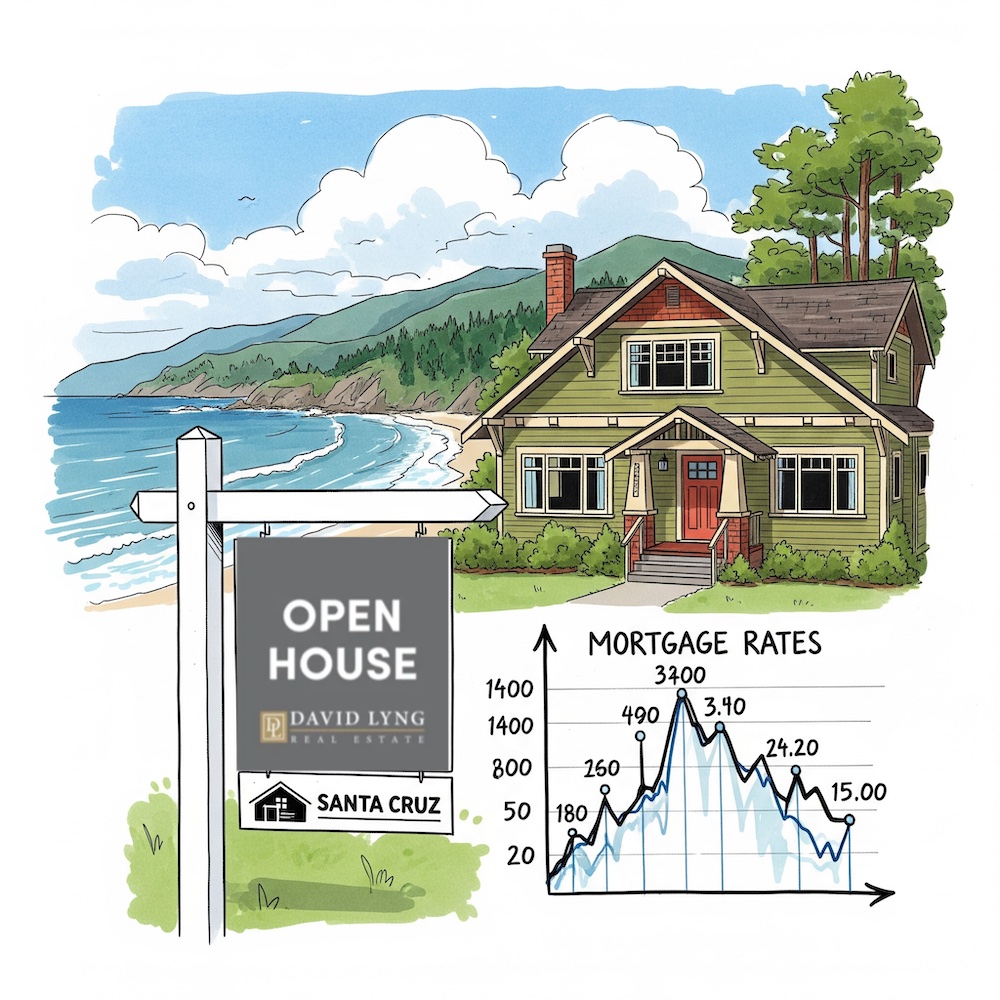
The biggest wild card? Mortgage rates. After peaking above 7% in early 2025, rates are expected to decline slightly by year-end. Most forecasts—including those from the Mortgage Bankers Association, Fannie Mae, and Wells Fargo—expect the average 30-year mortgage to land between 6.5% and 6.7% by the end of 2025 and possibly drift toward 6.1%–6.3% by late 2026.
But don’t expect a return to 4%. Inflation concerns, tariff impacts, and Fed caution mean we’re in a "higher-for-longer" environment.
What this means locally:
- Monthly payments will still price out many Santa Cruz would-be property buyers.
- Refinance activity will stay muted.
- Adjustable-rate mortgages (ARMs) and seller concessions may become more common.
Pro Tip: Want to buy in Santa Cruz? Don’t wait for rates to drop. Instead, focus on rate buydown strategies, new build incentives, or negotiating closing costs to improve affordability.
New Construction: Demand's Still There—but So Are the Headwinds
When existing home inventory dries up, buyers naturally start turning to what’s left on the table—new construction. And lately, that shift has been more noticeable than ever. Newly built homes now make up nearly 30% of all single-family housing inventory, according to U.S. News, which is more than double their usual market share. On the surface, that sounds promising. But dig a little deeper, and the picture is more complex.
Builders are facing real challenges right now. Interest rates remain elevated, affordability is under pressure, and buyer confidence is on shaky ground. That’s slowed down new construction across the board. Single-family housing starts dropped 4.6% in June, falling to an annual rate of 883,000 units, and overall construction for the first half of the year is down nearly 7% compared to 2024.
In some regions, like the South, builders are pulling back hard—construction is down 12% year-to-date. But there’s a flip side: the Midwest is showing resilience, with a 10% increase in starts, thanks largely to more favorable land costs and better affordability.
Even so, inventory is stacking up. By May, the supply of new single-family homes reached 9.8 months, more than twice the supply of existing homes on the market. And not all of these homes are still under construction—about 20% are move-in ready.
Incentives Are Ramping Up With more unsold inventory, builders are getting creative. If you’re shopping for new construction, this could work in your favor. Larger builders—especially the national names—are offering generous incentives, from mortgage rate buydowns to closing cost credits and even upgrade allowances. According to a June NAHB survey, 37% of builders were cutting prices—the highest level since they started tracking post-COVID. Meanwhile, 62% reported offering sales incentives, and that number is climbing.
That said, these deals won’t last forever. With mortgage rates starting to trend downward, builder discounts are likely to taper off in the coming months. The moment the market gets even a whiff of stronger demand; those perks will disappear.
A Changing Cost Equation Another thing to consider: the total cost of ownership. New homes may come with a higher sticker price upfront, but many include features that help reduce long-term expenses—solar power systems, newer appliances, better insulation, and lower maintenance costs. Some buyers are finding that, over time, these upgrades make new homes more cost-effective than older resale properties. That’s a huge selling point, especially in a market like Santa Cruz where buyers are weighing every dollar.
Multifamily is on the Rise, Too While the single-family sector wrestles with soft demand and tighter budgets, multifamily construction is surging. Starts for 5+ unit buildings jumped 30% in June, and are up more than 15% year-to-date. With many would-be homebuyers priced out of ownership or hesitant due to high rates, demand for rentals remains strong, making apartment development a bright spot for investors and developers alike.
In Santa Cruz County, don’t expect a construction boom. Strict zoning laws, land use restrictions, and limited flat land continue to cap large-scale development. You may find new inventory in Watsonville, Freedom, or parts of South County. But even there, homes sell quickly—and often with added incentives:
- Builder-funded rate buydowns
- Energy-efficient upgrades (solar panels, smart home features)
- Reduced closing costs
Local reality: Supply will improve—just not fast enough to meet demand. And in premium markets like Scotts Valley or Bonny Doon, scarcity will keep prices high.
Bottom Line? There’s still pent-up demand in the market—but elevated rates and affordability barriers are holding things back. Builders are responding with price cuts and perks, but they’re also slowing the pace of construction. If you're a buyer, that gives you a rare window of leverage in the new-home space. If you're an investor, multifamily might be where the momentum is shifting. Either way, the second half of 2025 will be all about navigating a market where opportunity and caution are walking hand-in-hand.
Key Trends IN SANTA CRUZ COUNTY:
1. Inventory is Increasing:
- 2025: The number of homes available for sale (Current Inventory) has consistently been higher than in 2024 for the same months.
- 2024: Inventory started at 176 in January and grew to 334 by July.
- 2025: Inventory started at 238 in January and grew to 552 by July, representing a significant year-over-year increase. For example, in July 2025, the inventory (552) was 65% higher than in July 2024 (334).
2. New Listings are Higher:
- 2025: The number of new listings is consistently higher month-over-month compared to 2024.
- 2024: New listings peaked at 216 in May.
- 2025: New listings were higher in the early months of the year, peaking at 279 in May. In July, new listings were at 216, a substantial increase from the 196 in July 2024.
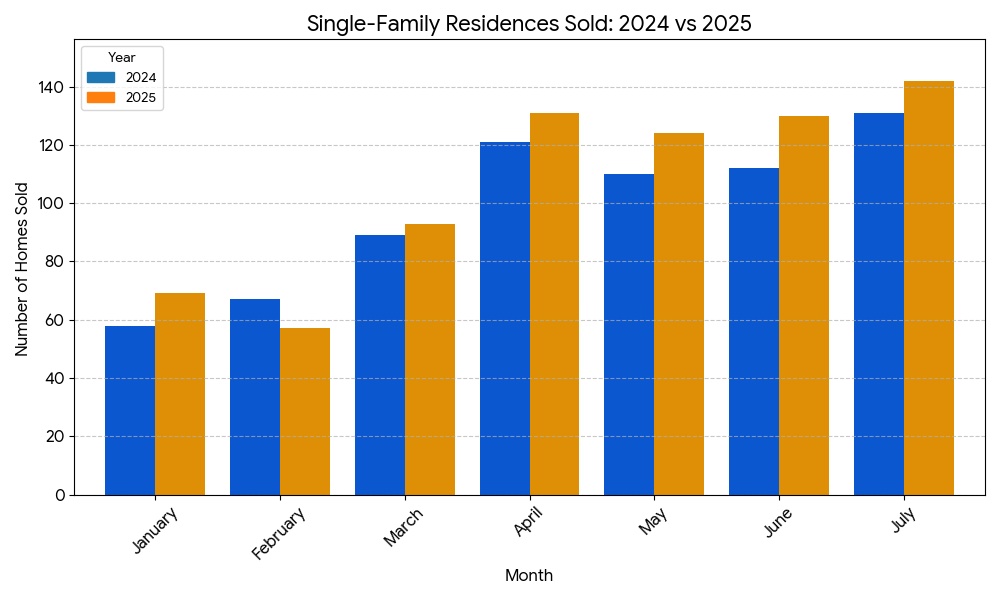
3. Sales Volume is Increasing:
- 2025: The number of homes sold has been higher in 2025 compared to 2024.
- 2024: Sales volume grew from 58 in January to 131 in July.
- 2025: Sales started at 69 in January and grew to 142 in July, showing a modest but consistent increase.
4. Homes are Selling Slower:
- 2025: The Days on Market (DOM) is, on average, longer in 2025.
- 2024: The DOM was 40 in January and dropped to a low of 28 in July.
- 2025: The DOM started at 46 in January and remained higher, only dropping to a low of 25 in April. This indicates that despite higher sales volume, it is taking slightly longer for homes to sell in 2025.
5. Average and Median Prices are Rising:
- 2025: Both the average and median sales prices have increased significantly compared to 2024.
- 2024: The median price fluctuated, but was around $1.3-1.4 million from March to July.
- 2025: The median price is consistently higher, ranging from $1.25 million to $1.4 million. In July 2025, the median price was $1,395,500, which is an increase of approximately 3% from July 2024's median of $1,355,000.
- 2024: The average price was more volatile, reaching a high of $1,584,224 in June.
- 2025: The average price in 2025 is higher, peaking at $1,612,410 in June. In July 2025, the average price was $1,502,316, an increase of about 7% from July 2024's average of $1,402,477.
COMPARISON:
- Current Inventory - Substantially higher inventory in 2025.
- New Listings - Consistently more new listings in 2025.
- Sold - Higher sales volume in 2025.
- DOM - Homes are taking slightly longer to sell in 2025.
- Average Price - Consistently higher average prices in 2025.
- Median Price - Consistently higher median prices in 2025.
The Real Cost of Owning a Home Is Climbing—Fast
When people talk about the cost of owning a home, they usually think in terms of just the mortgage principal and interest. But that’s only half the story. The real cost of homeownership includes everything else—utilities, maintenance, insurance, and property taxes—and those costs have jumped significantly. According to Bankrate’s mid-2025 update, homeowners are now spending an average of $1,783 a month, or $21,400 a year, just on these extras. That’s an 18% increase from last year alone.
The biggest chunk? Maintenance. It now makes up over 40% of those added costs. That’s a big reason HOAs across the country are feeling the heat to make sure their reserve funds are up to date. The only break? Newly built homes usually come with fewer maintenance headaches—at least in the first few years.
Part of the surge is just inflation. Between May 2020 and May 2025, the Consumer Price Index rose about 25%. But climate extremes are also a major driver—storms, fires, and flooding have pushed hazard insurance premiums up across the board.
Now, layer that on top of a typical $2,200 monthly mortgage payment, and you're looking at total costs creeping toward $4,000 a month for the average single-family home. Meanwhile, renting that same type of home in May 2025? About $2,296/month—over 40% less. That’s why many buyers with solid incomes are still sitting on the sidelines. For them, renting just makes more financial sense right now.
- “The math doesn’t pencil out yet,” one Aptos renter told us. “Buying would cost me almost double what I pay in rent.”

AI, Remote Work, and the Changing Nature of Demand
Artificial intelligence is transforming how people work—and where they choose to live. As AI tools make remote work even more accessible, Santa Cruz becomes increasingly attractive to digital nomads and tech workers seeking ocean views and small-town vibes over urban high-rises.
Marc Benioff, Salesforce CEO, says AI already does 30–50% of their company’s work. By 2030, that number will likely grow—and so will the number of remote workers be shopping for homes in places like Soquel, Felton, and the Santa Cruz Mountains.
Final Takeaway: Santa Cruz Will Stay Pricey—but Strategic Buyers Can Win
Santa Cruz isn’t becoming affordable—but it is becoming more navigable. The frenzied pace is slowing. Buyers have room to negotiate. Sellers have to adjust expectations. And investors need to plan for long-term gains—not fast flips. If you understand the numbers, play the timing smart, and stay open to creative financing, Santa Cruz can still offer a winning move.
Let Paul Burrowes Guide You to High-Performance Investments in Santa Cruz
Paul Burrowes, CRS, CCEC, SFR, NHCP, LHC, REALTOR® Licensed REALTOR® with over 15 years of experience and expertise. Commits to being on time and transparent. Acts as your consultant to ensure you make the best decisions to fit your transaction at every step in the process. Negotiates towards a low-stress, win-win outcome. Handles all the details for you, ensuring the hundreds of steps in your real estate transaction go smoothly. Proudly serving Silicon Valley, Santa Cruz, Monterey, and Santa Clara Counties! | DRE# 01955563 | (831) 295-5130 | paul@burrowes.com.

Want to Know How Much Your Property is Worth?
Free Valuation
Start searching for your dream home now.
Start SearchPaul Burrowes, CRS, CCEC, SFR, NHCP, LHC | David Lyng Real Estate | DRE# 01955563 | 15 plus years serving Santa Cruz, Silicon Valley & Monterey buyers | paul@burrowes.com | (831) 295-5130
Enjoy this blog post? Click here to subscribe for updates
1 Response to Santa Cruz Housing Market Outlook: Trends, Stats & Future Projections
dfs
Posted by Sarah F Burris on Wednesday, February 11th, 2026 at 12:10amLeave A Comment