

Buying your first home is one of the biggest financial decisions you'll ever make. It's also one of the most emotional — which is exactly why so many first-time buyers stumble. Between financing, contracts, inspections, and a market that moves fast, it's easy to feel like you're learning a new language under pressure.
Here's the good news: nearly every first-time buyer mistake is avoidable once you know what's coming. This guide walks through the process step by step — from getting your finances in order to closing day — so you can move forward with confidence instead of guesswork.
Step 1: Get Clear on Your Goals Before You Start Looking
Before you open a single listing, ask yourself why you're buying. For most first-time buyers, it comes down to trading rent payments for equity — building something tangible instead of paying down someone else's mortgage. For others, it's about independence, stability for a growing family, or laying the groundwork for a future investment property.
Your answer shapes everything that follows: how much you're willing to stretch financially, what neighborhood fits, and how long you plan to stay. A starter condo makes sense if you expect to move again in five years. A single-family home in a strong school district makes more sense if you're planning to put down roots. Getting honest about your timeline now saves you from second-guessing later.
A few mindset shifts worth adopting early:
- This is an investment, not a relationship. Falling in love with a house can lead to overpaying or overlooking real problems. Trust your instincts about value — not your emotions about paint colors.
- Don't chase the market. Trying to time the "perfect" moment to buy is a losing game. Real estate moves in cycles. The right time to buy is when you find a home that fits your needs and your budget.
- Look past the staging. Staged homes are designed to create an emotional reaction. Mentally strip away the furniture and decor, and focus on layout, structure, and condition — the things that are expensive or impossible to change.
- Think about resale, even if you plan to stay forever. Life changes. A home in a weak school district or on a busy street will always have a smaller buyer pool down the road, which affects both value and how quickly you could sell if you needed to.
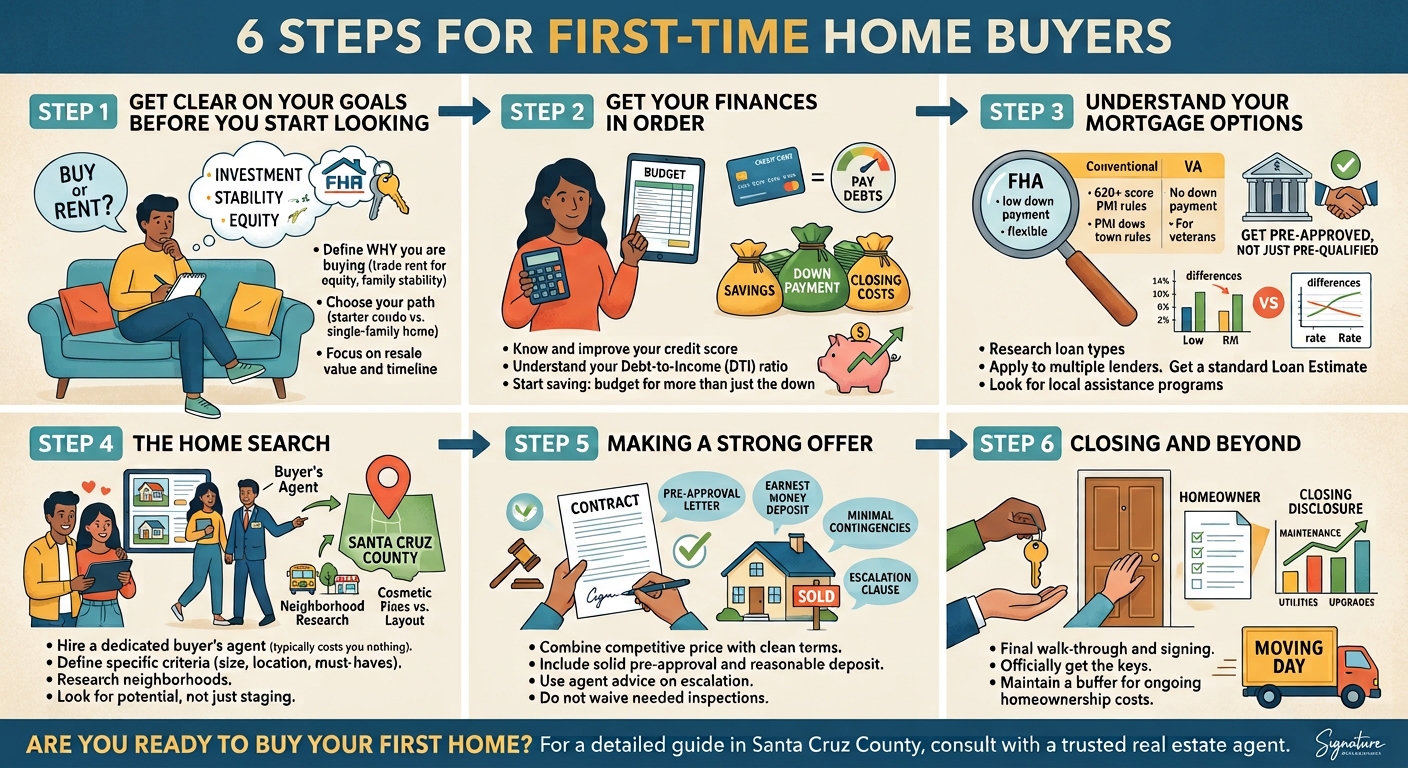
Step 2: Get Your Finances in Order
This is the step that determines everything else, and it's where most first-time buyers benefit most from starting early — ideally three to six months before you plan to shop for homes.
Know your credit score, and protect it. Most loan programs require a minimum score in the 580–620 range, with better rates available above 680. In the months before applying, pay down credit card balances below 30% of their limits, pay every bill on time, and resist opening new credit accounts or closing old ones. Even a car loan or a new furniture purchase can shift your debt-to-income ratio enough to change your loan terms — or derail your approval altogether.
Understand your debt-to-income ratio (DTI). Lenders look at two numbers: your housing costs as a share of gross monthly income (aim for 28% or less), and all your monthly debt payments combined (aim for 36% or less). If your DTI is running high, paying off smaller debts, increasing your down payment, or adding a co-borrower can all help bring it back in range.
Start saving — and know it takes more than just a down payment. Down payments can range from zero (VA and USDA loans) to 3–3.5% (conventional and FHA) up to 20% or more. On top of that, budget for closing costs, cash reserves lenders want to see after closing, and moving expenses. If your buying timeline is a few years out, a CD or short-term bond can help your savings grow without exposing them to market swings.
Leave your financial picture untouched once you start the process. Lenders want to see a clean, predictable paper trail. That means no new credit cards, no car loans, no large unexplained deposits, and no job changes between pre-approval and closing. Any of these can trigger a re-verification that delays — or kills — your loan.
Step 3: Understand Your Mortgage Options
First-time buyers have more loan options than most people realize, and the right one can make a meaningful difference in what you can afford and what you pay long-term.
Get pre-approved, not just pre-qualified. Pre-qualification is a quick, unverified estimate based on what you tell a lender. Pre-approval is the real thing: a lender verifies your income, assets, employment, and credit, and gives you a specific loan amount. Sellers take pre-approved buyers seriously — and in many markets, they won't seriously consider an offer without one.
Compare loan types against your situation:
- FHA loans are a common entry point for first-time buyers, with down payments as low as 3.5% and more flexible credit requirements. The tradeoff is mortgage insurance that, on most 30-year FHA loans, doesn't go away — many buyers plan to refinance into a conventional loan once they've built 20% equity.
- Conventional loans typically require a credit score of 620 or higher, with down payments from 3–20%. Private mortgage insurance (PMI) is required below 20% down, but unlike FHA insurance, it cancels automatically once you reach 78% loan-to-value — or you can request cancellation at 80%.
- VA loans are available to veterans, active military, and some surviving spouses, and are often the strongest option for those who qualify: no down payment, no PMI, and competitive rates.
- Many states, counties, and cities also offer first-time buyer assistance programs — down payment grants, low-interest second loans, or closing cost help. "First-time buyer" for these programs usually just means you haven't owned a home in the past three years, not that you've never owned one. It's worth asking your lender or agent what's available locally before you assume you don't qualify.
Shop more than one lender. Interest rate differences that look small — even a quarter of a percentage point — add up to thousands of dollars over the life of a loan. Federal law requires lenders to give you a standardized Loan Estimate within three days of applying, which makes it easy to compare rate, APR, monthly payment, and closing costs side by side. Applying to a few lenders within a short window (typically 14 days) counts as a single inquiry for credit scoring purposes, so there's little downside to comparing.
Step 4: The Home Search
Once your finances are in order, the search itself should be methodical, not random. This is where a buyer's agent earns their keep — and it's worth understanding why.
Always have your own representation. If you call the listing agent on a property that catches your eye, you're speaking with someone whose fiduciary duty is to the seller, not you. A buyer's agent works exclusively on your behalf, has access to properties before they're widely marketed, and — importantly — typically costs you nothing, since the seller usually covers the buyer's agent commission. There's rarely a good reason to go without one.
Define your criteria before you start touring homes. Size, location, layout, must-haves versus nice-to-haves — the more specific you are, the less time you'll waste on homes that were never going to work. An agent can set up automated MLS alerts matched to your exact criteria, so you hear about new listings the moment they hit the market rather than days later on a public site.
Research the neighborhood as thoroughly as the house. Drive by at different times of day. Time your actual commute. Check proximity to grocery stores and daily services. Even if you don't have kids, look into the school district — it can affect home values by as much as 20% compared to a similar home in a weaker district.
Don't be afraid of a home with potential. A house with dated cabinets or ugly wallpaper but a solid structure and good bones is often a smarter buy than a move-in-ready home at the top of your budget. Cosmetic fixes are inexpensive relative to the value they can add over time — and a home you can improve is a home that builds more equity.
Step 5: Making a Strong Offer
When you find the right home, how you structure your offer matters as much as the price.
A strong offer typically combines competitive pricing with clean terms: a solid pre-approval (not just pre-qualification), a reasonable earnest money deposit, minimal contingencies, and flexibility on closing timeline where possible. In a competitive market, your agent can also help you understand tools like escalation clauses, which automatically increase your offer if a competing bid comes in, giving sellers confidence without you having to guess at the "right" number upfront.
If you're in a multiple-offer situation, resist the urge to waive protections you genuinely need, like the inspection contingency, just to win. Your agent can help you find other ways to stand out — such as a larger deposit, a flexible closing date, or a shorter contingency period — without giving up the safeguards that protect you.
Step 6: Closing and Beyond
Once your offer is accepted, you're in escrow — typically a 30-day process involving inspections, appraisal, loan underwriting, and a review of all disclosures. This is also the point where discipline matters most: don't change jobs, open new credit, finance a car or furniture, make large purchases, or deposit large sums of cash while your loan is in underwriting. Any of these can trigger a re-verification that delays or jeopardizes your closing.
In the final days before closing, you'll do a walk-through to confirm the home's condition, review your closing disclosure, and sign your loan documents. Once the deed records, you officially get the keys.
Homeownership doesn't end at closing, though. Budget for ongoing costs beyond principal, interest, taxes, and insurance — utilities, maintenance, and eventual upgrades all add up. Many first-time buyers underestimate this part, so building a little cushion into your monthly budget from day one will save you stress later.
Common First-Time Buyer Mistakes to Avoid
A few patterns show up again and again with first-time buyers — and they're worth naming so you can sidestep them entirely.
Shopping for a home before shopping for a lender. It's tempting to start browsing listings the moment you decide to buy. But without a pre-approval in hand, you risk falling for a home that's outside your realistic budget — or losing it to a buyer who was ready to move faster.
Maxing out the loan amount you qualify for. Lenders calculate what you can borrow, not necessarily what you can comfortably afford once you factor in maintenance, commuting costs, HOA dues, and everyday life. Just because you're approved for a certain number doesn't mean you should spend it. Build your actual monthly budget first, then work backward to a price range you're comfortable living with.
Skipping the inspection to compete. In a hot market, it's tempting to waive contingencies to make an offer more attractive. An inspection contingency is one of the few protections that exists purely for your benefit — it's worth talking through with your agent before giving it up, even under pressure.
Underestimating the true cost of ownership. Principal, interest, taxes, and insurance are just the starting point. Utilities, HOA fees, routine maintenance, and the inevitable repairs that come with owning (rather than renting) all add up. Ask your agent to help you estimate these costs for the specific home and area you're considering, not just a rule of thumb.
Going it alone with the seller's agent. It might feel simpler to deal directly with the agent representing the home you love, but that agent's obligation is to get the seller the best possible price and terms — not to look out for you. A buyer's agent costs you nothing in most transactions and exists specifically to balance that equation in your favor.
The Bottom Line
Buying your first home is a process with a lot of moving parts, but none of them are mysterious once you know what to expect. Get your finances in order early, understand your loan options, work with an agent who represents your interests, and stay disciplined through escrow. Do that, and the path from renter to homeowner is a lot more straightforward than it feels at the start.
If you're beginning to think about buying your first home in Santa Cruz County, I'm happy to walk through your specific situation — financing, timeline, and what's realistic in today's market — with no pressure attached.


Paul Burrowes, CRS, CCEC, SFR, NHCP, LHC, REALTOR® With over fifteen years of experience and an elite list of credentials, Paul Burrowes is a REALTOR® dedicated to merging deep local expertise with modern innovation. Paul leverages the latest technology and AI-driven insights to provide his clients with the most accurate, data-rich information available in the Santa Cruz, Monterey, Santa Clara, and Silicon Valley markets. He serves as a personal adviser, skilled negotiator, and detail-oriented advocate, ensuring every transaction—from initial question to final signature—goes off without a hitch. Contact Paul at paul@burrowes.com, (831) 295-5130, (408) 497-3989, or DRE# 01955563.
Disclaimer: This article was developed with the assistance of AI technology to synthesize market data, then reviewed, edited, and verified for accuracy by Paul Burrowes to ensure it meets the highest professional standards.
Local Lenders
CrossCountry Mortgage, LLC
Brian Dean
Senior Mortgage Advisor
408-489-0952
thebriandeanteam.com
brian.dean@ccm.com
Jean Adams
Senior Mortgage Advisor
jean.adams@ccm.com
408-250-4550
Mark Junod
Senior Mortgage Advisor
831-600-4709
markjunod.com
mark.junod@ccm.com
Ryan Buckholdt
Branch Manager
M 831-818-2339
D 831-425-8326
W ryanbuckholdt.com
E ryan.buckholdt@ccm.com
Matthew Falconer
831-435-9197
teamfalconer.com
matthew.falconer@ccm.com
Santa Cruz Home Finance
Tai Boutell
Santa Cruz Home Finance
831-419-6931
tai@santacruzlending.com
Andrea Schenk
Mortgage Consultant
831.431.0496
andrea@santacruzlending.com
Bay Area Mortgages
David Warter
Mortgage Advisor
831-419-7604
bayareamortgages.com
dave@bayareamortgages.com
US Bank
David DeTeso
Mortgage Loan Officer
831-688-7161
831-234-1045
david.deteso@usbank.com
Selesa Webster
Sr. Mortgage Loan Originator
831.227.0727
selesa.webster@usbank.com
Shawna Watson
U.S. Bank Home Mortgage
Mortgage Loan Officer
Construction Loan Specialist
831.818.4909
shawna.watson@usbank.com
Posted by Paul Burrowes on
Enjoy this blog post? Click here to subscribe for updates
Leave A Comment