

If you're an investor, buyer, or homeowner keeping an eye on the Santa Cruz housing scene, get ready for an interesting change coming in 2026 and beyond.
Many homes in this beautiful coastal area already have backyard cottages, which are formally known as accessory dwelling units (ADUs). While these secondary units have typically served as rental spaces or homes for family members, new regulations could open up a new possibility: selling them as standalone properties.
Inside this Article:
The Legal Landscape: Understanding the AB 1033 Shift
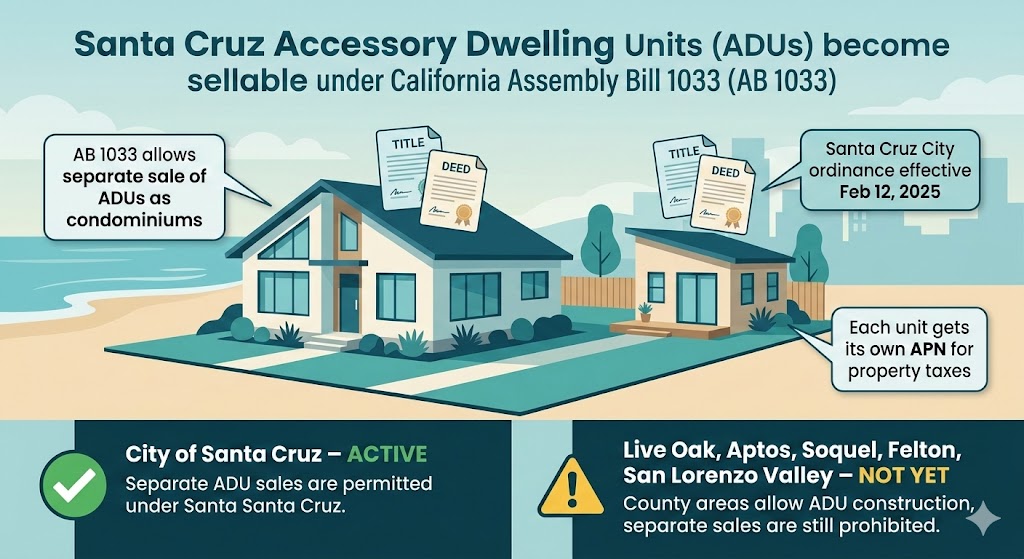
To understand ADUs as sellable assets, we must look at the law that made it possible. Santa Cruz wants people to build small extra homes (ADUs), in neighborhoods where people live or work. AB 1033 allows local agencies to adopt ordinances permitting the separate sale of ADUs as condominiums. This legal shift moves some properties away from "rental-only" restrictions to a condo-style ownership model.
Santa Cruz ADU Zoning Feasibility & Standards
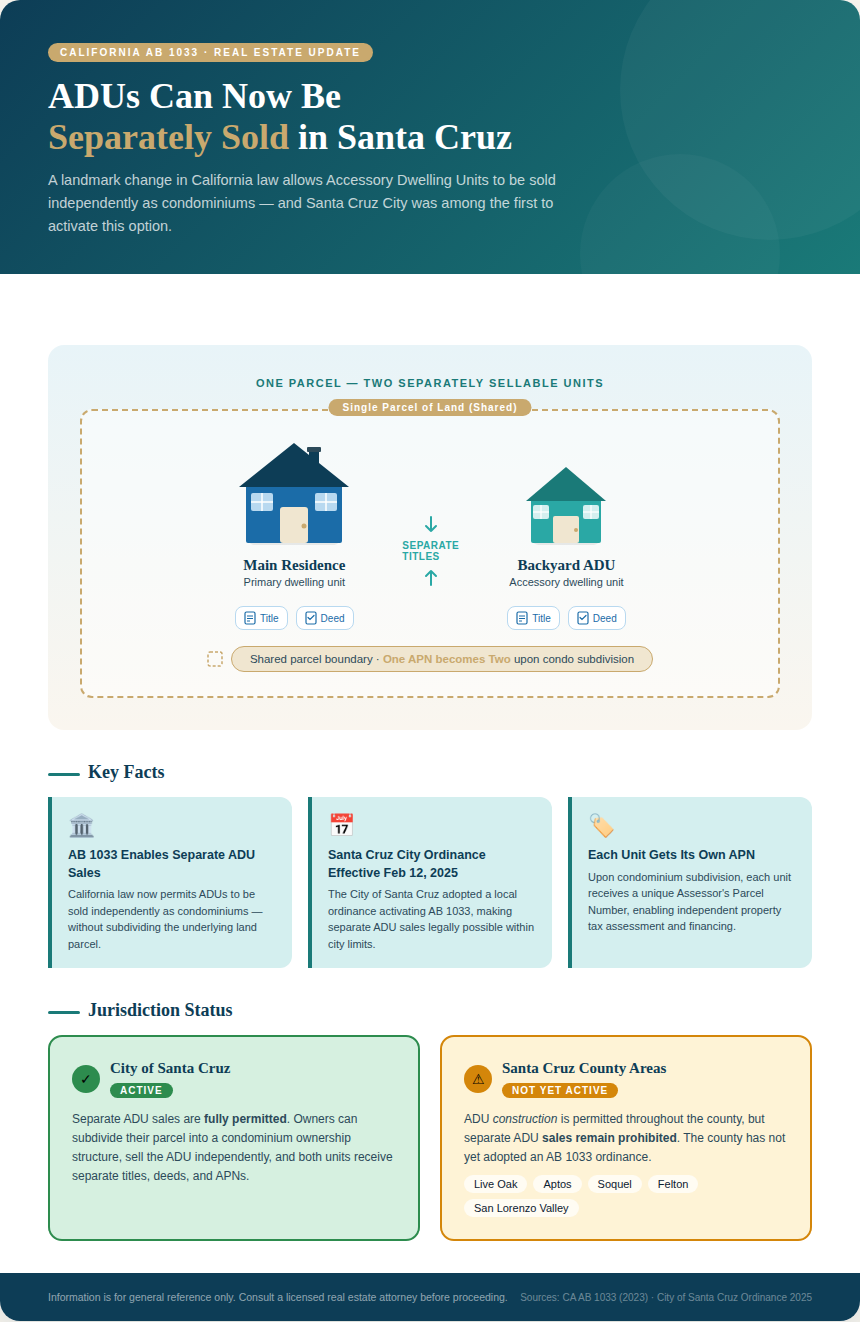
The City of Santa Cruz has officially implemented the AB 1033 ordinance after the City Council voted unanimously on January 14, 2025. The new rules kicked in on February 12, 2025. This process is a type of condominium conversion. It is not a typical lot split. Both the main home and the ADU become separate legal condo units. Each with its own title and deed. Meanwhile, the land beneath remains a single parcel with shared ownership.
For taxation purposes, each unit will indeed have a separate Assessor's Parcel Number (APN) assigned for individual property tax assessments once the condo map is legally recorded.
If your property is in areas like Live Oak, Aptos, Soquel, Felton, or the San Lorenzo Valley, the landscape is different. The County is actively considering an ordinance, but has not yet adopted it. While you can build an ADU under the standard county rules, the current ordinance still prohibits separate conveyance. Homeowners here should actively monitor the Santa Cruz County Planning Department for updates, but cannot initiate the process today.
You have to follow simple rules for the size of the ADU, its height, and where it sits on your property. Most of the time, you just need a basic building permit, which makes the process fast.
Easy Rules for Building an ADU
- Where can I build?
- You can build an ADU on any property that already allows houses, if there is already a main house there or you plan to build one.
- How many can I build?
- If you have one house (single-family lot): You can build one standard ADU and one very small ADU (called a JADU, which is part of the main house).
- If you have many homes (multi-family lot): You can build up to eight separate ADUs. You can also turn up to 25% of your non-living space (like garages or storage rooms) into ADUs.
- Do I have to live there?
- No, you do not have to live in the main house if you built your ADU after January 1, 2020.
- Yes, you (the owner) must live in the main house if you build a very small JADU.
- Can I rent it for a short time?
- No, you cannot rent the ADU for less than 30 days. The rental must be for at least a month.
- How do I get a permit?
- Most ADU projects only need a simple building permit.
- The city must approve your complete application within 60 days.
- You might need an extra "Coastal Permit" if your property is near the beach.
- What about utilities (water/sewage)?
- If you turn an existing space (like a garage) into an ADU, you usually don't pay new hookup fees.
- If you build a brand-new ADU, you might have to pay fees to connect to water and sewage lines.
- If your property uses a septic system, you must check with the Health Department to see if it needs an upgrade.
Pre-Sale Checklist: What to Verify Before Selling Your ADU
Before dreaming of a sale, you must ensure your ADU is fully legal. Whether in the City or County of Santa Cruz, your unit must follow local ADU rules to be eligible for anything. In most residential zones, you are allowed to build at least one ADU.
Key standards include:
- Size:
- Detached ADUs are typically capped at 1,200 sq. ft. (allowed on lots 1 acre or larger).
- For smaller lots (under 1 acre), the max size for a 2+ bedroom ADU is usually 1,000 sq. ft. (or 850 sq. ft. for a studio/1-bedroom unit).
- An 800 sq. ft. ADU is generally allowed regardless of lot size.
- Setbacks: The standard is a minimum of 4 feet from the rear and side lot lines. If your detached ADU is taller than 16 feet (in the County), the rear setback increases to 8 feet.
- Parking: Parking is usually not required if the ADU is within a half-mile of a major transit stop. However, specific rules in the Coastal Zone may still require parking spaces.
- Coastal Zone: If your property is in the Coastal Zone, your ADU will likely need a Coastal Development Permit (CDP). This permit is required even with the faster "ministerial" approval process.
Once you have confirmed your existing or planned ADU is legal, the process to sell it as a separate unit (condo-style conversion) involves these clear, technical steps:
1. Lienholder Consent: You must get written permission from all banks or lenders who have a mortgage on your property. Your lender has a security interest in the entire property; selling a portion of it requires their agreement, which may involve a partial loan payoff or refinancing.
2. Condominium Mapping: A licensed surveyor or engineer must create a "Condominium Plan" or "Parcel Map" for the City or County to approve. This map legally defines the boundaries of each unit's private area and the common shared land.
3. Form a Small HOA: State law requires the creation of a Homeowners Association (HOA), even for just two units. An attorney must draft Covenants, Conditions & Restrictions (CC&Rs) to manage shared expenses like land, roofs, driveways, and maintenance.
4. Utility Separation & Final Approval: You must arrange for separate utility meters for each unit (or a clear cost-splitting agreement). The City/County will conduct final inspections before officially recording the map. At that point, each unit gets its own separate title deed and property tax bill.
Critical Strategy Notes (Often Misunderstood)
Understand these distinctions to avoid costly missteps.
- Not a lot split: Condominium-style subdivision. The land itself is not split into two parcels.
- Junior ADUs (JADUs): These cannot be sold separately under any circumstance.
- Owner occupancy: As of January 1, 2025, local jurisdictions may not impose any owner-occupancy requirements on conventional ADUs.
The Financial Benefits of Unlocking ADU Liquidity
Selling your Accessory Dwelling Unit (ADU) as a separate property can give you a large amount of money all at once, which you can use for major life goals like retiring, paying off debt, or helping your family.
If you were renting the ADU, selling it as a separate unit can be a smart financial move.
1. Capital Acceleration: Big Cash Now vs. Small Monthly Rent
The primary benefit is the velocity of capital. Selling an ADU rather than renting it can help you bypass the "trickle" effect of monthly income in favor of a lump-sum windfall.
For example, if you list it for $750,000, you get that cash right away. Depending on whether it's your primary residence and your tax situation, you can use the Section 121 tax break to keep more of that profit without paying taxes on it.
Now, let's consider renting it out. If you charge $3,500 a month for the same unit, it would take roughly 18 years to bring in $750,000 in rental income (gross earnings). It doesn't factor in property taxes, ongoing maintenance costs, insurance, or the general hassle of dealing with tenants as a landlord.
2. Strategic Family Empowerment
In a tough real estate market like Santa Cruz, you can use this approach to help your family build wealth over generations. It lets you make sure your family has stable housing without just handing over the property. For example, you could sell a small secondary unit (like an ADU) to an adult child for less than what it's worth on the open market—a special deal just for them. This gives them a chance to start building their own home equity and stay nearby, while you pocket a nice sum to boost your savings.
The "Giving Back" Aspect: Or, if you sell the unit at the full market price, the money you earn could help start a college fund for a grandchild or cover a down payment for another family member who wants to buy a home somewhere else.
3. Debt Reduction and De-Leveraging
High-interest debt is a quiet drain on a homeowner's net worth. Many Santa Cruz residents use the liquidity from an ADU sale to reduce leverage.
Example: Using the $750,000 proceeds to pay off a high-interest mortgage or HELOC. By eliminating a monthly mortgage payment, you effectively "give yourself a raise" every month while significantly increasing your home's clear equity.
4. Funding Retirement and Healthcare Longevity
The older a person gets, the more having cash in hand may be important than having valuable property. A benefit of selling your ADU is the financial cushion it creates, allowing you to remain in your primary residence.
- Example: A homeowner can use the sale proceeds to fund an annuity or a dedicated healthcare fund. This ensures that if specialized medical care or in-home assistance is needed in the future, the capital is already liquid and accessible, providing peace of mind without the need for a stressful "fire sale" of the entire property.
5. Reallocating into Low-Maintenance Assets
Being a landlord takes a lot of time and effort. If you're looking to simplify your life, selling your ADU lets you reinvest that money into "hands-off" investments.
Example: Instead of managing an ADU (repairs, tenant screenings, local Santa Cruz rent registries), a homeowner can move that $750,000 into a diversified portfolio of REITs, bonds, or dividend-paying stocks. You maintain an income stream, but with zero "maintenance calls" or property management chores.
Frequently Asked Questions About AB 1033 in Santa Cruz
Does Santa Cruz zoning support AB 1033 ADU sales? Yes. The City has opted in. County properties require verification.
Can I sell a Junior ADU (JADU)? No. JADUs must remain tied to the primary residence.
Do I need lender approval to sell my ADU separately? Yes. Written consent from all lienholders is required.
But before you jump in, it's crucial to know the difference between the City of Santa Cruz and the unincorporated parts of Santa Cruz County, since their rules are quite different right now. Making your way through this new situation means you'll need the insight of a developer and the careful attention to detail of a REALTOR®. Paul Burrowes, a consultant with over 15 years of experience, is here to help. He ensures you make smart choices at every stage of your transaction in this exciting new era of property value. Contact Paul
Related Links
- California Legislative Information: Full Text of AB 1033 – Review the official text of Assembly Bill 1033, which authorizes local agencies to allow separate ADU sales.
- California Government Code § 65852.2 – For the foundational state law that governs how ADUs are created and regulated.
- California Dept. of Housing (HCD) ADU Handbook (2025) – The comprehensive 2025 guide from the state on all ADU regulations, including recent updates to state laws.
- Santa Cruz County Planning Department – The main portal for land use, zoning, and building information for residents in unincorporated Santa Cruz County.
- City of Santa Cruz: Official ADU Resource Page – Access the City’s specific rules for ADUs, including the local opt-in to AB 1033 and permitting checklists.
- City of Santa Cruz: Ordinance & Policy Updates – Track local legislative changes, including the unanimous January 2025 vote that enabled ADU condo conversions.
- Santa Cruz County: ADU Basic Requirements – Key information for homeowners in unincorporated areas (Aptos, Soquel, etc.) regarding standard ADU construction rules.
Paul Burrowes, CRS, CCEC, SFR, NHCP, LHC, REALTOR® Paul Burrowes is a REALTOR® with more than fifteen years of experience and a long list of credentials, including CRS, CCEC, SFR, NHCP, and LHC. He promises to be prompt and forthright and serves as your personal adviser during the transaction, answering your questions and guiding you to the best possible choices. He is skilled at negotiating and strives for a win-win solution. Paul ensures that every little detail is taken care of so that the real estate transaction goes off without a hitch. Contact Paul Burrowes at paul@burrowes.com, (831) 295-5130, or DRE# 01955563; he proudly serves the counties of Santa Cruz, Monterey, Santa Clara, and Silicon Valley.

Enjoy this blog post? Click here to subscribe for updates
Leave A Comment