

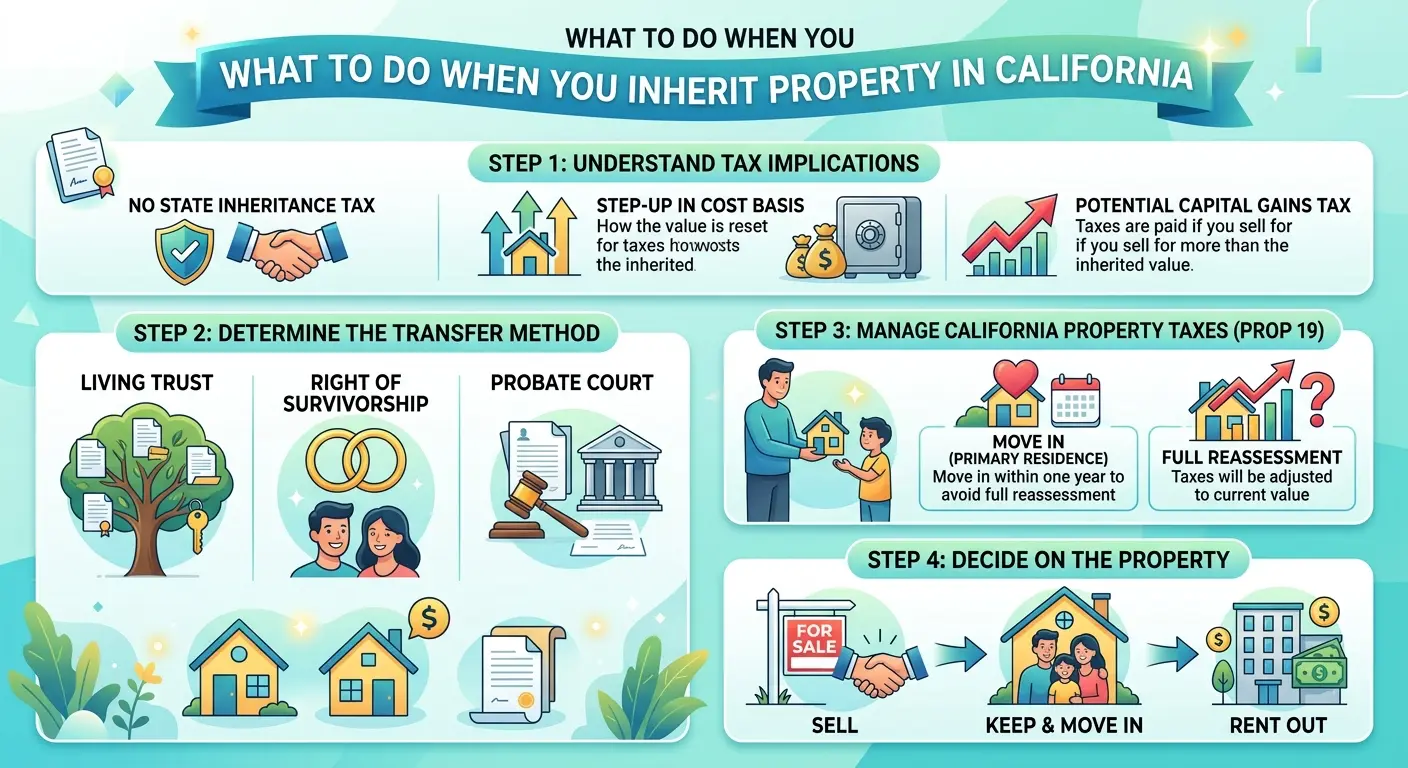
Inheriting real estate in California is often a life-changing financial event. With California home prices historically outstripping national averages, receiving a residential or commercial property can substantially increase your net worth. However, California’s tax code, property reassessment laws, and probate rules create an intricate landscape.
Making the wrong move—such as missing a tax exclusion filing deadline or improperly transferring title—can result in devastating capital gains taxes or an immediate, multi-thousand-dollar surge in annual property taxes. This guide details everything you need to know: determining ownership transfer, navigating California property tax laws, managing federal and state capital gains, and choosing the right long-term strategy for the property.
1. Determine the Transfer Method & Legal Authority
Before you can sell, rent, or move into an inherited California home, you must establish who has the legal authority to sign documents, pay bills, and manage the title. How the deceased individual titled the asset determines the path forward.
Option A: Revocable Living Trust (Non-Court Transfer)
If the property was held in a Living Trust, it bypasses court oversight entirely.
- The Role: The designated Successor Trustee assumes management authority.
- The Process: The trustee records an Affidavit of Change of Trustee with the County Recorder alongside a certified copy of the death certificate.
- Powers: Once recorded, the trustee can immediately manage, rent, distribute, or sell the property according to the terms of the trust document without seeking permission from a judge.
Option B: Right of Survivorship / Community Property
When a co-owner or spouse dies, the title may pass directly to the surviving owner outside of probate.
- Joint Tenancy: Transfers automatically to surviving joint tenants via an Affidavit of Death of Joint Tenant.
- Community Property with Right of Survivorship: Transfers to the surviving spouse while retaining distinct tax advantages.
- The Process: Filing the appropriate affidavit with the county recorder clears the deceased owner's name off the deed.
Option C: Court-Supervised Probate
If the decedent owned the property in their individual name with no trust or survivorship deed, the asset must go through probate.
- The Process: A petition is filed in the Superior Court of the county where the property is located.
- The Authority: The court appoints a personal representative (Executor if there’s a will, Administrator if there isn't) and issues Letters Testamentary or Letters of Administration.
- Timeline: Probate in California typically takes 9 to 18 months (or longer). You cannot sell or transfer the deed until the court grants specific authority, often through the Independent Administration of Estates Act (IAEA).
2. Navigating California Property Taxes: Understanding Proposition 19
Perhaps the biggest pitfall for heirs in California is the property tax reassessment rules under Proposition 19. Historically, California parents could pass their primary residence and up to $1 million in assessed value of other real estate to their children without triggering a property tax increase. Proposition 19 eliminated those blanket protections.
The Core Rules Under Proposition 19
- Investment & Commercial Properties Are Fully Reassessed: Inherited rental properties, vacation homes, and commercial buildings are reassessed at full fair market value on the date of death. Property taxes will immediately adjust up to current market rates.
- Primary Residence Exception: A child (or grandchild, if parents are deceased) can preserve a portion of the parent’s low Proposition 13 tax base only if:
- The home was the parent’s primary residence.
- The child moves in and establishes the home as their own primary residence within 12 months of the date of death.
- The child files a Homeowners' Exemption with the county assessor within that 12-month window.
The Proposition 19 Exemption Cap Calculation
Even if you move in, the exclusion is not unlimited. It protects the original assessed value plus an indexed cap ($1,044,586 for transfers occurring between Feb 16, 2025, and Feb 15, 2027).
Formula:
New Assessed Value = Parent's Assessed Base + Max (0, Market Value − Parent's Assessed Base − Statutory Cap)
Example: A parent bought a San Jose home in 1990 for $200,000, and its taxable assessed value is $300,000. At death, the home is worth $2,000,000.
- Cap Limit: $300,000 + $1,044,586 = $1,344,586
- Excess Over Cap: $2,000,000 − $1,344,586 = $655,414
- Adjusted Assessed Value: $300,000 + $655,414 = $955,414
The child saves tax dollars compared to full reassessment at $2M, but the assessed value still increases from $300,000 to $955,414.
3. Federal & State Income Tax: Stepped-Up Basis Explained
While inheriting property can complicate local property taxes, income tax rules for inherited real estate offer significant advantages.
The Federal Stepped-Up Basis (IRC § 1014)
When you inherit property, its cost basis for capital gains tax purposes resets ("steps up") from the decedent's original purchase price to the Fair Market Value (FMV) as of the owner's exact date of death.
| Ownership History | Basis Calculation | Capital Gain Upon Immediate Sale |
|---|---|---|
| Purchased 1980: $150,000 FMV at Death: $1,500,000 |
New Stepped-Up Basis: $1,500,000 | Sale Price ($1,500,000) − New Basis ($1,500,000) = $0 Taxable Gain |
If you sell the home shortly after inheriting it, you will generally owe zero capital gains tax.
California’s "Double Step-Up" for Community Property
California is a community property state. Under Internal Revenue Code § 1014(b)(6), if a married couple owns real estate as Community Property, the entire property gets a 100% basis step-up upon the death of the first spouse—not just the 50% share belonging to the deceased.
- Joint Tenancy Trap: If a married couple holds title as "Joint Tenants," the IRS and California Franchise Tax Board (FTB) may only allow a 50% step-up in basis.
- Community Property Advantage: Titling as "Community Property with Right of Survivorship" provides the smooth, non-probate transfer of joint tenancy alongside a 100% double step-up in basis.
No Inheritance or Estate Tax in California
- State Level: California has no state inheritance tax and no state estate tax.
- Federal Level: The federal estate tax exemption ($15 million per individual in 2026) means only multi-million-dollar ultra-high-net-worth estates trigger federal estate taxes.
4. The 5 Steps to Take Immediately Upon Inheritance
Executing the administrative process properly prevents costly legal or municipal errors.
- Step 1: Secure and Preserve the Property (Days 1–7)
Lock the physical premises, forward mail, secure personal valuables, and ensure ongoing utility services (water, gas, electric) remain active. Do not remove furniture or alter the estate until legal ownership authority is clarified. - Step 2: Update Property Insurance Policies (Days 7–14)
Homeowners insurance policies automatically expire or change terms shortly after an owner's death. Contact the insurer immediately to notify them of the death and transition the coverage to a Vacant Home Policy or Landlord/Trustee Policy. Standard policies often deny claims if a home sits unoccupied for over 30 days. - Step 3: Order a Professional Date-of-Death Appraisal (Days 14–30)
Hire an independent, California-licensed real estate appraiser to establish the Fair Market Value (FMV) as of the exact date of death. This official report serves as legal proof of your new stepped-up basis for both the IRS and FTB, protecting you against future audit disputes. - Step 4: File Assessor Notifications (Within 150 Days)
California Revenue and Taxation Code Section 480 requires heirs to file a Change in Ownership Statement - Death of Real Property Owner (BOE-502-D) with the county assessor within 150 days of the date of death. If applying for Prop 19 benefits, also file Form BOE-19-B. - Step 5: Determine Title Authority and Clear Liens
Review the preliminary title report. Identify outstanding mortgages, reverse mortgages, property tax liens, or Medi-Cal estate recovery claims. Ensure mortgages are paid current to prevent foreclosure while decisions are made.
5. Strategic Options: Sell, Rent, Keep, or Buy Out Co-Heirs
Once legal authority is cleared and values are set, you face the core strategic choice: what should you do with the property?
| Decision Strategy | Primary Financial Benefit | Primary Risk or Challenge | Ideal Scenario |
|---|---|---|---|
| Sell Immediately | Cash liquidity with minimal to no capital gains tax due to stepped-up basis. | Forfeiting future real estate market appreciation. | Multiple co-heirs who prefer cash distributions over property management. |
| Rent Out Property | Long-term passive rental income and ongoing property appreciation. | Full Proposition 19 property tax reassessment, tenant laws, and maintenance costs. | Low debt on property, cash-flow focus, willingness to act as a landlord in CA. |
| Move In (Primary) | Preserves low Prop 13 property tax base (up to Prop 19 statutory cap). | Must commit to residing in the home within 12 months as primary residence. | Sole heir or heir willing to buy out siblings who needs a primary home. |
Managing Co-Heirs and Buyout Options
Inheriting property alongside siblings or relatives can lead to disagreements over whether to sell or keep the asset.
- Promissory Note / Refinance Buyout: One heir refinances the property or takes out a mortgage to pay the remaining siblings their equal share of equity based on the appraisal value.
- Parent-to-Child Trust Loan: To avoid triggering a premature Prop 19 reassessment during a sibling buyout, the trustee can take out a non-recourse loan against the trust assets to equalize cash distributions to non-keeping siblings before distributing the deed.
- Partition Action: If co-heirs reach an impasse and cannot agree on a buyout or sale, any co-owner can file a court petition called a Partition Action, which legally forces the sale of the property on the open market.
6. Real-World Case Studies
Scenario A: Sibling Inheritance Under Prop 19
The Situation: Sarah and Mark inherit their mother’s home in San Diego, valued at $1.2M. The mother’s assessed Prop 13 value was $250,000. Sarah wants to move in; Mark wants his cash share.
The Action: Sarah buys out Mark’s 50% share ($600,000) using a new mortgage. Sarah moves into the home within 9 months, makes it her primary residence, and files Form BOE-19-B with the San Diego Assessor.
The Tax Result: Because Sarah moved in as a primary resident, Prop 19 cap protection applies. The original $250k tax base plus the $1.044M cap ($1.294M total) covers the $1.2M value entirely. Sarah keeps her mother's original low property tax rate.
Scenario B: Inheriting an Investment Rental
The Situation: Alex inherits a duplex in Los Angeles worth $1.8M that his father used as a rental property. Original purchase price: $300,000.
The Action: Alex chooses to keep the rental property.
The Tax Result:
- Property Tax: Because it is an investment rental property, Prop 19 allows no primary residence exclusion. The LA County Assessor reassesses the duplex at full $1.8M market value, causing property taxes to jump from ~$4,000 to ~$22,000 annually.
- Capital Gains / Basis: Alex’s income tax basis steps up from $300,000 to $1.8M. Alex can now restart the federal depreciation schedule based on the new $1.8M value, offering massive income tax write-offs to offset rental income.
7. Action Checklist for California Heirs
- Obtain 5–10 certified copies of the Death Certificate.
- Identify how title is held (Trust, Joint Tenancy, Individual).
- Hire an appraiser to perform a date-of-death valuation report.
- Switch insurance to a vacant or landlord policy.
- Submit BOE-502-D (Change in Ownership Statement) within 150 days.
- File BOE-19-B within 12 months if claiming primary residence exclusion under Prop 19.
- Consult a California estate planning attorney and CPA before signing deeds or list agreements.
8. Frequently Asked Questions (FAQs)


Paul Burrowes, CRS, CCEC, SFR, NHCP, LHC, REALTOR® With over fifteen years of experience and an elite list of credentials, Paul Burrowes is a REALTOR® dedicated to merging deep local expertise with modern innovation. Paul leverages the latest technology and AI-driven insights to provide his clients with the most accurate, data-rich information available in the Santa Cruz, Monterey, Santa Clara, and Silicon Valley markets. He serves as a personal adviser, skilled negotiator, and detail-oriented advocate, ensuring every transaction—from initial question to final signature—goes off without a hitch. Contact Paul at paul@burrowes.com, (831) 295-5130, (408) 497-3989, or DRE# 01955563.
Disclaimer: This article was developed with the assistance of AI technology to synthesize market data, then reviewed, edited, and verified for accuracy by Paul Burrowes to ensure it meets the highest professional standards.
Inheritance & Estate Attorneys (Santa Cruz & Santa Clara Counties)
Santa Cruz County
- Website: santacruzlegal.net
- Email: AngelHess@SantaCruzLegal.net
- Phone: (831) 426-8536
- Website: buchbinderlaw.com
- Email: emily@buchbinderlaw.com
- Phone: (831) 462-1313
- Website: pcg-llp.com
- Email: spenrose@pcg-llp.com / echun@pcg-llp.com
- Phone: (831) 515-3344
- Website: cormanlaw.net
- Email: CormanLaw@gmail.com
- Phone: (831) 427-2414
- Website: lawjac.com
- Email: jc@lawjac.com
- Phone: (831) 515-7540
- Website: lisagreenburglaw.com
- Email: greenburglaw@gmail.com
- Phone: (831) 227-3324 (cell)
Santa Clara County
- Website: gomezedwardslawgroup.com
- Email: admin@gomezedwardslawgroup.com
- Phone: (408) 413-1200
- Website: kaiwesselslaw.com
- Email: kaiwessels@wesselslaw.com
- Phone: (408) 705-4577
- Website: springerlawfirm.com
- Email: Online Contact Form
- Phone: (408) 706-7348
- Website: brotherssmithlaw.com
- Email: info@brotherssmithlaw.com
- Phone: (925) 944-9700
- Website: breretonlawoffice.com
- Email: ajm@brereton.law
- Phone: (831) 429-6391
Enjoy this blog post? Click here to subscribe for updates
Leave A Comment