

Table of Contents
- 1. Find Out What Was Actually Remodeled
- 2. Investigate Water Management, Not Just the Roof
- 3. Look Closely at Windows, Doors, and Exterior Transitions
- 4. Examine Drainage and Grading Around the Property
- 5. Ask What Happened Behind the Walls
- 6. Understand the Materials Chosen for a Coastal Environment
- 7. Don't Confuse a Beautiful Remodel With a Complete One
- A Remodeled Home Deserves a Different Kind of Inspection
- The Real Value Is Beyond the Finishes
- About the Author
A beautifully remodeled home can make an immediate impression. New windows, a designer kitchen, updated bathrooms, fresh flooring, and carefully selected finishes can make a property feel move-in ready.
But for buyers in Coastal California, what looks new on the surface does not always tell the full story.
A remodel can dramatically improve a home's appearance and functionality, but the quality of the work behind the finishes matters just as much. Coastal properties face particular challenges from moisture, salt-laden air, wind-driven rain, aging infrastructure, drainage issues, and the demands of maintaining a home in a challenging environment.
That does not mean buyers should be suspicious of remodeled homes. It means they should look beyond the visual transformation.
Before purchasing a recently renovated property, here are 7 construction-related areas worth investigating.
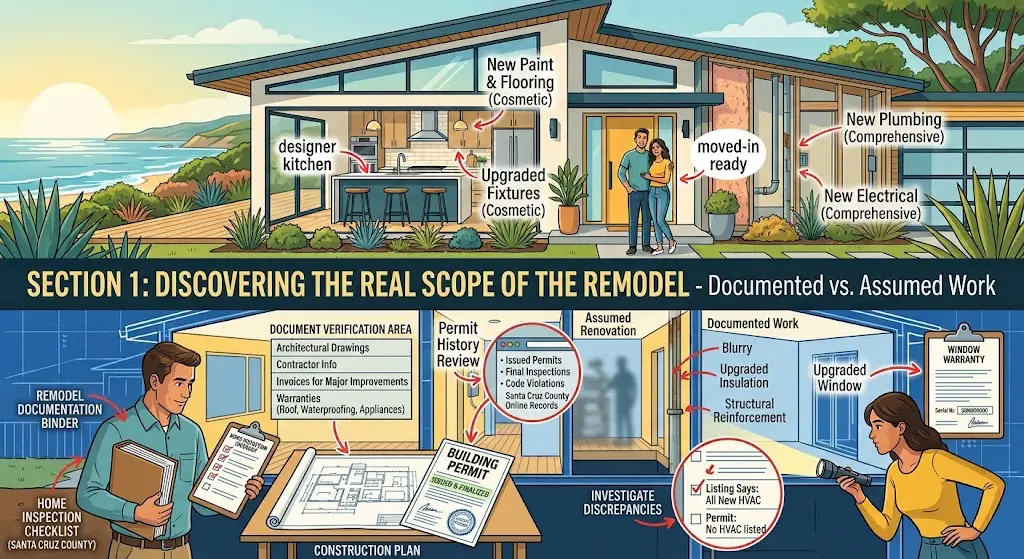
1. Find Out What Was Actually Remodeled
The word "remodeled" can mean very different things.
In one home, it may mean new paint, flooring, fixtures, and appliances. In another, it may involve opening walls, replacing plumbing and electrical systems, upgrading windows and doors, modifying the roof, improving insulation, or completely reconfiguring the floor plan.
Ask for a clear scope of work showing what was changed and when.
If possible, request:
- Construction plans or architectural drawings
- Building permits and final inspections
- Contractor information
- Invoices or documentation for major improvements
- Warranties for roofing, windows, appliances, waterproofing, and other significant components
- Information about structural or mechanical upgrades
This documentation can help you distinguish between a cosmetic refresh and a more comprehensive renovation.
Permit history deserves particular attention when buying a remodeled home. In unincorporated Santa Cruz County, records can show issued and finalized permits, code violations, and discretionary projects. Buyers can use the County’s online records to verify whether major renovations, additions, or structural changes were properly documented and finalized.
For a practical starting point, a home inspection checklist for Santa Cruz County can help organize your due diligence. Compare permit records with the improvements described in the listing and visible in the home, and investigate any discrepancies before moving forward.
2. Investigate Water Management, Not Just the Roof
In a coastal environment, water management deserves special attention.
A roof may look new, but moisture problems can originate in many other places: around windows and exterior doors, at decks, where different materials meet, around penetrations, or where the building meets the ground.
During an inspection, look for signs such as:
- Staining around windows or ceilings
- Soft or deteriorated exterior materials
- Peeling paint or damaged finishes
- Musty odors
- Cracking or separation around exterior transitions
- Evidence of previous water intrusion
- Improperly directed downspouts
- Standing water near the foundation
The goal is not simply to determine whether the home has experienced a leak. It is to understand how effectively the property's exterior assemblies are designed to manage water.
A whole-home remodel should ideally address the building envelope rather than simply conceal evidence of older problems.
For buyers, this is one reason a standard home inspection and, when appropriate, a more specialized evaluation can be valuable. A home can look completely finished while still having vulnerabilities that are difficult to see during a casual walkthrough.
3. Look Closely at Windows, Doors, and Exterior Transitions
New windows and doors are popular upgrades in remodeled coastal homes, but the products themselves are only part of the equation.
Installation matters.
The transition between a window or door and the surrounding wall needs to be properly integrated with the home's water-management system. The same principle applies where decks, balconies, siding, stucco, roofing, and other exterior materials meet.
These transition points can become vulnerable when a remodel combines new materials with an older structure.
Ask:
- Were the windows and doors part of the recent remodel?
- Were surrounding assemblies opened or replaced?
- Was water intrusion discovered during construction?
- Are there records showing how the installation was completed?
- Are warranties or product information available?
A high-end window does not compensate for poor installation. The performance of the overall assembly matters more than the appearance of the individual product.
4. Examine Drainage and Grading Around the Property
Some of the most important construction decisions happen outside the house.
Walk the property after, or preferably during, wet weather if possible. Look at how water moves around the site.
Pay attention to:
- Sloping ground near the foundation
- Downspout discharge locations
- Retaining walls
- Drainage channels
- Areas where water appears to collect
- Soil erosion
- Lower-level rooms or foundations
- Landscaping that directs water toward the structure
Coastal and hillside properties can make drainage particularly important because site conditions vary considerably from one property to another.
A remodel may have transformed the interior while leaving an underlying drainage issue untouched.
This is also where buyers should resist the temptation to focus only on the home's finished square footage and visual appeal. A beautiful kitchen is easy to appreciate. Effective site drainage is not. Yet drainage can have a much greater impact on long-term maintenance and building performance.
5. Ask What Happened Behind the Walls
Some of the most valuable improvements in a remodel are the ones you cannot see.
If walls were opened during construction, were the home's electrical, plumbing, insulation, or ventilation systems upgraded at the same time?
Ask whether the remodel included:
- Electrical panel or wiring upgrades
- Plumbing replacement
- New supply or drain lines
- HVAC improvements
- Improved bathroom ventilation
- Insulation upgrades
- Structural reinforcement
- New water-heating equipment
- Changes to gas or mechanical systems
Older homes can have a combination of original systems and newer components. That is not necessarily a problem, but buyers should understand the relationship between them.
For example, a new kitchen with beautiful cabinetry and appliances may still depend on older plumbing or electrical infrastructure that was never intended to support the updated space.
Documentation from the renovation can help answer these questions. If the seller or listing agent cannot provide much information, that does not automatically make the property a bad purchase. It simply means the buyer may need to investigate further.
6. Understand the Materials Chosen for a Coastal Environment
Coastal California is not one uniform environment.
A property directly exposed to ocean air may experience very different conditions from a home farther inland or protected by surrounding terrain. Salt exposure, humidity, wind, sunlight, and moisture can all influence how exterior materials perform over time.
This makes material selection important.
Ask what was used for exterior hardware, fasteners, railings, doors, windows, decking, roofing details, and other exposed components.
Corrosion resistance is particularly relevant around properties with significant exposure to salt air. Materials that perform well in one environment may require more maintenance in another.
The same thinking applies to exterior wood, coatings, sealants, flashing, and other components.
The objective is not to find a home where every material is maintenance-free. No coastal home is. Instead, buyers should understand whether the renovation choices were appropriate for the property's specific exposure.
7. Don't Confuse a Beautiful Remodel With a Complete One
Perhaps the most important question is also the simplest:
What did the remodel solve, and what did it leave behind?
A renovation is often completed in phases. There are many decisions that determine whether the remodel goes well. A homeowner may have prioritized the kitchen and bathrooms while postponing the roof, drainage, windows, mechanical systems, or other less visible improvements.
There is nothing inherently wrong with that approach.
The problem occurs when buyers assume "fully remodeled" means every major component of the property has been addressed.
Before making an offer, create a simple renovation inventory:
Recently upgraded:
What was replaced or substantially improved?
Previously upgraded:
Which major systems were addressed before the most recent remodel?
Original:
Which components remain from the home's earlier construction?
Unknown:
Which areas lack sufficient documentation?
This gives you a much clearer picture of the property's actual condition.
A Remodeled Home Deserves a Different Kind of Inspection
Buying a remodeled home is not necessarily about looking for reasons to walk away. It is about understanding what you are buying.
A thoughtful renovation can eliminate years of deferred maintenance, improve energy efficiency, modernize outdated systems, and make a home significantly more functional. But those benefits are easier to appreciate when the buyer knows what was actually done.
California's Contractors State License Board provides an online licence-checking service that buyers can use to research a contractor’s licence status and related public information. This can be useful when researching the professionals involved in substantial renovation work.
For properties with extensive renovations, it may also be worthwhile to go beyond a standard inspection when circumstances warrant it. Depending on the property, additional specialists may be appropriate for areas such as structural conditions, roofing, drainage, electrical systems, or other components.
The Real Value Is Beyond the Finishes
Coastal California homes are valuable partly because of their setting. Ocean views, natural light, indoor-outdoor living, and distinctive architecture can make these properties exceptionally appealing.
But those same environmental conditions can make construction quality especially important.
When evaluating a remodeled home, look beyond the countertops and tile. Ask how the building manages water. Find out what happened behind the walls. Review permits and project documentation. Examine drainage. Consider the materials used outside. And determine which major systems were actually upgraded.
The best remodels are not simply the ones that photograph beautifully.
They are the ones where the improvements continue to perform long after the final coat of paint has dried.
For buyers, understanding that distinction can lead to better questions, better due diligence, and ultimately a more informed real estate decision.
About the Author
Denali Builders & Design is a California-based residential construction and design company specializing in home renovations, additions, kitchens, bathrooms and whole-home transformations. The team approaches renovation with an emphasis on thoughtful planning, construction quality and creating spaces designed to perform as well as they look.
Posted by Paul Burrowes onEnjoy this blog post? Click here to subscribe for updates
Leave A Comment