
Entitlements and Subdivisions in Santa Cruz County
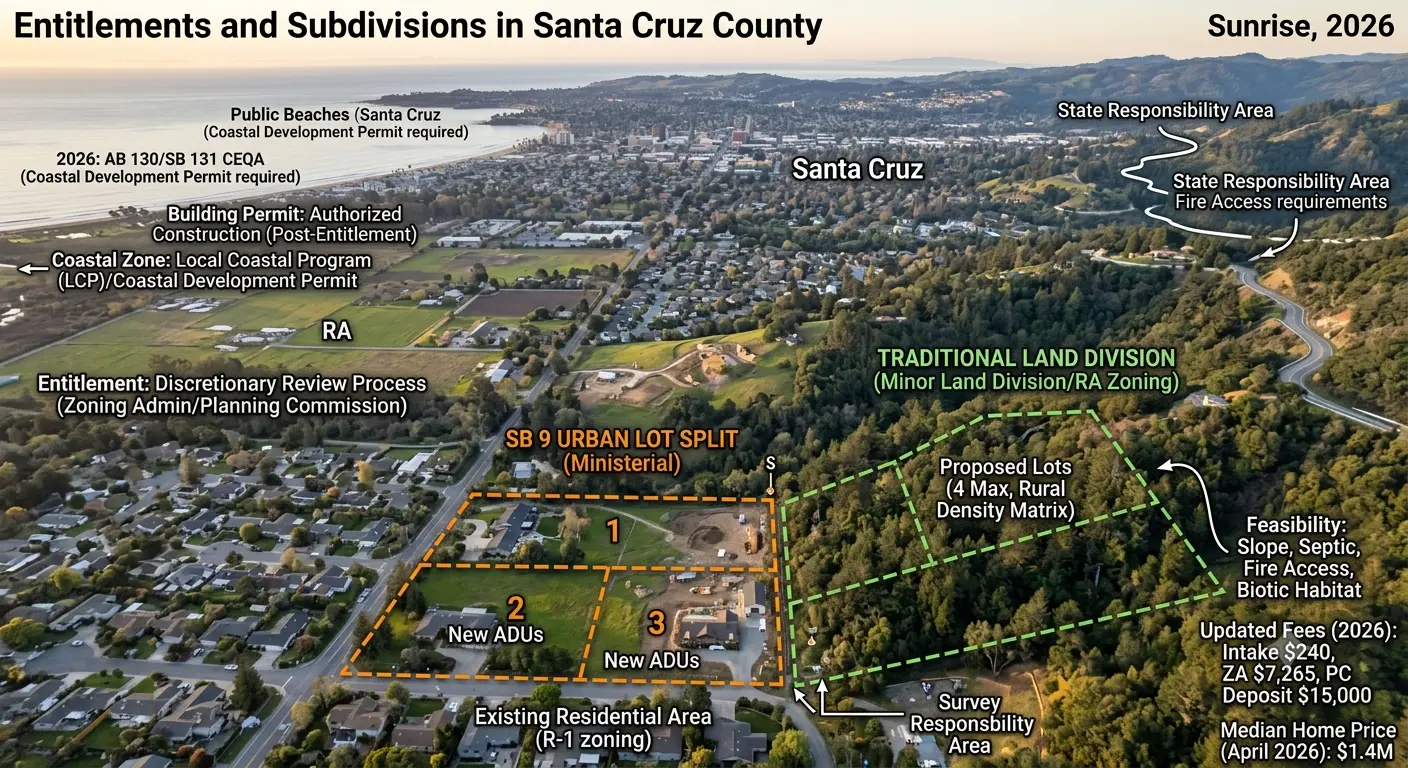
If you own land in Santa Cruz County, you've probably run into two words that shape almost everything you can or can't do with it: entitlement and subdivision. One determines whether you have the legal right to build. The other determines whether you can split one parcel into several. In 2026, both processes are being reshaped by new state housing laws, a countywide fee update, and an Annual Code Update to the General Plan and Local Coastal Program — which makes this a good moment to get a clear picture of how the two fit together.
This guide walks through what an entitlement is, how subdivision works under SB 9 and traditional county rules, what the 2026 legislative changes mean for your timeline, and roughly what it costs. It's written for landowners, small builders, and buyers who want to understand the mechanics before they commit money to engineers, surveyors, or an application fee.
The two processes overlap more than people expect. A parcel might need to be subdivided before it can be entitled for its highest use or entitled first so the resulting lots are worth more once split. Either way, the same county departments, the same fee structure, and many of the same physical constraints — slope, septic, fire access — apply to both. Understanding one makes the other easier to plan around.
Table of Contents
- Key Takeaways
- What "Entitlement" Actually Means
- Subdividing Property: SB 9 vs. Traditional Land Divisions
- The 2026 Legislative Landscape
- What It Costs: Fees and Financial Planning for 2026
- Site Constraints That Can Derail a Project
- The Process, Start to Finish
- Working with the Right Team
- Frequently Asked Questions
Key Takeaways
- An entitlement is the legal right to use land a certain way; a building permit is the separate, later step of authorizing construction. Most significant projects require discretionary review, not just a checklist.
- Subdividing a parcel can happen two ways: a ministerial SB 9 urban lot split, which skips public hearings, or a traditional minor land division, which goes through the Planning Commission.
- 2026 brought real changes — AB 130 and SB 131 narrow the reach of CEQA for qualifying housing projects, and the county's new Objective Design Standards replace some of the old subjective review with measurable rules.
- Fees were updated on February 27, 2026, and they add up fast: intake fees start at $240, Zoning Administrator review starts around $7,265, and Planning Commission-level projects carry deposits near $15,000, before engineering and environmental studies.
- Site conditions — slope stability, septic capacity, fire access, and protected habitat — decide feasibility as much as zoning does, and they're worth checking before you spend on formal applications.
What "Entitlement" Actually Means
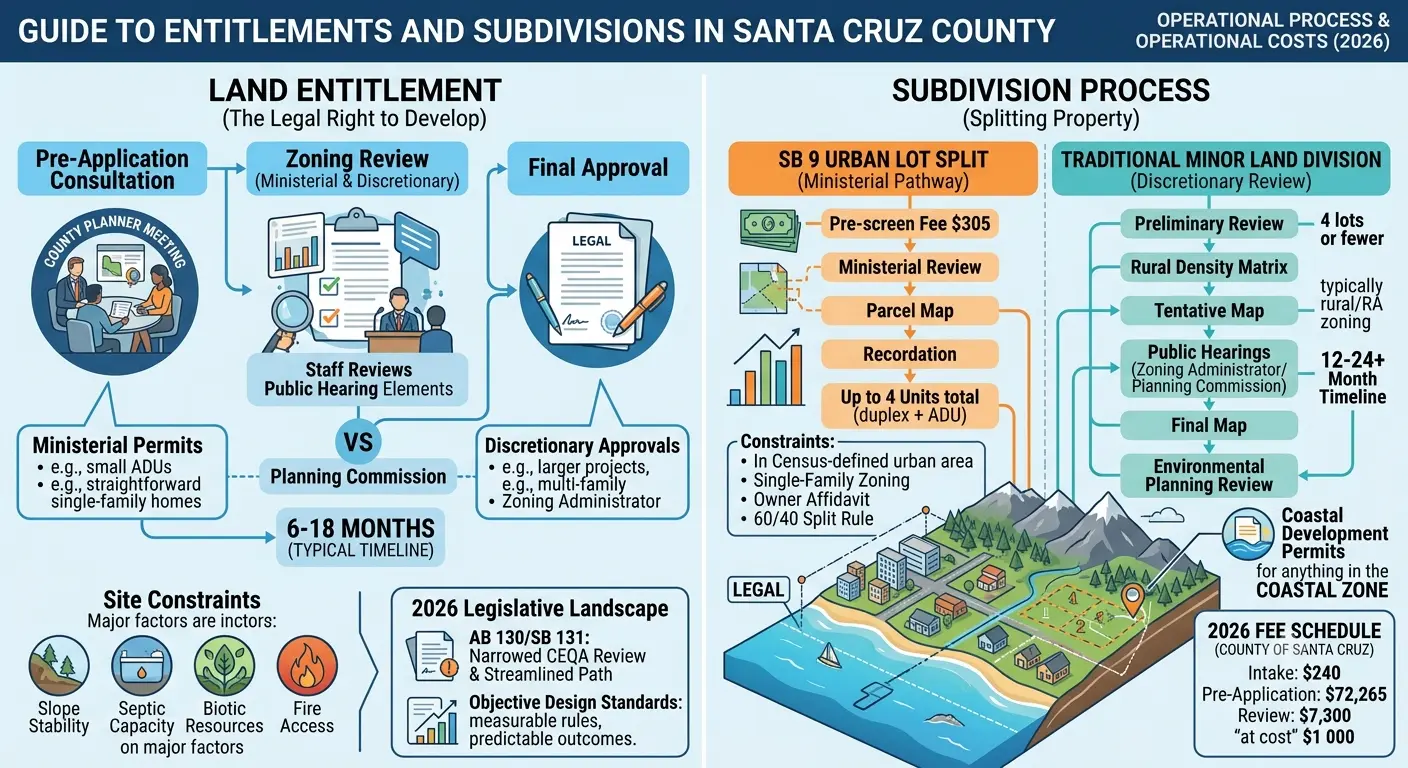
An entitlement is the legal right to develop a piece of land for a specific use — it's separate from, and comes before, a building permit. Until a parcel has that approval, it's limited to whatever its current zoning and General Plan designation already allow.
The first distinction worth understanding is between ministerial permits and discretionary approvals. Ministerial permits are close to automatic: meet the objective standards in the code, and the permit gets issued. Discretionary approvals are different. They go through county staff, sometimes a Zoning Administrator, sometimes the Planning Commission, and the outcome depends partly on judgment calls, not just a checklist. This is where most of the real risk in a project sits, and where a strong application and a track record with staff make a difference.
It also matters whether your parcel falls under the City of Santa Cruz or the County — they run separate planning departments with different fee schedules and different informal norms. Ocean-facing and coastal-adjacent parcels add another layer, since anything in the Coastal Zone has to comply with the Local Coastal Program and, in some cases, go through the California Coastal Commission as well.
There's a real value difference, too, between land that's entitled and land that isn't. A parcel with its discretionary approvals already in hand removes a lot of the uncertainty a buyer or lender would otherwise have to price in, which is part of why entitled lots tend to command a premium over raw ones with the same zoning.
Getting to that point usually comes down to the relationship between an applicant and the assigned planner. Their recommendation in the Staff Report carries real weight when a project reaches the Zoning Administrator or Planning Commission, and it's shaped by how clearly and completely the application answers questions before they're asked. Projects that show up with vague site plans or unaddressed technical gaps tend to generate more scrutiny, not less — the review process rewards preparation more than persistence.
Subdividing Property: SB 9 vs. Traditional Land Divisions
Subdivision is the legal separation of one parcel into two or more parcels, each with its own title, its own Assessor Parcel Number, and its own development rights. With Santa Cruz County's median home price reaching $1,400,000 in April 2026, splitting an oversized lot into two buildable parcels can unlock real value — but which path you take depends on where the property sits and how it's zoned.
SB 9 urban lot splits offer a ministerial path, meaning no public hearing and no discretionary review, provided the parcel qualifies. To use it, the property has to sit in a census-defined urban area and carry single-family zoning. The owner has to sign an affidavit committing to live in one of the resulting units for at least three years. The two new lots also have to follow a 60/40 split — neither can be smaller than 40% of the original parcel — and each new lot has to be at least 1,200 square feet. The county's SB 9 pre-screen fee is $305, which is a low bar to entry, but the objective design standards attached to it leave little room to negotiate if your layout doesn't fit.
Traditional minor land divisions apply to everything SB 9 doesn't cover — typically parcels in RA (Residential Agriculture) or rural R-1 zones. These go through the Planning Commission and public hearings, and the county's Rural Density Matrix sets how many parcels a piece of land can be split into based on slope, septic capacity, and water availability. Coastal Zone parcels need a Coastal Development Permit on top of standard subdivision approval, since the California Coastal Commission has jurisdiction over anything that could affect public access or sensitive habitat.
One useful way to think about it: SB 9 works when you already qualify on paper. Traditional subdivision is for everything else, and it comes with a longer timeline, more required studies, and more room for a project to run into local objections. Either way, it's worth confirming which category your parcel falls into before assuming a timeline or budget — a "paper-ready" lot is only worth something if it can actually be built on.
There's also a decision worth making early about what happens after the split: hold the new parcels as long-term investments, sell them raw and entitled, or build on them yourself. Each path changes how much further entitlement work is worth doing before you sell, and each carries different tax exposure once construction or a sale triggers reassessment. It's worth thinking through before the map is even drawn, since it affects how much you invest in the entitlement side versus stopping once the lots are legally separate.
The 2026 Legislative Landscape
Several state and local changes are reshaping both entitlement and subdivision timelines this year, and most of them push in the direction of more predictability for projects that meet objective standards.
AB 130 and SB 131 narrow when CEQA's full environmental review applies. AB 130 provides statutory exemptions for certain qualifying urban housing developments, letting them skip the traditional environmental impact report process. SB 131 gives projects that narrowly miss a full exemption a streamlined review pathway instead of the multi-year process CEQA has historically required. You still have to address geological and biotic issues on a case-by-case basis, but the administrative record is lighter for projects that qualify. The public comment period on the AB 130 Statewide VMT Mitigation Program closed on May 8, 2026, another sign of the state moving toward standardized mitigation rather than site-by-site litigation.
The Housing Accountability Act (HAA) limits how much a local agency can lean on vague "neighborhood character" objections to deny housing that already meets General Plan density requirements. That's reinforced locally by the county's move toward Objective Design Standards, which swap out some of the old subjective architectural review for measurable rules — setbacks, height limits, and materials requirements that either are or aren't met, rather than left to a commission's taste.
The California State Density Bonus Law remains one of the more useful tools for maximizing what a parcel can hold: it allows unit counts above base zoning in exchange for including affordable housing components, and it's increasingly paired with ADU strategies on multi-unit projects.
Locally, the county's 2026 Annual Code Update — worked through in public hearings in April and May — amended both the General Plan and the Local Coastal Program. It's aimed at reconciling state housing mandates with the county's environmental and character goals, and it's the reason fee schedules, design standards, and some review procedures all shifted this year.
ADUs deserve a separate note: most accessory dwelling units in Santa Cruz County are now reviewed ministerially rather than through discretionary hearings, provided they meet objective standards, since the state has continued to prioritize ADU production to address the housing shortage. Coastal Zone parcels and lots with meaningful biotic constraints may still need specific clearances first.
What It Costs: Fees and Financial Planning for 2026
Santa Cruz County updated its planning fee schedule on February 27, 2026, and the numbers are worth knowing before you file anything.
For entitlement applications: intake fees start at $240. Projects requiring Zoning Administrator review start around $7,265. Planning Commission-level projects carry "at cost" deposits starting at $15,000. An Initial Study, if your project needs one, carries its own $5,000 deposit. On top of the base fees, technology and maintenance surcharges add roughly 13%.
For subdivisions: County intake is also $240, with pre-application review ranging from $1,210 for minor projects to $2,420 for major ones. Environmental Planning Review for land divisions runs $965 for urban parcels and $1,935 for rural ones — rural parcels cost more to review because they're more likely to need septic and water-availability analysis. Within the City of Santa Cruz specifically, subdividing four lots or fewer carries a base fee of $10,201 plus a 6% technology surcharge. County planner time, where billed hourly, currently runs $242.18/hour.
Beyond the fee schedule, budget for the "soft costs" that don't show up on the county's list — civil engineers, biotic and geological consultants, licensed surveyors, and the time it takes to respond to a Request for Additional Information if your first submittal comes back incomplete (which is common, not exceptional). A grading review deposit, for instance, is typically another $5,000 "at cost." It's also worth building in a contingency specifically for unplanned technical reports, since slope or habitat issues that surface mid-review can add real cost and time.
Subdivision also has a longer-term financial wrinkle: splitting a parcel generates new Assessor Parcel Numbers and separate tax bills, and while the split itself usually doesn't trigger a full assessment, any later construction or sale of the new parcels will be reassessed at current market value.
A reasonable rule of thumb: budget for the published fees, then add another 20-30% on top for the soft costs the fee schedule doesn't capture — engineering revisions, a second round of environmental review if the first comes back with questions, and the carrying costs of however many months the process actually takes. Projects that go in assuming the published fee is the whole budget are usually the ones that run short partway through review.
Site Constraints That Can Derail a Project
Zoning tells you what's allowed on paper. The land itself often has the final say. A handful of physical constraints show up again and again as the reason projects stall or get denied:
- Slope stability and landslide hazard zones: Steep terrain in the Santa Cruz Mountains often requires retaining structures and additional engineering that can significantly change a project's economics.
- Septic and water capacity: Any lot not on sewer service needs Environmental Health Department clearance showing adequate leach field capacity and room for a secondary expansion area — for every new lot created, not just the original parcel.
- Biotic resources: Sensitive habitats, including Sandhills and riparian corridors, typically require setbacks that reduce the usable building envelope.
- Fire access: Parcels within State Responsibility Areas have specific road width and turnaround requirements that need to be built into the tentative map from the start, not added later.
Running these checks early — before a full application, ideally before hiring a full design team — is the single best way to avoid finding out six months in that a project isn't viable as drawn. A short preliminary study, even an informal one, that pulls slope maps, habitat overlays, and septic records for the parcel usually costs a fraction of what a full engineering package runs, and it tells you quickly whether the project as imagined is realistic or needs to be scaled back before more money goes into it.
The Process, Start to Finish
Whether you're entitling a project or subdividing a parcel, the sequence looks similar, even if the details differ.
- Feasibility and preliminary survey: For entitlement, this means checking slope, biotic resources, and septic capacity against your intended use. For subdivision, it starts with a formal boundary survey to confirm the proposed lot lines are legally and physically sound. Either way, this phase catches the problems that are cheapest to fix before any money goes into design.
- Design and technical documentation: Architects, civil engineers, and surveyors produce the plans, grading studies, and drainage analysis the county will actually review. For subdivisions, this is where a Parcel Map (for four or fewer lots) or Subdivision Map (for larger projects) gets prepared.
- Submittal and the "Deemed Complete" milestone: Getting an application formally deemed complete is a real legal threshold — it starts the statutory review clock and locks in some protection against mid-review policy changes. Expect at least one round of a Request for Additional Information; it's rare for a complex application to be accepted as complete on the first pass.
- Discretionary review: If your project needs a hearing, this is where the Zoning Administrator, Planning Commission, or Board of Supervisors reviews the Staff Report and hears public testimony. Neighborhood concerns can move quickly here, so outreach before this stage — not during it — tends to matter more than anything said in the hearing itself.
- Approval and recordation: For entitlements, final approval clears the way for building permits. For subdivisions, the last step is recording the Final Map with the County Recorder, which is what creates the new Assessor Parcel Numbers and finalizes the separation of titles.
Timelines vary widely. Discretionary entitlements typically run six to eighteen months, longer for projects needing a full Environmental Impact Report or facing organized opposition. Traditional subdivisions run 12 to 24 months from tentative map to recordation; SB 9 splits are designed to move faster, with a 60-day county review window once the application is deemed complete, though the preliminary survey and mapping phase still adds several months up front.
Working with the Right Team
None of this happens with one person filling out a form. A realistic project team includes a land surveyor, civil engineer, and often a biologist or geologist, coordinated by someone who can translate between the technical work and what county staff actually need to see. Establishing a relationship with the Community Development Infrastructure department before formal submittal — resolving technical questions in conversation rather than through a formal RFI — tends to save real time later.
The most common failure mode isn't a bad project; it's an unprepared one. Projects get denied or stalled far more often because of unaddressed slope instability, biotic conflicts, or a Staff Report that flags concerns nobody responded to, than because the underlying idea was flawed. A feasibility study that catches these issues early, and a submittal that anticipates them, is usually the difference between a project that moves and one that sits.
Neighborhood outreach fits into this too, and it works better done early than done defensively. Talking with adjacent property owners before a hearing — not during one — gives you a chance to address concerns about traffic, privacy, or construction noise while there's still room to adjust the plan. By the time a project reaches a public hearing, positions have usually hardened; the outreach that changes minds happen months earlier, in ordinary conversations rather than formal testimony.
Frequently Asked Questions
Article by
Paul Burrowes

Paul Burrowes, CRS, CCEC, SFR, NHCP, LHC, REALTOR® With over fifteen years of experience and an elite list of credentials, Paul Burrowes is a REALTOR® dedicated to merging deep local expertise with modern innovation. Paul leverages the latest technology and AI-driven insights to provide his clients with the most accurate, data-rich information available in the Santa Cruz, Monterey, Santa Clara, and Silicon Valley markets. He serves as a personal adviser, skilled negotiator, and detail-oriented advocate, ensuring every transaction—from initial question to final signature—goes off without a hitch. Contact Paul at paul@burrowes.com, (831) 295-5130, (408) 497-3989, or DRE# 01955563.
Disclaimer: This article was developed with the assistance of AI technology to synthesize market data, then reviewed, edited, and verified for accuracy by Paul Burrowes to ensure it meets the highest professional standards.
© 2026 Paul Burrowes - David Lyng Real Estate. Market analysis based on regional indicators compiled for the 2026 calendar year.
Santa Cruz County Land Use Consultants
The following directory provides a curated list of professional land use planning and zoning consultants who specialize in conducting property feasibility studies, pre-purchase site assessments, and navigate environmental regulations within Santa Cruz County, California.
| Consultant Name | Address | Phone | URL | |
|---|---|---|---|---|
| Swift Consulting Services John Swift |
500 Chestnut St., Suite 100 Santa Cruz, CA 95060 |
(831) 459-9992 | john@swiftconsultingservice.com | swiftconsultingservice.com |
| Hamilton Land Planning Deidre Hamilton |
911 Center St., Santa Cruz, CA 95060 | (831) 423-9992 | deidre@hamiltonlandplanning.com | hamiltonlandplanning.com |
| Lawlor Land Use Owen Lawlor |
612 Spring St, Santa Cruz, CA 95060 | (831) 212-8594 | owen@lawlorlanduse.com | lawlorlanduse.com |
| Hogan Land Services Mike Hogan |
Offices in Santa Cruz, Santa Rosa, & Livermore | (831) 425-1617 | asr@hoganls.com | hoganls.com |
| IFLAND ENGINEERS, INC. Jon Ifland |
5300 Soquel Avenue, Suite 101, Santa Cruz, CA 95062 | (831) 426-5313 x206 | JonIfland@iflandengineers.com | iflandengineers.com |
| Robert Grinager Design Robert Grinager |
P.O. Box 186 Capitola, CA 95010 |
(831) 426-4264 | info@grinagerdesign.com | grinagerdesign.com |
| Pacific Rim Planning Group Jim Weaver |
206 Morrissey Blvd. Santa Cruz, CA 95062 |
(831) 457-2033 | pacrimplangrp@gmail.com | Guild Profile |
| Susan Dee Cummins Building Design & Land Use Analysis | 17 Locke Way Scotts Valley, CA 95066 |
(831) 239-2539 | Available via phone | Guild Profile |
| AEI Consultants Environmental & Due Diligence |
1509 Seabright Avenue, Suite 1A Santa Cruz, CA 95062 |
(800) 801-3224 | info@aeiconsultants.com | aeiconsultants.com |

How Much is Your Property Worth?
Free Valuation
Search for your dream home now!
Start Search
Paul Burrowes, CRS, CCEC, SFR, NHCP, LHC | David Lyng Real Estate | DRE# 01955563 | 15 plus years serving Santa Cruz, Silicon Valley & Monterey buyers | paul@burrowes.com | (831) 295-5130
Enjoy this blog post? Click here to subscribe for updates
Leave A Comment