


The traditional assumption that homeownership always trumps leasing may lead to strategic errors in the 2026 Santa Cruz housing market. Choosing between a rental vs purchase requires an analysis of asset liquidity and shifting regulatory landscapes. You likely recognize that the current 1.3 million dollar median entry point creates a significant barrier, while complex California zoning laws add layers of risk to any acquisition.
This analysis promises to reveal whether a rental vs purchase strategy aligns with your specific financial security and lifestyle objectives for the coming year. You'll gain the confidence to act as a strategic partner in your own prosperity. This guide breaks down the essential data points you need to secure your future in Santa Cruz County.
Key Takeaways
- Evaluate the long-term wealth impact of equity accumulation versus the unrecoverable costs of leasing within the high-appreciation zones of Santa Cruz County.
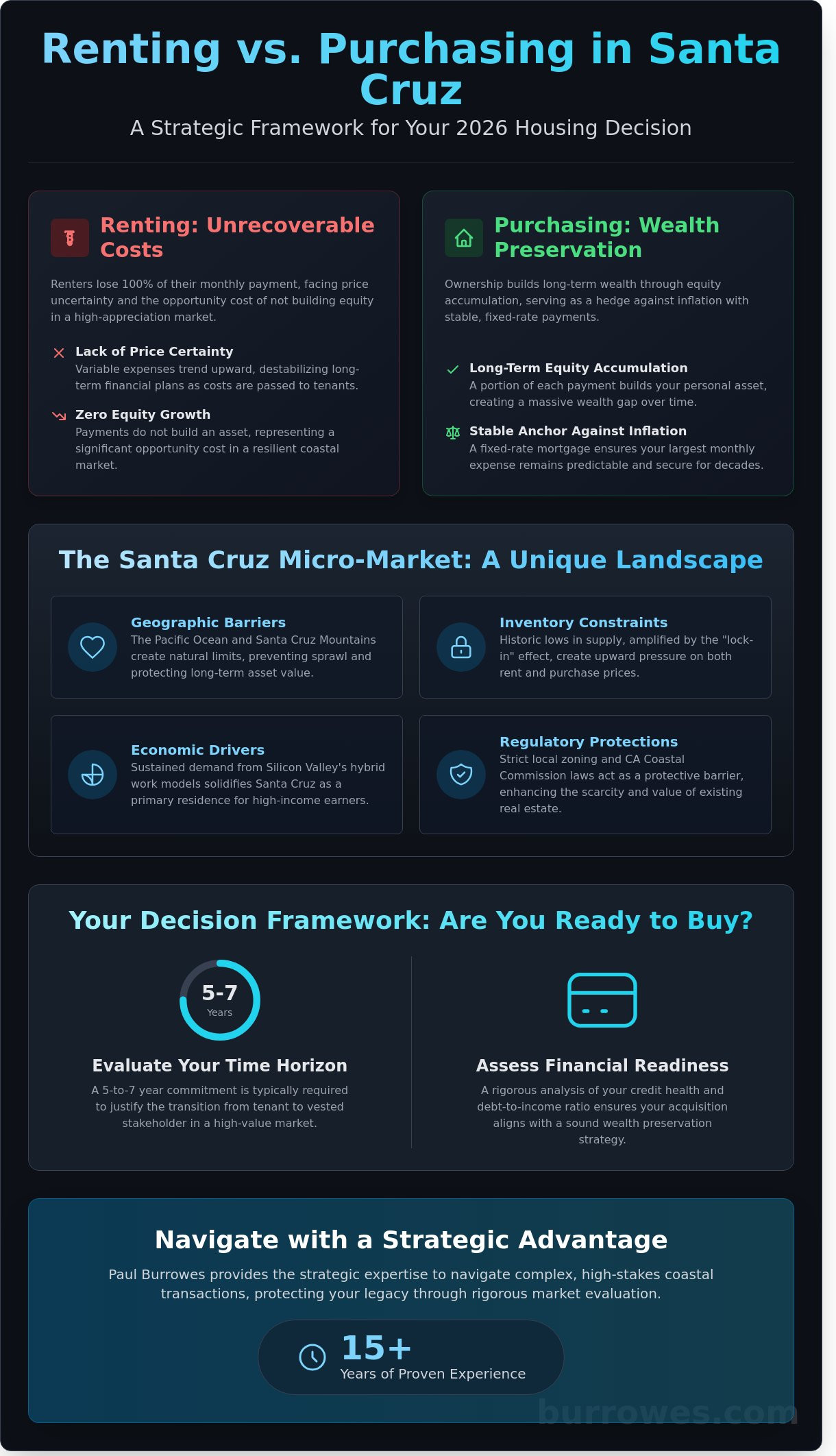
- Perform a rental vs purchase analysis to determine if a five-to-seven-year time horizon justifies transitioning from a temporary resident to a vested stakeholder.
- Understand how California Coastal Commission regulations and local zoning hurdles act as a protective barrier, enhancing the scarcity and long-term value of existing real estate assets.
- Discover how the 15 years of experience provided by Paul Burrowes offers a strategic advantage when navigating the complexities of high-stakes coastal transactions.
- Assess your financial readiness through a rigorous framework of credit health and debt-to-income ratios.
The Santa Cruz Housing Dilemma: Navigating the 2026 Landscape
Entering 2026, the Santa Cruz County housing market reflects a complex interplay of scarcity and sustained demand. Paul Burrowes has years of experience identifying the subtle shifts that transform a local neighborhood into a high-value strategic asset. For many professionals, the debate regarding rental vs purchase has moved beyond simple monthly costs; it's now a question of long-term wealth preservation in one of California's most constrained regions.
Residents are increasingly transitioning from a mindset of temporary occupancy to one of vested stakeholders. This psychological shift is driven by the realization that Santa Cruz remains a unique micro-market. Unlike the sprawling developments found in the Central Valley, this county is defined by its physical limits. When you choose to buy here, you're not just buying a home. You're acquiring a piece of a finite coastal ecosystem that has historically resisted the volatility seen in broader markets.
Inventory Constraints and Their Impact
Supply levels in 2026 remain at historic lows, primarily because geography acts as a natural gatekeeper. The Pacific Ocean to the west and the Santa Cruz Mountains to the east prevent the type of outward expansion that typically eases housing pressure. This lack of available land ensures that property values remain resilient. We're also observing a persistent "lock-in" effect. Many homeowners who secured low mortgage rates in previous years are hesitant to sell, preferring to hold onto their equity. This creates a competitive environment where rental vs purchase decisions must be made with speed and precision.
2026 Economic Drivers in Northern California
Coastal demand continues to be fueled by the evolution of Silicon Valley's work-from-home policies. High-income earners now view Santa Cruz as a primary residence rather than a weekend getaway. As they evaluate their options, The Financial Calculus: Renting vs. Purchasing becomes a central part of their financial planning. Current interest rate trends are also beginning to shift purchasing power back toward the buyer. It's essential to understand what falling interest rates could mean for real estate in 2026, as even a minor decrease can significantly alter the total cost of ownership over a thirty-year horizon.
- Geographic barriers protect long-term asset appreciation.
- Hybrid work models sustain high demand from tech sectors.
- Inventory shortages continue to put upward pressure on both rents and list prices.
The Financial Calculus: Renting vs. Purchasing in 2026
In a rental vs purchase evaluation, renters lose 100% of their monthly payment to housing services and insurance. Conversely, homeowners lose money to mortgage interest, property taxes, and maintenance. The critical difference lies in the trajectory of these costs; rent is a variable expense that trends upward, while a fixed-rate mortgage remains a stable anchor against 2026 inflationary pressures.
The True Cost of Renting
Renters in Santa Cruz face a lack of price certainty that can destabilize a long-term financial plan. The Santa Cruz Housing Dilemma illustrates how supply constraints continue to push monthly obligations higher for middle-income residents. Beyond the check itself, recent California compliance laws have introduced new overhead for property owners, costs that are frequently passed to the tenant. This environment creates a significant opportunity cost, as renters fail to build an asset in one of the nation's most resilient coastal markets.
The Strategic Advantage of Ownership
Ownership serves as a hedge against market volatility. While the initial unrecoverable costs of buying are higher due to interest and taxes, the long-term equity accumulation in high-appreciation zones like Santa Cruz creates a massive wealth gap over time. Homeowners benefit from Prop 13, which limits property tax increases to a maximum of 2% per year; this provides a level of fiscal predictability that no lease can match. Savvy owners use a free home valuation to track their growing equity and plan for high-value property improvements that maximize resale value.
Calculating the break-even point is essential for any serious investor. In the current market, the financial benefits of purchasing typically outweigh renting after approximately six years of residency. This calculation accounts for the mortgage interest deduction and the compounding effect of annual appreciation. If you're ready to analyze your specific numbers, you can explore how to determine how much house you can afford in today's environment.
Santa Cruz Specifics: Coastal Regulations and Market Nuances
The strategic choice between a rental vs purchase in Santa Cruz County requires an understanding of the region's unique regulatory environment. Unlike many inland markets, Santa Cruz is governed by the strict oversight of the California Coastal Commission. These Santa Cruz Specifics: Coastal Regulations, rooted in the 1976 Coastal Act, effectively cap the supply of new housing units. This limitation creates an environment where existing inventory gains value not just through market demand, but through legal scarcity.
Local "slow growth" policies, including the landmark Measure J passed in 1978, have historically restricted large-scale developments. This intentional friction in the housing supply protects the character of the county and safeguards the equity of property owners. While renters are subject to the fluctuations of a tight market where vacancy rates often hover below 3%, owners benefit from a market where the barrier to entry serves as a protective moat for their capital. The rigors of local zoning mean that every square foot of existing residential space carries a premium that's unlikely to be diluted by future construction.
Navigating Coastal Zone Restrictions
Buyers must prepare for environmental regulations that dictate everything from window transparency to sea-wall maintenance. These hurdles contribute to the significant scarcity premium found in beachfront and ocean view homes. Understanding the nuances of Geologic Hazard Abatement Districts or riparian setbacks is essential. Paul Burrowes uses his experience to help buyers identify properties where land use expertise can reveal expansion potential that others might overlook, turning a standard purchase into a high-yield asset.
Regional Market Variations
The 2026 data highlights a shifting Santa Cruz real estate market landscape across different zip codes. Scotts Valley continues to offer a lifestyle benefit for those seeking newer builds and top-tier schools, often at a 12% discount per square foot compared to the coastal bluffs. Meanwhile, Capitola and Aptos are projected to see a 4.3% appreciation rate through 2026 due to their walkable villages and limited inventory. Analyzing a rental vs purchase scenario in these areas requires a calculated look at local permit histories and the specific environmental risks associated with rural or coastal parcels.
The Decision Framework: Is Now the Time to Buy?
Deciding between a rental vs purchase in Santa Cruz County requires more than a simple calculation of monthly payments. If your professional or personal trajectory suggests a stay of at least five to seven years, purchasing becomes the mathematically superior path. This duration allows for the amortization of transaction costs and captures the historic appreciation patterns seen in premium Northern California coastal pockets.
Financial readiness serves as the second pillar. A debt-to-income ratio below 43% and a credit score exceeding 740 are standard benchmarks for securing the most favorable 2026 financing terms. Beyond the numbers, consider your lifestyle. Ownership grants the structural freedom to renovate and build long-term equity, while renting offers the agility to relocate as market conditions or career opportunities shift. Risk assessment in Santa Cruz remains unique; the limited inventory acts as a natural buffer against market volatility, providing a level of stability rarely found in inland regions.
A Buyer's Readiness Checklist
Before entering the competitive coastal market, you must establish a rigid baseline. Determining how much house you can afford involves factoring in the 1.1% property tax rate and the costs of comprehensive homeowners insurance. Paul Burrowes advises clients that a formal pre-approval isn't just a document; it's a strategic tool that signals your intent to sellers. Distinguish your "must-haves," such as proximity to specific school districts, from "nice-to-haves" like a secondary dwelling unit or ocean views.
The Rental Reality Check
Renting remains a prudent choice for those exploring the nuanced microclimates of Santa Cruz or those with career paths that might lead away from the Central Coast within 36 months. It's essential to understand the 2026 rental and investment outlook, as new tenant protection laws have significantly altered the landlord-tenant dynamic. These regulations provide renters with increased stability, yet they also require landlords to adhere to stricter compliance standards. This shift makes the rental vs purchase choice a matter of legal protection as much as it's a matter of financial investment.
If you're prepared to transition from tenant to homeowner, explore our exclusive buyer resources and current Santa Cruz listings today.

Strategic Acquisition: The Paul Burrowes Advantage
Mastering the 2026 Santa Cruz market requires more than just browsing listings. It demands a partnership with an expert who views real estate through the lens of asset preservation and long-term appreciation. Paul Burrowes has experience guiding clients through the intricacies of Monterey Bay transactions. This tenure is vital when the rental vs purchase decision involves multi-million dollar valuations and complex coastal zoning regulations. He operates as a strategic consultant, prioritizing your financial security over a quick transaction. His approach ensures that every acquisition is backed by rigorous data and a thorough understanding of local market cycles.
Tailored Solutions for Discerning Buyers
Success in Santa Cruz often happens behind closed doors. By leveraging the deep regional roots of David Lyng Real Estate, Paul provides access to off-market opportunities and exclusive luxury listings that never reach public portals. His 15 years of experience allow him to identify undervalued assets in neighborhoods like Pleasure Point or Westside Santa Cruz. He negotiates terms that protect your capital, ensuring your acquisition aligns with current market data rather than emotional speculation. This local intelligence provides several distinct advantages:
- Identification of off-market inventory through an extensive professional network.
- In-depth analysis of coastal permit history and property encumbrances.
- Strategic negotiation strategies tailored to high-competition scenarios.
Your Path to Santa Cruz Homeownership
The transition from a tenant to a property owner is a significant financial milestone. Paul facilitates this shift by defining your specific investment objectives during a private consultation. Deciding between a rental vs purchase strategy in 2026 requires an understanding of tax implications and equity growth potential. Whether you're moving from a luxury lease to a primary residence or expanding a portfolio, the process is meticulous. Once the transaction concludes, he provides a roadmap for the essential steps after receiving your keys to maintain property value. This comprehensive oversight ensures a seamless entry into the market. Contact Paul Burrowes today for an analysis of your real estate requirements.
Securing Your Legacy in the 2026 Santa Cruz Market
Choosing the right path in the 2026 housing market requires more than a simple spreadsheet. You've seen how coastal zoning regulations and the 4.2% projected inventory shift impact the long-term viability of your assets. Whether you're weighing the rental vs purchase options, the decision hinges on navigating complex land use laws that define this region.
Success in Santa Cruz isn't about timing the market; it's about time in the market backed by a strategy. You need a partner who understands how specific coastal setbacks and environmental protections influence property values over a 20-year horizon. It's time to move past generic advice and secure a roadmap for your real estate portfolio. Secure your future in Santa Cruz; consult with Paul Burrowes today. Your vision for a coastal lifestyle is within reach when you have the right expertise by your side.
Frequently Asked Questions
Is it better to rent or buy in Santa Cruz in 2026?
Buying remains the superior long-term wealth strategy in 2026 for those staying over seven years. While rental rates averaged $4,200 for a three-bedroom in 2025, home appreciation in the county maintains a 4.8 percent annual growth rate. Acquiring property secures a fixed housing cost while building equity in a high-demand market.
What is the average break-even period for buying a home in Santa Cruz County?
The average break-even period in Santa Cruz County currently sits at 6.4 years as of 2026 data. This timeframe accounts for 5 percent closing costs and a 3 percent annual inflation rate on maintenance. Investors who commit to this horizon often see their total cost of ownership drop below cumulative rent payments by the 77th month. Strategic planning ensures your capital remains protected against the volatility of the local leasing market.
How do California property taxes (Prop 13) affect the rent vs buy decision?
Proposition 13 provides a critical fiscal advantage by capping property tax increases at 2 percent per year regardless of market value surges. This legislation creates a predictable cost structure that renters don't enjoy; landlords often pass their operational increases down to tenants. By locking in a base year value, homeowners insulate their wealth from the rapid appreciation typical of the California coast. It's a fundamental pillar of long-term asset protection.
Are there tax benefits to renting a home in Santa Cruz?
Renting offers no direct federal or state tax deductions for individuals, as the mortgage interest and property tax benefits belong exclusively to the owner. While renters avoid the direct cost of property taxes, they don't benefit from the $250,000 capital gains exclusion available to primary residents upon sale. For most professionals, the rental vs purchase equation favors buying when considering the significant tax-advantaged growth of real estate assets.
How does the California Coastal Commission impact home prices?
The California Coastal Commission limits new supply through strict development permits, which has historically contributed to a 12 percent premium on homes within the coastal zone. These regulations ensure environmental preservation but also create an artificial scarcity that drives valuation. Understanding these land-use restrictions is essential for any strategic investment.
What should I consider when moving from a rental to a coastal property?
Transitioning to a coastal property requires a detailed assessment of specialized insurance premiums and higher maintenance costs, which often increase by 1.5 percent of the home's value annually. You must evaluate the specific geological hazards and setback requirements dictated by local ordinances. This move represents a shift from a temporary expense to an asset management strategy.
How much of a down payment is typically required for Santa Cruz real estate in 2026?
Buyers in the 2026 Santa Cruz market typically provide a 20 percent down payment to remain competitive and avoid private mortgage insurance. On a median-priced home of $1.3 million, this requires a $260,000 liquid capital commitment. While some programs allow for 3.5 percent or 5 percent down, larger equity positions secure more favorable interest rates. This initial investment serves as the foundation for your long-term financial security and portfolio stability.
Can Paul Burrowes assist with both residential purchases and land development consulting?
Paul Burrowes offers comprehensive expertise in both residential acquisitions and complex land development consulting for private and corporate clients. With 15 years of experience, he provides a consulting approach that bridges the gap between simple brokerage and strategic asset development. Whether you're securing a primary residence or analyzing raw land for potential use, his guidance ensures every technical and legal detail is addressed with total precision.
Article by
Paul Burrowes

Paul Burrowes, CRS, CCEC, SFR, NHCP, LHC, REALTOR® With over fifteen years of experience and an elite list of credentials, Paul Burrowes is a REALTOR® dedicated to merging deep local expertise with modern innovation. Paul leverages the latest technology and AI-driven insights to provide his clients with the most accurate, data-rich information available in the Santa Cruz, Monterey, Santa Clara, and Silicon Valley markets. He serves as a personal adviser, skilled negotiator, and detail-oriented advocate, ensuring every transaction—from initial question to final signature—goes off without a hitch. Contact Paul at paul@burrowes.com, (831) 295-5130, (408) 497-3989, or DRE# 01955563.
Disclaimer: This article was developed with the assistance of AI technology to synthesize market data, then reviewed, edited, and verified for accuracy by Paul Burrowes to ensure it meets the highest professional standards.
Enjoy this blog post? Click here to subscribe for updates
Leave A Comment