
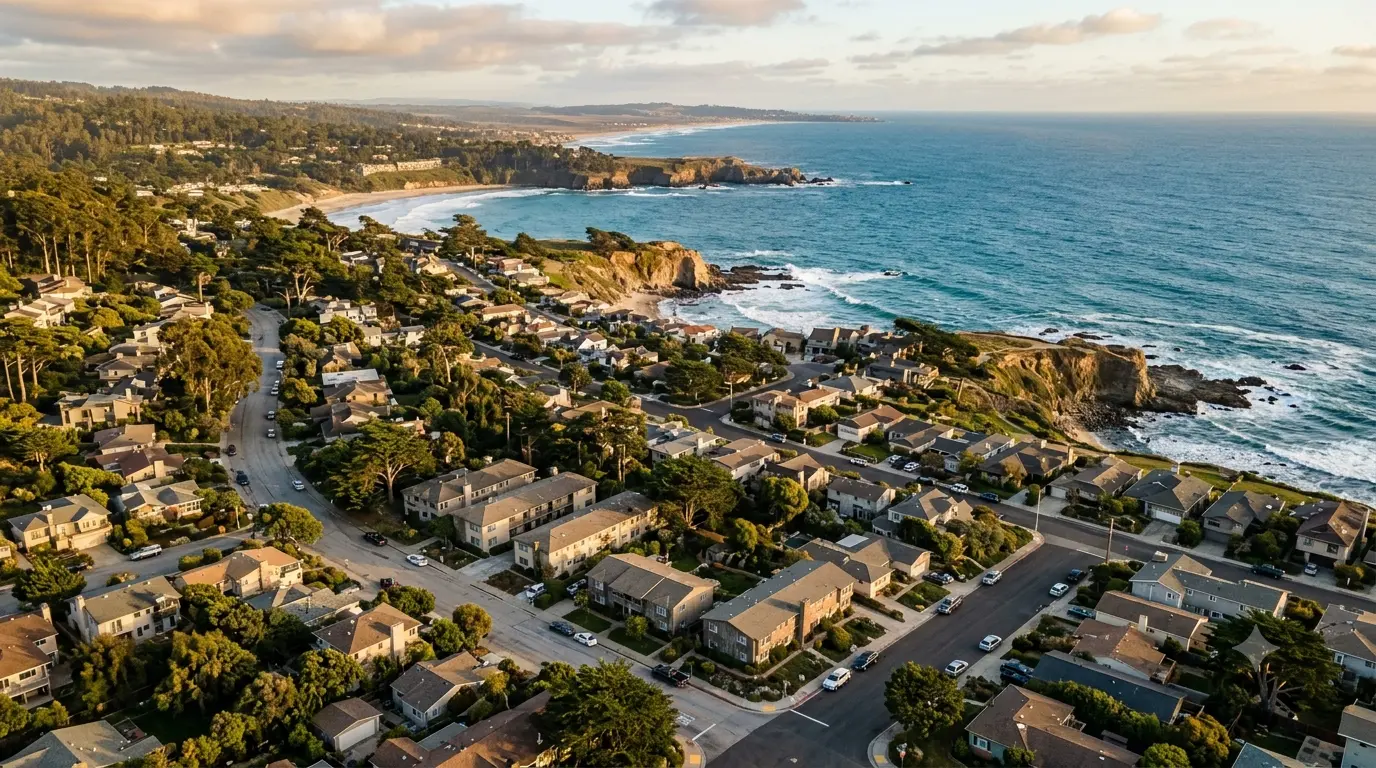
Understanding Investment Property ROI and Cap Rates in Santa Cruz
This guide combines two essential frameworks for evaluating investment property in Santa Cruz: how to analyze return on investment (ROI) across the full life of a hold, and how to use cap rate calculations as a starting point for comparing assets. Understanding both — and where each one falls short — is what separates investors who build lasting portfolios here from those who get stuck chasing yield that the market simply doesn't offer.
Why Simple ROI Falls Short in a High-Cost Market
The instinct when analyzing a rental property is to look at monthly rent against monthly costs and see what's left over. That math works reasonably well in markets with lower acquisition prices. In Santa Cruz, it often produces discouragement without telling you the full story.
Average rents for a two-bedroom apartment were around $3,706 per month as of May 2026. That sounds promising until you factor in debt service on a $1.1 million purchase at a 7.35% interest rate. The initial cash flow will likely be thin, and in some cases slightly negative. That's not necessarily a reason to walk away — but it does mean you need a more complete picture of where the return actually comes from.
In a high-barrier coastal market, the sources of return include:
- Net cash flow — usually compressed in the early years of a leveraged acquisition
- Principal paydown — your tenant is buying down the loan balance every month
- Depreciation and tax benefits — the IRS lets you depreciate a residential investment property over 27.5 years, which can shelter significant rental income from taxation even when the asset is appreciating
- Appreciation — Santa Cruz home values increased approximately 2.3% in the year ending March 2026; historically, appreciation has been the primary engine of wealth in this market
- Forced equity — strategic improvements, ADU additions, or development entitlements that increase the asset's value above what the market alone would provide
When you add these together, a property with a marginally negative monthly cash flow can still produce a strong total Internal Rate of Return (IRR) over a ten-year hold. The IRR calculation accounts for the time value of money and factors in the eventual sale proceeds — which is where a significant portion of the return is typically realized in this market.
The takeaway is not that cash flow doesn't matter. It does, particularly for covering carrying costs and maintaining reserves. But in Santa Cruz, investors who anchor their entire analysis to month-one cash flow tend to either overpay for the rare property that pencils immediately or sit on the sidelines indefinitely.
Cap Rate: What It Measures and What It Doesn't
The capitalization rate is the most widely used tool for comparing investment properties on an apples-to-apples basis. The formula is straightforward:
Net Operating Income (NOI) is the income the property generates after operating expenses but before debt service. The cap rate tells you what the property would yield if purchased entirely with cash — no mortgage, no financing variables. That makes it useful for comparing a four-unit building in Capitola to a small commercial storefront in Scotts Valley without the distortion of different loan structures getting in the way.
In Santa Cruz, cap rates are compressed relative to inland California markets. This is partly a reflection of lower risk — the supply constraints that keep vacancy rates at 2.2% don't change quickly — and partly a reflection of appreciation expectations baked into asset pricing. Buyers are willing to accept a lower current yield because they expect the asset to be worth substantially more in ten years.
General 2026 Benchmarks for Santa Cruz County
| Submarket | Typical Cap Rate Range |
|---|---|
| Westside & coastal properties | 3.5% – 4.2% |
| City of Santa Cruz multi-unit (stabilized) | 4.2% – 4.8% |
| Scotts Valley & Capitola | 4.5% – 5.0% |
| Watsonville | 5.0% – 5.5% |
The higher cap rates in Watsonville reflect lower entry prices and different tenant profiles rather than superior quality. Whether that tradeoff makes sense depends on your investment goals — immediate income versus long-term appreciation — not on which number looks better in isolation.
Single-family homes in desirable school districts often carry cap rates as low as 3%, because buyers in those neighborhoods are purchasing future equity growth as much as current rental income. Chasing an 8% cap rate in a tertiary location tends to come with tradeoffs: higher maintenance costs, more tenant turnover, and slower appreciation.
Calculating NOI Accurately for a Santa Cruz Property
The reliability of your cap rate analysis depends entirely on how accurately you've calculated NOI. This is where many investors go wrong — either by using optimistic income projections or by omitting operating costs that are easy to overlook.
Starting with Gross Income
Begin with Gross Potential Income — the total annual revenue if every unit is fully leased at current market rents. The March 2026 average for a two-bedroom unit in Santa Cruz was approximately $3,317 per month according to local rental data, though rents vary significantly by submarket, unit condition, and amenities.
Applying a Vacancy Factor
Even in a market with a 2.2% vacancy rate, you should build in a vacancy and credit loss factor. Professional underwriting typically uses 5% regardless of current conditions. This provides a buffer for the inevitable turnover periods and any collection issues, and it keeps your NOI calculation honest rather than optimistic.
Operating Expenses to Include
- Property taxes: Santa Cruz County's effective property tax rate runs between 1.1% and 1.26% of assessed value
- Insurance, including any earthquake or flood coverage depending on location
- Property management: even if you plan to self-manage, include a 7% to 10% management fee — this reflects the property's value as a passive investment and gives you an honest comparison against other assets
- Routine maintenance and reserves: coastal properties require higher maintenance allocations than inland equivalents due to salt-air exposure affecting exterior surfaces and HVAC equipment
- Utilities that landlords cover in common areas or in specific unit configurations
2026 Compliance Costs to Factor In
California Assembly Bill 628, which took effect January 1, 2026, requires landlords to provide and maintain working refrigerators and stoves in all units covered by new or renewed leases. Across a multi-unit portfolio, this becomes a real capital expenditure that needs to show up in your NOI calculation, not as an afterthought.
AB 12, which revised security deposit limits, also affects how you structure move-ins and what reserves you can collect. And AB 1414 introduced restrictions on certain bundled service arrangements in rental agreements. These aren't particularly burdensome individually, but taken together they reinforce why a careful review of compliance obligations is worth doing before you sign a purchase contract.
What to Exclude from NOI
Mortgage payments, principal, and interest are not operating expenses — they're financing costs. Capital expenditures (a new roof, complete kitchen remodel, HVAC replacement) should also be tracked separately from recurring operating costs. When sellers provide a pro forma NOI, verify that they haven't blended in financing costs or omitted major anticipated expenses.
The Local Regulatory Layer
Analyzing investment property in Santa Cruz isn't just a financial exercise — it requires a working understanding of the local regulatory environment, because that environment directly affects what you can do with an asset and what it will cost you to operate it.
Rental Stabilization and Just Cause Eviction
The City of Santa Cruz maintains a rental registry and stabilization framework. Measure M and related ordinances primarily apply to older multi-unit residential buildings, while many single-family homes and newer construction remain exempt under Costa-Hawkins. But exemption status is property-specific, not a category you can assume. Before closing, confirm exactly which protections apply to the units you're acquiring and what that means for rent adjustment timelines.
Just cause eviction protections — which require landlords to document a legally recognized reason before a tenant can be asked to leave — do provide a degree of tenant stability. They also require owners to think longer-term about tenant relationships and lease management than they might in a less regulated market.
The California Coastal Commission
For properties within the coastal zone, the Commission's oversight on improvements, additions, and changes in use can significantly extend project timelines. Any renovation intended to improve a property's value or density potential needs to account for these permitting layers. Delays in the entitlement process carry real costs, particularly when financing at 7%+ interest rates.
ADU Ordinance Updates
In February 2026, the Santa Cruz City Council advanced amendments to the local ADU ordinance to align with updated state law. These changes generally streamline the path for adding accessory dwelling units — a meaningful development for investors looking to add rental income to residential parcels. The specifics of what's permissible depend on lot size, zoning, and location, and vary between the city limits and unincorporated county areas.
Zoning and Entitlement
In a coastal market where vacant land is nearly nonexistent, the value of a property is often tied to what the land can support as much as what's currently on it. Grandfathered uses in specific zones, lot dimensions that support additional density, or parcels where the current use doesn't reflect the highest permitted use all represent potential value that doesn't show up in a standard cap rate calculation.
This is one area where local expertise pays for itself. Identifying which properties have meaningful ADU or development potential requires knowledge of the entitlement process that isn't captured in an MLS listing or a seller's pro forma.
Cap Rate Compression Near the Coast
As you move closer to the shoreline, cap rates naturally compress further. Investors in Capitola, La Selva Beach, and the coastal neighborhoods of Santa Cruz consistently accept lower initial yields because ocean-view and beach-proximate properties carry a scarcity premium that tends to hold up during market fluctuations better than inland assets.
A 3.5% cap rate on a well-located beachside duplex in 2026 isn't a poor return in context — it reflects a lower risk profile and a reasonable expectation of appreciation that inland properties at the same price point simply can't offer.
The flip side is that coastal properties also carry higher maintenance costs, so your NOI calculation needs to be adjusted accordingly. Salt air accelerates wear on roofing, siding, windows, and HVAC equipment. Building that into your reserves before you buy is less painful than discovering it afterward.
When the Calculator Isn't the Whole Answer
A cap rate gives you a useful snapshot of an asset's current income performance. It doesn't tell you what the property could earn with a thoughtful renovation, an ADU addition, or a change in use — and in Santa Cruz, those hidden variables are often where the real opportunity lives.
Value-Add Through ADUs
A well-executed ADU addition can shift a property's effective cap rate considerably. A single-family home producing a 3% yield can move toward a 5% or higher yield once a permitted secondary unit is added. The secondary rental income also changes the asset's risk profile — two tenants are less concentrated risk than one.
The cost-to-value ratio of ADU construction varies by submarket. In Scotts Valley, larger lots often allow more expansive detached units. In the City of Santa Cruz, the focus tends to be on maximizing livable square footage within tighter urban footprints. Either way, a realistic feasibility assessment before committing capital is essential, particularly given the permit timelines and construction costs in 2026.
Appreciation as a Return Component
The anticipated loosening of interest rates through the latter part of 2026 will likely affect property valuations and cap rate expectations across the county. When financing costs ease, competition for stabilized assets tends to intensify, which compresses cap rates further. Investors who buy during a period of rate pressure and hold through a rate normalization cycle have historically benefited from both income improvement and asset appreciation.
1031 Exchanges and Tax Strategy
For investors holding appreciated property, a 1031 exchange allows the full proceeds of a sale to be reinvested into a replacement asset without triggering immediate capital gains taxation. This mechanism is particularly valuable in a market like Santa Cruz, where long-term holders often carry significant embedded gains. A 1031 into a larger multi-unit property or a commercial asset can extend the compounding of equity without the drag of a substantial tax event.
Working with a CPA who has experience in California real estate taxation is worth the cost. The interaction between depreciation recapture, state capital gains rates, and federal treatment can significantly affect your net proceeds on a sale.
Comparing Submarkets
Watsonville generally offers the highest cap rates in the county and lower entry prices. It appeals to investors focused on cash flow and willing to accept a different tenant demographic and slower appreciation compared to coastal Santa Cruz. The Hillcrest Residences development and ongoing infill projects are bringing new inventory to this part of the market.
Scotts Valley occupies a middle position — cap rates between Watsonville and Santa Cruz, with strong school district demand and a growing professional resident base. Lot sizes tend to be larger, which creates more ADU feasibility in many cases.
Capitola and Live Oak offer coastal adjacency at prices somewhat below the Westside, with cap rates that tend to land in the 4.5% to 5% range for stabilized multi-unit assets. These neighborhoods have seen steady demand from renters priced out of the city.
City of Santa Cruz (Westside, Downtown, Eastside) represents the tightest supply, the most compressed cap rates, and the strongest long-term appreciation. The regulatory framework here is also the most layered, given the density of rental stabilization ordinances and coastal zone overlap. Entry prices are the highest in the county, but so is the depth of the buyer pool on resale, which tends to support more predictable exits. For investors with a longer time horizon and available equity, the Westside in particular has historically produced strong total returns even with modest initial cash flow.
No submarket is objectively the right choice — that depends on your timeline, income needs, available capital, and tolerance for regulatory complexity. The mistake is buying in a submarket without understanding what makes it different from the others.
Bay Area Commercial and Multi-Family Property for Sale.
Santa Cruz County Commercial and Multi-Family Property for Sale.
One additional consideration when comparing submarkets: resale liquidity. Properties in the City of Santa Cruz and Capitola tend to attract a broader buyer pool — including owner-occupants willing to pay a premium — which makes exits more predictable. In Watsonville, the buyer pool for investment property is narrower and more price-sensitive, which can complicate a sale if market conditions shift. That doesn't make Watsonville a bad investment, but it does mean you should factor in a more conservative exit assumption when you're modeling the hold.
Putting It Together: How to Evaluate a Property
A practical workflow for evaluating a Santa Cruz investment property in 2026:
-
Verify gross income. Don't accept a seller's rent roll at face value. Check current leases, compare rents to market data for comparable units, and ask when leases expire. In a stabilized market with low vacancy, the difference between contract rent and market rent can be meaningful.
-
Build your own NOI. Use current market rents (adjusted for vacancy), add all operating expenses including the compliance costs noted above, and calculate from there. Compare your NOI to the seller's pro forma. Large discrepancies usually mean the seller has omitted expenses or used optimistic assumptions.
-
Calculate the going-in cap rate. Divide your NOI by the purchase price. Compare to local benchmarks for the submarket and property type. If the cap rate is significantly below market, understand why — and decide whether the premium is justified by location, quality, or development potential.
-
Model the full hold. Estimate rent growth, appreciation, and debt paydown over a 7- to 10-year hold. Calculate IRR across the full projection, including an exit. If the IRR under conservative assumptions meets your threshold, the investment is worth pursuing.
-
Assess development potential. Before closing, understand what the lot can support. Is there ADU potential? Are there zoning constraints or entitlements that affect future use? This step requires local knowledge and sometimes a conversation with a land use consultant before you're committed.
-
Review regulatory status. Confirm whether the property falls under rent stabilization, which units are covered, and what just cause eviction requirements apply. Get clarity on any open permits or compliance issues.
A Note on Off-Market Opportunities
In a supply-constrained market where the best properties don't sit on the MLS for long, off-market access matters. Apartment buildings and multi-residential properties with strong income histories and clean entitlements are often sold quietly, through agent networks, before they're ever listed publicly. Building relationships with agents who specialize in investment property — and who have standing relationships with owners of the type of asset you're targeting — is a practical competitive advantage in this environment.
It also helps to know what you're looking for before you're looking. Investors who have done the work of defining their target — submarket, unit count, minimum NOI, acceptable cap rate range, development potential requirements — move faster when something comes available and make fewer reactive decisions under time pressure. In a market that moves quickly and rewards preparation, that clarity matters.
Frequently Asked Questions
Click on the arrows below for the answers to the question.
What's a realistic ROI target for a Santa Cruz investment property in 2026?
Do 2026 interest rates make Santa Cruz investment properties unworkable?
Does Measure M apply to every multi-unit property in the city?
How much does an ADU typically add to a property's value?
Is it better to focus on Watsonville or Santa Cruz proper?
How often should I recalculate cap rates on properties I already own?
What expenses should I exclude from a cap rate calculation?
How does a 1031 exchange affect total return?
Article by
Paul Burrowes

Paul Burrowes, CRS, CCEC, SFR, NHCP, LHC, REALTOR® With over fifteen years of experience and an elite list of credentials, Paul Burrowes is a REALTOR® dedicated to merging deep local expertise with modern innovation. Paul leverages the latest technology and AI-driven insights to provide his clients with the most accurate, data-rich information available in the Santa Cruz, Monterey, Santa Clara, and Silicon Valley markets. He serves as a personal adviser, skilled negotiator, and detail-oriented advocate, ensuring every transaction—from initial question to final signature—goes off without a hitch. Contact Paul at paul@burrowes.com, (831) 295-5130, (408) 497-3989, or DRE# 01955563.
Disclaimer: This article was developed with the assistance of AI technology to synthesize market data, then reviewed, edited, and verified for accuracy by Paul Burrowes to ensure it meets the highest professional standards.
© 2026 Paul Burrowes - David Lyng Real Estate. Market analysis based on regional indicators compiled for the 2026 calendar year.
Local 1031 and tax deferment specialists
Carl F Worden III
Author, Educator, Tax Deferral Consultant
Tax Deferral Strategies LLC
www.DeferTax.com
www.StartAnExchange.com
3031 Tisch Way Suite 901
San Jose, CA. 95128
TF: 877-TAX-STRATEGY (877-829-7872)
PH: 408-261-2275
Ron Ricard
Account Executive, VP
IPX1031
ron.ricard@sis.ipx1031.com
(408) 483-1031
Work | (877) 747-7875
www.ipx1031.com/ricard
Thomas Foster, Esq., President
Nationwide 1031 Exchange Intermediary Services
331 Soquel Avenue, Suite 100
Santa Cruz, CA 95062
tom@coast1031.com
www.coast1031.com
831-464-1031

How Much is Your Property Worth?
Free Valuation
Search for your dream home now!
Start Search
Paul Burrowes, CRS, CCEC, SFR, NHCP, LHC | David Lyng Real Estate | DRE# 01955563 | 15 plus years serving Santa Cruz, Silicon Valley & Monterey buyers | paul@burrowes.com | (831) 295-5130
Enjoy this blog post? Click here to subscribe for updates
Leave A Comment