
While many buyers hesitate when looking at high purchase prices, historical housing data shows that securing multi-unit properties now is one of the most reliable ways to build a stable portfolio for the future. Finding profitable multi-family homes for sale in Santa Cruz County requires a clear, data-driven approach rather than just sorting through public listings. It is a unique market where local rental housing laws and a steady drop in building permits create real barriers to entry. To navigate it successfully, you need a partner who understands land use, local regulations, and long-term financial safety.
Key Takeaways
- Zoning Opportunities: Learn how to use California Senate Bill 9 (SB9) and local rules to find hidden value in undervalued lots throughout Santa Cruz County.
- The "True" Cap Rate: Calculate your actual returns by analyzing modern interest rate trends and real local operational costs.
- Off-Market Sourcing: Discover how to find actual multi-family deals by looking past public real estate websites to tap into local networks.
- Smart Due Diligence: Protect your capital by thoroughly checking rent rolls and matching current income against realistic growth plans.
- Expert Alignment: Move past standard transactional real estate and partner with local professionals who understand the nuances of the Monterey Bay market.
1. The Appeal of Multi-Family Real Estate in Santa Cruz County
Buyers entering the market today focus heavily on stability and long-term financial health over quick, speculative wins. Santa Cruz County sits at a rare crossroads: it offers highly desirable coastal living combined with a permanent, intense demand for rental housing.
Acquiring multi-family properties—like duplexes, triplexes, and fourplexes—serves as a practical engine for building equity. These assets provide a reliable layout where monthly rental income directly offsets the high carrying costs of coastal real estate, creating a buffer against general market drops.
The strength of multi-residential properties lies in their built-in ability to combine steady cash flow with appreciation. While single-family homes depend entirely on the ups and downs of market prices, multi-family properties offer several income streams under one roof. This setup makes property management more efficient and strengthens your overall financial position. In a real estate climate where protecting your capital comes first, these properties act as defensive pillars for personal portfolios and family estates alike.
Diversifying Wealth through Multi-Residential Assets
Multi-family units are a classic hedge against inflation because rents in coastal California historically adjust to the market much faster than fixed, long-term mortgage debt. They also lower your risk when a tenant moves out; if one unit sits empty, the remaining doors keep bringing in revenue to pay the mortgage. Shifting from single-family houses to income-generating properties is a smart way to manage risk. A practical multi-family investor looks for high-barrier coastal markets to secure steady cash flow and protect family equity across generations.
Current Market Dynamics: Supply vs. High Rental Demand
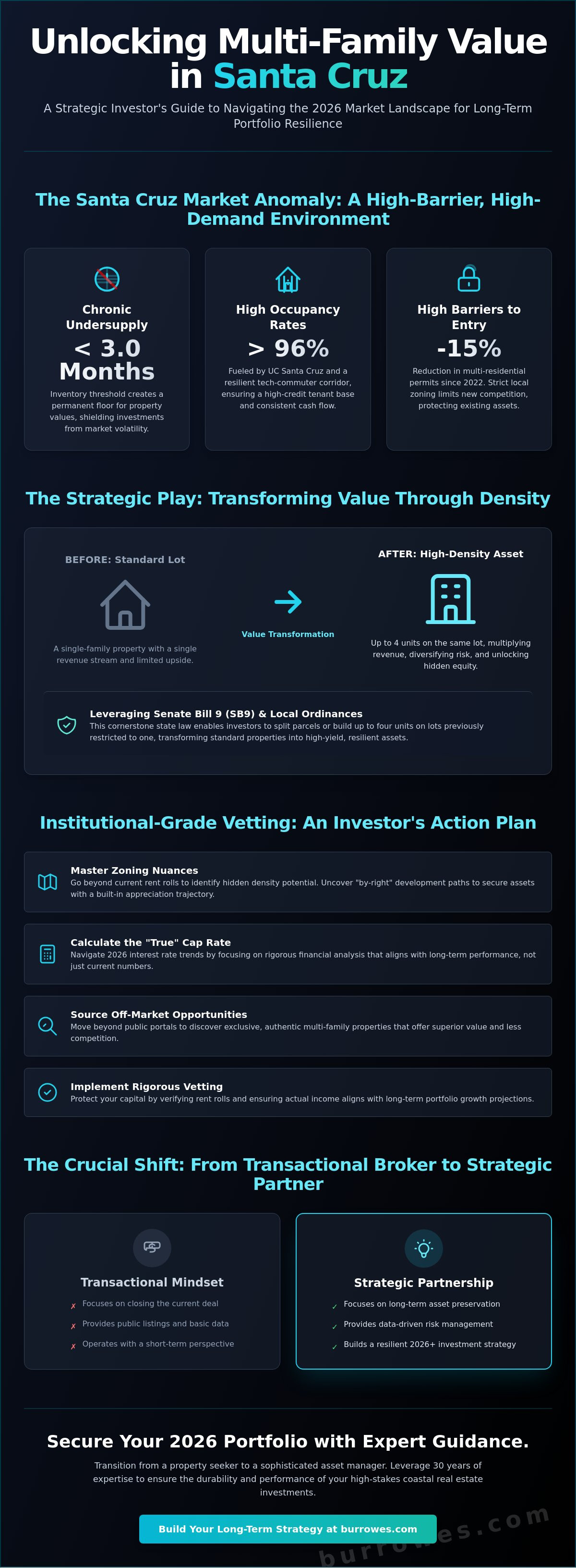
The massive gap between available housing and rental demand is the defining feature of our local market. The inventory of multi-family homes for sale in Santa Cruz County stays consistently low, which puts a permanent floor under property values. This shortage is driven by two main factors: steady demand from the University of California, Santa Cruz (UCSC) student body, and a large pool of tech professionals who prefer the Monterey Bay lifestyle over the crowded neighborhoods of Silicon Valley.
- High Occupancy: Rental occupancy rates in well-placed multi-family properties often stay above 96%.
- Strong Tenant Pool: Proximity to major job centers attracts reliable, credit-worthy renters.
- Strict Local Planning: Hard local zoning rules prevent massive new developments, protecting the value of existing buildings.
Understanding these local pressures is key to a smart purchase. For a deeper look at these patterns, check out our guide, Santa Cruz Real Estate: A Strategic Guide to the Market Landscape. This insight helps buyers look past basic sales flyers and focus on the deep data required for coastal property deals.
2. Navigating Zoning and Density Regulations for Maximum Value
When searching for multi-family homes for sale in Santa Cruz County, you have to look past current rental income. The true wealth often lies hidden in the land itself. Smart planning helps identify properties where current zoning allows you to add units without a long, frustrating public review process. This approach can turn a standard duplex into a high-yielding asset by opening up simple development paths. By spotting these spots early, you buy a property with an upward value curve that outpaces the rest of the market.
Leveraging SB9 and Local ADU Ordinances
California Senate Bill 9 (SB9) is an excellent tool for expanding density. This law allows owners of single-family lots to split their parcels or build up to four units in areas that used to be strictly limited to one home. With regional home prices remaining high, these lot splits offer a clean way to grow your portfolio without taking on the massive overhead of a commercial construction project.
You can also boost density by adding Junior Accessory Dwelling Units (JADUs) and detached ADUs to existing multi-family setups. Keeping up with these shifting local and state rules is crucial for long-term legal safety, as covered in our Santa Cruz Landlord Alert: New California Compliance Laws.
The Importance of Land Use Consulting in Acquisitions
A standard residential real estate agent often lacks the specialized technical background required for complex multi-family due diligence. The Santa Cruz County Planning Department has a detailed approval process that can stall projects for years if it isn't handled perfectly. Our team focuses on an advisory-first model, running a complete zoning check on every property before making an offer. This stops expensive mistakes by proving what you can legally build before you spend a dime.
We search for properties with very specific traits:
┌────────────────────────────────────────────────────────┐
│              TARGET PROPERTY CHECKLIST                 │
├────────────────────────────────────────────────────────┤
│ [ ] Urban lots over 1,200 sq. ft. ready for SB9 splits │
│ [ ] Multi-family zones (RM) allowing 1 ADU per 4 units │
│ [ ] Properties within 0.5 miles of major transit lines │
│ [ ] Lots with deep setbacks for easy detached builds   │
└────────────────────────────────────────────────────────┘
Finding "by-right" opportunities means focusing on lots where the local General Plan allows for more units without requiring a public hearing. This reduces your risk from local pushback and gets your new units rented out much faster. If you need a customized look at a specific property, our team provides the oversight needed to protect your capital.
3. Evaluating Financial Performance: ROI, Cash Flow, and Taxes
Buying multi-family homes for sale in Santa Cruz County requires a sharp financial look that goes far beyond basic home loan math. In a market where high demand meets strict geographic boundaries, you must calculate your true capitalization rate carefully. While interior valley markets might show higher immediate yields on paper, Santa Cruz multi-family properties usually trade at cap rates between 3.5% and 4.8%.
This percentage reflects the massive premium placed on coastal stability and the strong, historical appreciation rates of the region over the last few decades. Buyers shouldn't view these lower cap rates as a flaw—instead, they represent a much lower risk level and a higher probability of keeping your wealth intact.
Financing plans have changed alongside broader economic shifts. Our research into shifting interest rates suggests that the current environment favors "refi-ready" purchases. Smart buyers use the Gross Rent Multiplier (GRM) as their first screening filter. In coastal California, a GRM between 16 and 20 is standard for a steady 2-to-4 unit property. If a building sits outside this window, it usually points to deferred maintenance or an opportunity to raise rents through smart updates.
Rental Outlook and Market Rents in Northern California
The latest local rental data confirms that vacancy rates across the Santa Cruz-Watsonville area stay incredibly low, hovering around 3.2%. We are also seeing a clear shift toward updated, modern units. Properties that feature refreshed finishes and energy-efficient upgrades bring in a rental premium of up to 18% over unrenovated buildings. This trend is highly visible on the Westside and in the Seabright neighborhood, where being close to the beach and employment hubs keeps tenant competition high.
Strategic Tax Considerations for Multi-Family Investors
Protecting your equity requires a clear plan for both buying and selling. Many investors run into a costly surprise when they decide to sell, often getting caught in a heavy capital gains tax situation. To avoid this, using a 1031 exchange remains the industry standard for moving into larger multi-family properties without triggering immediate tax bills.
Beyond exchanges, cost segregation studies are highly useful tools for owners of duplexes, triplexes, and fourplexes. By breaking down certain parts of the building into shorter depreciation timelines, you can front-load your tax savings. This creates a large, non-cash deduction that can cancel out a major chunk of the property's rental income during the first five to seven years you own it. This forward-thinking approach to taxes ensures your investment serves as a solid foundation for your financial future.
4. Sourcing and Vetting Multi-Family Opportunities in Santa Cruz
Finding a top-performing multi-family property requires a completely different approach than standard home shopping. In a fast-moving market with limited inventory, the best deals rarely stay on public websites for long. Success requires an active approach that values real numbers and deep inspections over quick surface appeal.
Identifying High-Potential Multi-Residential Listings
Experienced investors focus on off-market deals and private listings where you don't have to deal with bidding wars. You can gain an edge by using our localized data access, which highlights filtered, income-producing properties across the region. We look specifically for poorly managed buildings where current rents sit 15% to 20% below actual market averages. These properties offer a chance for "forced appreciation"—meaning you can raise the property's value quickly through professional management and simple fixes rather than waiting around for the general market to rise.
Sourcing authentic multi-residential listings means looking past the staging photography. We check the rent rolls carefully, verifying actual collected income against the often optimistic projections provided by sellers. If a listing relies too heavily on "what the income could be" without a clear path to get there, it is a sign to look deeper into the building's financial health.
Due Diligence: Beyond the Standard Home Inspection
Physical due diligence in Santa Cruz requires a real understanding of older coastal homes. Many local duplexes and triplexes were built several decades ago, making a close look at deferred maintenance a main priority.
┌────────────────────────────────────────────────────────┐
│             DEEP VETTING PHYSICAL FOCUS                │
├────────────────────────────────────────────────────────┤
│ • Foundation stability & seismic updates               │
│ • Outdated electrical panels (Knob & Tube checks)      │
│ • Coastal moisture intrusion & hidden dry rot          │
│ • Utility configuration (Separated vs. Master meters)  │
└────────────────────────────────────────────────────────┘
Checking the utility setup is incredibly important. Properties that use a single master meter for water or electricity can quickly drain your monthly cash flow. On the other hand, individually metered units pass the utility costs directly to the tenants, keeping your net operating income safe.
Legality is another foundational piece of our vetting process. We review old building permits to ensure every single unit is fully recognized by the county. An unpermitted garage conversion or backyard unit might bring in extra cash today, but it represents a massive legal risk under current rental rules. A complete multi-family checklist must include a structural review, a look at past permit histories, and a moisture report to protect your long-term investment.
For those looking to buy as an owner-occupant, "house hacking" is an exceptional path. By living in one unit while renting out the others, you let your tenants pay down your mortgage and build your equity. Before jumping in, it is wise to consult our guide on home affordability to ensure your debt-to-income ratios stay balanced while managing a multi-unit layout.
If you are ready to secure a multi-family property in this competitive market, connect with our advisory team for a private strategy conversation.
5. Working with a Strategic Consultant for Long-Term Success
Buying a multi-family asset requires moving past the old way of doing real estate. Investors shouldn't settle for a traditional agent who simply writes up offers and opens doors. Instead, you need an advisor who views real estate through the lens of overall portfolio balance and risk management. Paul Burrowes offers this high-level, data-driven service. His relationship with David Lyng Real Estate—a local institution serving the region since 1980—gives investors a major competitive edge. This connection combines deep local community roots with the sharp market statistics required to win in the current landscape.
Deep market analysis isn't an extra perk; it is a requirement for protecting your money. By comparing historical trends with current neighborhood growth, we ensure your capital is placed where it can work the hardest. This advisory model prioritizes the safety of your property over a quick closing day. It is about building a portfolio that stays strong through the natural ups and downs of the California real estate market. We focus entirely on solid structural builds and dependable rental income, keeping your investments secure for years to come.
Clear Planning for Every Goal
Protecting your equity requires a custom strategy tailored to your specific comfort level and long-term targets. We build buying plans that match your exact goals, whether you are looking for immediate monthly cash flow or long-term family security. Investors gain peace of mind knowing their partner has a deep understanding of local land use rules and complex building frameworks in Santa Cruz County. This technical skill makes it simple to find value-add opportunities that other buyers skip right over. You can access this dedicated support by reaching out through our contact page for a private conversation.
Navigating Complexity with Calm
Managing valuable multi-residential properties means handling a wide web of legal, financial, and tenant rules. Transparency and professional care are the foundations of our business, ensuring your portfolio stays secure within the modern legal landscape. This active management style serves as a strong shield against market uncertainty, giving you the confidence to grow your holdings over time. Our commitment to quality means every single detail, from tax plans to local rent rules, is handled cleanly. For those ready to step up their real estate approach, we invite you to explore our multi-residential options or set up a strategy call to map out your next steps.
Securing Your Position in the Santa Cruz Multi-Family Market
Winning in this region requires a clear understanding of changing local rules. Maximizing your property's value through SB9 lot splits and ADU density plans has become the foundation of high-performance investing. By focusing on smart property upgrades and reliable cash flow, you ensure your real estate stays protected against market shifts while providing valuable housing to our local community. It is about building a legacy that withstands economic changes.
Finding the best multi-family homes for sale in Santa Cruz County requires a partner who truly understands land use. Working as a licensed professional with David Lyng Real Estate, an industry leader since 1980, Paul Burrowes provides the sharp data and clear guidance needed to handle complex purchases and maximize your returns. This strategic support protects your capital, turning potential market risks into clean opportunities for growth.
Your path toward an intelligent real estate future starts with a single, deliberate decision. Connect with us for a multi-family strategy session to refine your approach and claim your spot in this competitive market. We are ready to help you reach your goals.
Frequently Asked Questions
Is Santa Cruz County a good place for multi-family investment right now?
Yes. Santa Cruz County is an excellent option due to a highly stable, low rental vacancy rate (around 2.1% to 3.2% depending on the neighborhood) reported by housing data sources. UCSC's ongoing student housing needs keep rental demand permanent and steady. Strategic buyers use our risk analysis to select stable, high-value properties that withstand broader economic shifts.
How does SB9 affect multi-family properties in Santa Cruz?
Senate Bill 9 allows property owners to split single-family lots or build up to four units on a single parcel under specific conditions. This law helps grow the multi-family supply by opening up density in residential areas that used to be strictly limited. It is important to work with a local expert to understand how adding density impacts your local building plans and insurance coverage.
What is the average cap rate for a duplex in Santa Cruz County?
Average cap rates for local duplexes generally run between 3.5% and 4.8%. While these yields look lower than in inland or secondary markets, local investors value the strong, steady historical appreciation that the Santa Cruz coastline has delivered over the past several decades. Our team builds customized property strategies to ensure your long-term equity stays secure.
Can I add an ADU to a multi-family property in Santa Cruz?
Yes. Under California state law, you can generally add at least two detached Accessory Dwelling Units (ADUs) to an existing multi-family property. Local ordinances also offer paths to convert existing non-living spaces—like garages, carports, or old storage rooms—into extra rental units. Doing this requires a careful review of your local building permits and property insurance to account for the new layout.
What are the highest-demand areas in Santa Cruz County for rental properties?
The Westside of Santa Cruz and the Seabright neighborhood offer excellent rental histories due to their easy access to the beach, downtown, and the university. Capitola Village also maintains incredibly high occupancy rates, making it a very stable choice for long-term buyers. We focus on finding properties in these high-demand zones to ensure your asset stays rented.
How do I finance a multi-family home purchase as a first-time investor?
Many first-time buyers use residential FHA or conventional multi-unit loans, which allow you to buy a 2-to-4 unit property with a much lower down payment than a commercial loan. To qualify for these low-down-payment options, you must live in one of the units as your primary home for at least 12 months. This is a highly popular strategy often called "house hacking."
What should I look out for when inspecting an older multi-family building?
Make it a priority to check the core infrastructure: look for older knob-and-tube wiring, check for ungrounded electrical systems, and look for galvanized pipes in buildings built before 1960. Foundation health and coastal moisture/termite damage are also critical points. Identifying these physical challenges during your inspection phase prevents unexpected repair costs after you close.
National Market Update: May Housing Starts Pull Back
While Santa Cruz County continues to experience isolated high demand, macroeconomic headwinds are shifting development trends on a national scale. According to the June 2026 joint report from the U.S. Census Bureau and the U.S. Department of Housing and Urban Development (HUD), U.S. housing starts fell 15.4% in May to a six-year low, heavily impacted by a sharp pullback in multi-family pipeline developments.
| Construction Sector | May Month-over-Month Change | Seasonally Adjusted Annual Pace |
|---|---|---|
| Total Housing Starts | Down 15.4% | 1.177 Million Units |
| Multi-Family Starts (5+ Units) | Down 40.2% | 284,000 Units |
| Single-Family Starts | Down 1.9% | 882,000 Units |
Why Developers Are Pausing Multi-Family Groundbreakings
The decline in construction arrives during what is typically the peak seasonal window for residential real estate velocity. However, builders are adjusting pipelines to match broader financial conditions:
- Financing Hurdles: Persistent, elevated mortgage rates and strict commercial lending terms are causing multi-family developers to pause new projects.
- Affordability Cracks: Stagnant real household incomes, high purchase prices, and ongoing global economic uncertainty have cooled consumer demand.
- Sentiment Shifts: The National Association of Home Builders (NAHB) sentiment index recently slid to territory reminiscent of the 2011 housing contraction recovery period.
"Elevated mortgage rates, affordability challenges, and cautious buyers continue to weigh on demand for new homes. Builders are offering incentives and cutting prices, but difficult market conditions are still limiting sustained momentum for new construction."
— Bill Owens, NAHB Chairman
The Regional Split
Construction pullbacks are not distributed evenly across the United States. Year-to-date data reveals a stark geographical divide in building activity:
- Northeast: Up 17.5%
- West: Down 4.9%
- Midwest: Down 4.1%
- South: Down 1.6%
Looking Forward: Is a Rebound on the Horizon?
Despite the steep drop in actual groundbreakings, forward-looking data points to stabilization. Total building permits only ticked down a marginal 0.7%, while single-family permits actually edged higher.
Lead economists predict this dip may temporarily overstate structural industry weakness. As inflation indicators cool and anticipated Federal Reserve interest rate cuts materialize later this year, lower borrowing costs are expected to stimulate both home sales and new multi-family starts.
The Takeaway for Santa Cruz Investors
For local multi-family buyers on the Central Coast, this national multi-family supply squeeze serves as a reminder of our local market's defensibility. While national apartment construction plunges 40%, the geographic constraints and strict building limits of Santa Cruz County keep existing multi-residential inventory protected from oversupply risks—safeguarding asset values and rental yields.
Article by
Paul Burrowes

Paul Burrowes, CRS, CCEC, SFR, NHCP, LHC, REALTOR® With over fifteen years of experience and an elite list of credentials, Paul Burrowes is a REALTOR® dedicated to merging deep local expertise with modern innovation. Paul leverages the latest technology and AI-driven insights to provide his clients with the most accurate, data-rich information available in the Santa Cruz, Monterey, Santa Clara, and Silicon Valley markets. He serves as a personal adviser, skilled negotiator, and detail-oriented advocate, ensuring every transaction—from initial question to final signature—goes off without a hitch. Contact Paul at paul@burrowes.com, (831) 295-5130, (408) 497-3989, or DRE# 01955563.
Disclaimer: This article was developed with the assistance of AI technology to synthesize market data, then reviewed, edited, and verified for accuracy by Paul Burrowes to ensure it meets the highest professional standards.
© 2026 Paul Burrowes - David Lyng Real Estate. Market analysis based on regional indicators compiled for the 2026 calendar year.
Local 1031 and tax deferment specialists
Carl F Worden III
Author, Educator, Tax Deferral Consultant
Tax Deferral Strategies LLC
www.DeferTax.com
www.StartAnExchange.com
3031 Tisch Way Suite 901
San Jose, CA. 95128
TF: 877-TAX-STRATEGY (877-829-7872)
PH: 408-261-2275
Ron Ricard
Account Executive, VP
IPX1031
ron.ricard@sis.ipx1031.com
(408) 483-1031
Work | (877) 747-7875
www.ipx1031.com/ricard
Thomas Foster, Esq., President
Nationwide 1031 Exchange Intermediary Services
331 Soquel Avenue, Suite 100
Santa Cruz, CA 95062
tom@coast1031.com
www.coast1031.com
831-464-1031

How Much is Your Property Worth?
Free Valuation
Search for your dream home now!
Start Search
Paul Burrowes, CRS, CCEC, SFR, NHCP, LHC | David Lyng Real Estate | DRE# 01955563 | 15 plus years serving Santa Cruz, Silicon Valley & Monterey buyers | paul@burrowes.com | (831) 295-5130
Enjoy this blog post? Click here to subscribe for updates
Leave A Comment