
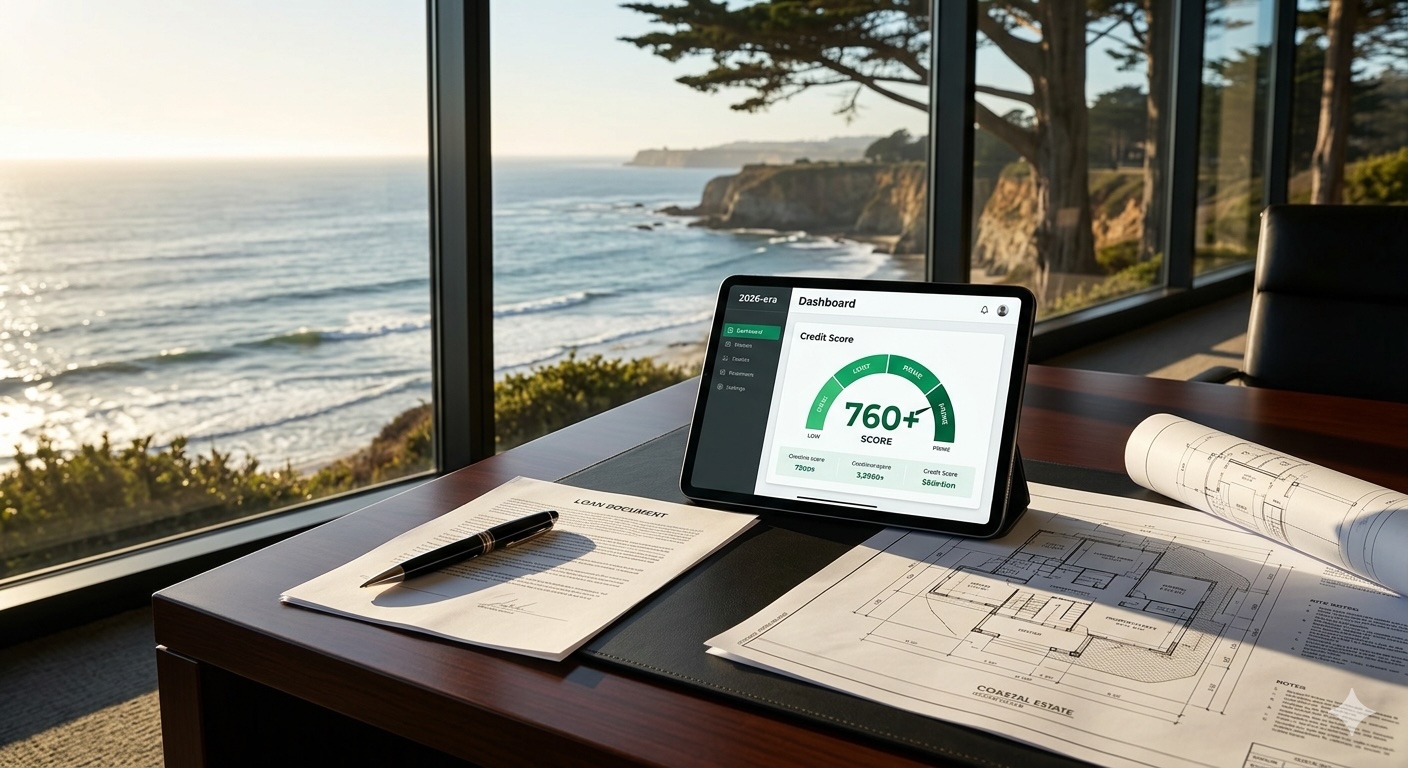
In the 2026 Santa Cruz real estate landscape, a "good" credit score is no longer a guarantee of securing a coastal estate; it's merely the entry fee for a more complex financial dialogue. You likely recognize that California's premium markets demand a level of fiscal precision that exceeds national averages. Paul Burrowes has 15 years of experience guiding sophisticated investors through these high-stakes acquisitions. He understands that the uncertainty surrounding what credit score do you need to buy a house can lead to missed opportunities or costly delays. Precision is paramount.
We believe that protecting your legacy begins with a clear roadmap to financing approval. This guide details the precise credit thresholds required for both conventional and Jumbo loans in Santa Cruz County, ensuring you approach your next purchase with absolute confidence. By examining current lending standards and strategic asset positioning, we provide the clarity needed to secure your coastal investment. You'll discover how to optimize your purchasing power and navigate the nuances of high-value underwriting with the support of a seasoned local professional. Explore our real estate advisory services to begin your journey with a partner who prioritizes your long-term financial security.
Key Takeaways
-
Understand how 2026 market dynamics elevate credit expectations and why Paul Burrowes utilizes 15 years of experience to protect your purchasing power in Santa Cruz.
-
Identify the precise thresholds for what credit score do you need to buy a house across Conventional, FHA, and VA loan programs to ensure a successful coastal investment.
-
Examine the "Jumbo Loan" factor and why high-balance property acquisitions in Santa Cruz County typically require a rigorous credit score of 700 or higher.
-
Master proactive, consultative strategies for credit optimization to establish a sophisticated financial profile that meets the standards of premier lending institutions.
-
Discover how a strategic partnership with a seasoned expert facilitates access to the David Lyng Real Estate network for more flexible and secure financing solutions.
Table of Contents
-
The Significance of Credit Scores in the 2026 Santa Cruz Real Estate Market
-
Minimum Credit Score Requirements Across Major Mortgage Programs
-
The 'Jumbo Loan' Factor: Why Santa Cruz Buyers Often Need 700+
-
Proactive Strategies to Optimize Your Credit Profile Before Buying
The Significance of Credit Scores in the 2026 Santa Cruz Real Estate Market
Credit isn't just a numerical value; it's the primary testament to your financial integrity and the engine of your purchasing power. In the 2026 Santa Cruz market, where the median home price remains significantly higher than national averages, your credit profile acts as a strategic asset. While many prospective buyers ask what credit score do you need to buy a house, the answer depends on whether you seek basic entry-level access or a dominant bidding position in a competitive environment. In a county where properties often command seven-figure sums, lenders demand precision and a proven track record of fiscal responsibility.
The Local Economic Landscape of Santa Cruz
The proximity to Silicon Valley, located just 30 miles from our coastal enclaves, creates a unique lending environment. Institutional lenders view Santa Cruz County as a high-value, low-risk zone because of its resilient equity growth and high demand. This stability means that while the baseline for what credit score do you need to buy a house may start low, the reality is more demanding for premium inventory. To secure prestigious assets like ocean-view homes, a score above 760 is often the unofficial requirement for the most favorable jumbo loan rates. Lenders in 2026 are looking for stability and deep reserves, viewing the Santa Cruz market as a fortress of value that requires equally sturdy borrowers.
Defining Your Financial Starting Point
Success begins with a clear-eyed assessment of your current standing. Lenders in California primarily rely on the FICO model to assess risk and determine your interest rate. What is a credit score? At its core, it's a mathematical representation of your creditworthiness based on your history of managing debt. Achieving a "pre-approved" status provides a psychological advantage; it transforms you from a curious shopper into a verified buyer in the eyes of a seller. This status is a prerequisite before you attempt to determine how much house you can afford in the current climate. Consider these benchmarks for 2026:
-
740 to 850: Excellent. You'll qualify for the lowest rates and the most flexible terms.
-
700 to 739: Good. You're a strong candidate, though you may face slightly higher fees.
-
620 to 699: Fair. You can buy a home, but your monthly payments will reflect the increased risk.
Paul Burrowes treats every transaction as a strategic partnership, focusing on the permanence and security of your real estate assets.
Minimum Credit Score Requirements Across Major Mortgage Programs
The mortgage landscape of 2026 reflects a refined institutional approach following the comprehensive regulatory updates implemented in late 2025. These shifts have mandated a more rigorous analysis of borrower risk, particularly in high-value markets like Northern California. When determining minimum credit score requirements, lenders now prioritize a holistic view of financial durability. In the competitive environment of Santa Cruz County, understanding what credit score do you need to buy a house involves more than just meeting a baseline; it requires a strategic alignment with specific loan programs.
Conventional and Conforming Loan Standards
Conventional lenders generally maintain a 620 baseline for eligibility. However, this figure is often misleading for those seeking optimal terms in 2026. Achieving a 740 score remains the critical threshold for "prime" pricing. A 760+ score offers a definitive advantage by securing the lowest possible private mortgage insurance (PMI) premiums. For a $1.2 million property in Aptos, the difference between a 680 and a 760 score can represent thousands of dollars in annual PMI costs. While a down payment of 25% or more can occasionally mitigate a marginal score, the institutional preference for high-tier credit remains absolute. If you're calculating your potential budget, you can explore how much house can you afford based on your current credit standing and local market conditions.
Government-Backed Options: FHA and VA
FHA programs continue to provide a pathway for those navigating the 500 to 580 score bracket, though these applications face rigorous manual underwriting in 2026. Borrowers with scores below 580 typically must provide a 10% down payment to offset the perceived risk. VA loans offer Santa Cruz veterans the unique benefit of no official minimum score, yet the reality of high-appraisal areas like Scotts Valley often dictates a higher internal "overlay" from lenders. These government-backed options are vital for market accessibility, but they require a sophisticated approach to documentation to satisfy modern risk management standards. In a region where the median home price often exceeds $1 million, a score that is considered "safe" in other states is frequently viewed as marginal here due to the significant debt-to-income ratios involved.
Maintaining a proactive stance on your credit profile is essential for securing a stable financial future. To better understand your position in this exclusive market, consider requesting a personalized buyer consultation to review your specific goals.
The 'Jumbo Loan' Factor: Why Santa Cruz Buyers Often Need 700+
Santa Cruz County presents a unique financial landscape. The median home price frequently surpasses $1.3 million. This reality pushes the majority of local transactions into the territory of Jumbo Loans. Unlike conforming loans backed by Fannie Mae or Freddie Mac, Jumbo Loans remain on the balance sheets of private institutions. These lenders assume higher levels of risk. This translates to a significantly more rigorous vetting process for your financial profile.
When clients ask what credit score do you need to buy a house in this specific market, the answer isn't found in federal minimums. It's determined by the institutional appetite for stability. For a standard mortgage, you might qualify with a 620. The luxury property sector demands Tier 1 credit. Navigating the entitlement and appraisal nuances for luxury homes requires an immaculate credit history to offset the inherent volatility of high-value assets.
Credit Thresholds for High-Value Assets
In the Santa Cruz market, a score of 700 to 720 serves as the functional minimum for competitive financing. Lenders look beyond the three-digit number to scrutinize your Debt-to-Income (DTI) ratio. They often require it to remain below 43 percent, or even 38 percent for the most aggressive rates.
Securing Favorable Rates for Investment Properties
The stakes escalate when transitioning from residential acquisitions to apartment building investments. Institutional lenders view multi-unit acquisitions through a lens of risk mitigation. They prioritize borrowers who demonstrate a history of managing significant debt loads without delinquency. A credit score of 740 or higher is often the benchmark to secure the lowest possible interest rates. The long-term impact of a 0.5 percent rate difference on a high-balance loan of $2.5 million can exceed $240,000 in interest over a thirty-year term.

Proactive Strategies to Optimize Your Credit Profile Before Buying
Paul Burrowes recognizes that your credit profile is more than a number; it is a strategic asset that dictates the long-term cost of your investment. When clients ask what credit score do you need to buy a house, the discussion must shift from mere qualification to total optimization. While a 620 might secure a loan, a score of 760 or higher typically secures the elite interest rate tiers that save homeowners tens of thousands of dollars over the life of a mortgage.
A consultative approach to credit repair involves more than just paying down debt. It requires a rigorous, "clean" 12-month window prior to property acquisition. Lenders prioritize recent behavior as a primary indicator of risk. Any late payment, collection, or judgment within the last year can trigger a manual underwrite or a higher interest rate, regardless of your cumulative score. Furthermore, new credit inquiries are the primary enemy of a successful escrow. Opening a new credit line for a vehicle or luxury furniture during the closing process can alter your debt-to-income ratio enough to cause a loan denial 48 hours before signing.
Tactical Credit Management
Precision is vital for rapid score improvement. Adhering to the 10% credit utilization rule is the fastest way to signal fiscal discipline to bureaus. If your credit limit is $10,000, your reported balance should never exceed $1,000. Additionally, roughly 20% of institutional credit reports contain inaccuracies that suppress scores. Identifying and disputing these errors through formal channels is a foundational step in your preparation. Because every financial move has a ripple effect, you should consult with a buyer's specialist before making any large purchases or closing old accounts.
Managing Large-Scale Financial Transitions
Large financial shifts require careful timing to maintain lending integrity. If you are currently navigating a practical transition or move, be aware that liquidating significant assets can create "unseasoned" funds. Lenders prefer to see large deposits sitting in your account for at least 60 to 90 days to verify their source.
Explore the latest Santa Cruz property listings and analyze your purchasing power today.
Securing Your Santa Cruz Investment with Paul Burrowes
Achieving the ideal financial profile is only the first stage of a successful property acquisition. While you might wonder what credit score do you need to buy a house in a competitive market like Santa Cruz, the answer often involves more than just a numerical value; it requires a lending partner who understands the nuance of high-value California contracts. Through the extensive David Lyng Real Estate network, Paul connects clients with flexible lending institutions that look beyond standard algorithms to recognize the true strength of a borrower's financial portfolio.
The 2026 market landscape demands a level of rigor that exceeds traditional brokerage. Paul's approach centers on protecting your assets through exhaustive market analysis and a deep understanding of local inventory. By leveraging 15 years of historical data and neighborhood-specific trends, he mitigates risk before you ever commit to a contract. This commitment to your long-term wealth ensures that every investment is positioned for sustained growth and durability. Once you've solidified your financial standing, the next phase is a strategic market entry designed to capture value in a shifting landscape.
The Burrowes Consultative Advantage
Representation for properties in Santa Cruz, Scotts Valley, and Los Gatos requires a sophisticated touch that prioritizes wealth preservation. Paul Burrowes doesn't just facilitate transactions; he provides a consultative framework focused on land use optimization and rigorous risk management. Integrity serves as the foundation of his practice. In an environment where market uncertainty can erode capital, having an expert with 15 years of local tenure acts as a vital safeguard. This high-end approach ensures that your real estate holdings remain a cornerstone of your financial legacy.
Your Path to Santa Cruz Homeownership
The journey toward owning a piece of the California coast begins with a clear understanding of what credit score do you need to buy a house and ends with the keys to a premier property. Paul invites you to a private consultation to align your specific real estate goals with a customized acquisition strategy. You can begin exploring the current market by viewing exclusive Santa Cruz real estate listings. Partnering with a professional who understands the complexities of the high-end market provides a level of serenity that is rare in modern real estate. Your investment deserves the attention of a seasoned expert who values precision and long-term partnership above all else.

Securing Your Financial Future in the Santa Cruz Market
Navigating the 2026 real estate landscape requires a sophisticated understanding of how financial health dictates your purchasing power. Determining what credit score do you need to buy a house involves more than checking a single number; it requires a strategic alignment with local market demands. While entry-level programs may accept a 580 score, the high-value residential inventory in Santa Cruz often necessitates a 700 plus threshold for favorable Jumbo loan terms.
Success in this competitive environment isn't accidental. It's the result of meticulous planning and professional advocacy.
Partner with Paul Burrowes for a Strategic Real Estate Consultation
Your journey toward a sophisticated coastal lifestyle is within reach when you have the right expert guiding your every move.
Frequently Asked Questions
What is the absolute minimum credit score to buy a house in Santa Cruz in 2026?
The absolute minimum credit score to buy a house in Santa Cruz in 2026 is 580 for FHA-insured loans with a 3.5% down payment. While this federal floor exists, local market competition often dictates that a score of 620 or higher is necessary for conventional financing.
Can I buy a home in Scotts Valley with a credit score under 600?
You can purchase a home in Scotts Valley with a score under 600, provided you utilize an FHA loan and offer a 10% down payment. Since the median home price in Scotts Valley frequently exceeds $1,200,000, lenders scrutinize these applications. Most successful buyers in this high-end enclave maintain scores above 700 to remain competitive against multiple offers and secure their assets.
Do Jumbo loans in Santa Cruz County require a higher credit score than standard loans?
Jumbo loans in Santa Cruz County typically require a minimum credit score of 700 to 720, which is significantly higher than standard conforming loans. Because loan amounts in our region often surpass the 2026 conforming limit of $1,149,825, buyers must demonstrate superior fiscal stability. This higher threshold acts as a protective measure for lenders managing the increased risk of high-value properties in coastal California.
How much does a credit score affect my monthly mortgage payment in a high-cost area?
Your credit score dictates the interest rate, which can alter your monthly mortgage payment by $450 or more on a typical Santa Cruz property. When you ask what credit score do you need to buy a house, it's vital to realize that a 760 score might secure a rate 1.5% lower than a 660 score. Over a 30-year term, this difference results in over $160,000 in additional interest costs on a million-dollar loan.
How long does it take to improve my credit score enough to qualify for a better rate?
It typically takes 3 to 7 months of disciplined financial behavior to improve your credit score by the 50 points needed for a better pricing tier. Rapid rescoring services can sometimes reflect changes in 5 to 10 business days if you've recently paid down significant revolving debt.
Will checking my own credit score lower it before I apply for a mortgage?
Checking your own credit score through authorized consumer platforms doesn't lower your rating because it's classified as a soft inquiry. Only hard inquiries, which occur when a lender reviews your report for a formal loan application, can cause a minor dip of 5 to 10 points. Monitoring your own data is a proactive way to maintain the integrity of your financial profile before seeking a pre-approval.
Are there local Santa Cruz programs for first-time buyers with lower credit?
Local initiatives like the CalHFA MyHome Assistance program and the City of Santa Cruz Measure O program offer support to first-time buyers with moderate credit. These programs often require a minimum score of 640 to 660 to qualify for down payment assistance or below-market-rate units.
Does Paul Burrowes work with lenders who specialize in unique credit situations?
Paul Burrowes maintains an exclusive network of portfolio lenders who specialize in unique credit situations and complex financial profiles. By providing consulting, he ensures that clients with non-traditional income or recovering credit scores receive a tailored approach. You can explore these specialized options and strategic partnerships by visiting burrowes.com to discuss your specific requirements for a sophisticated protection strategy.
Article by
Paul Burrowes

Paul Burrowes, CRS, CCEC, SFR, NHCP, LHC, REALTOR® With over fifteen years of experience and an elite list of credentials, Paul Burrowes is a REALTOR® dedicated to merging deep local expertise with modern innovation. Paul leverages the latest technology and AI-driven insights to provide his clients with the most accurate, data-rich information available in the Santa Cruz, Monterey, Santa Clara, and Silicon Valley markets. He serves as a personal adviser, skilled negotiator, and detail-oriented advocate, ensuring every transaction—from initial question to final signature—goes off without a hitch. Contact Paul at paul@burrowes.com, (831) 295-5130, (408) 497-3989, or DRE# 01955563.
Disclaimer: This article was developed with the assistance of AI technology to synthesize market data, then reviewed, edited, and verified for accuracy by Paul Burrowes to ensure it meets the highest professional standards.
Local Lenders
CrossCountry Mortgage, LLC
Brian Dean
Senior Mortgage Advisor
408-489-0952
thebriandeanteam.com
brian.dean@ccm.com
Jean Adams
Senior Mortgage Advisor
jean.adams@ccm.com
408-250-4550
Mark Junod
Senior Mortgage Advisor
831-600-4709
markjunod.com
mark.junod@ccm.com
Ryan Buckholdt
Branch Manager
M 831-818-2339
D 831-425-8326
W ryanbuckholdt.com
E ryan.buckholdt@ccm.com
Matthew Falconer
831-435-9197
teamfalconer.com
matthew.falconer@ccm.com
Santa Cruz Home Finance
Tai Boutell
Santa Cruz Home Finance
831-419-6931
tai@santacruzlending.com
Andrea Schenk
Mortgage Consultant
831.431.0496
andrea@santacruzlending.com
Bay Area Mortgages
David Warter
Mortgage Advisor
831-419-7604
bayareamortgages.com
dave@bayareamortgages.com
US Bank
David DeTeso
Mortgage Loan Officer
831-688-7161
831-234-1045
david.deteso@usbank.com
Selesa Webster
Sr. Mortgage Loan Originator
831.227.0727
selesa.webster@usbank.com
Shawna Watson
U.S. Bank Home Mortgage
Mortgage Loan Officer
Construction Loan Specialist
831.818.4909
shawna.watson@usbank.com

Enjoy this blog post? Click here to subscribe for updates
Leave A Comment